A vending machine presents a wonderfully small problem: you are hungry, and the crisps are behind glass. Tap a card, press a button, retrieve lunch’s less respectable cousin. The whole encounter takes seconds. For the person who owns the machine, however, the transaction has barely begun. Something has left the shelf. Money must reach the right account. Someone needs to decide whether to send a truck.
Cantaloupe makes its living in that second story. Its readers collect payments; its software helps operators keep track of stock and organise the work of replenishing it. The customer sees a snack. The operator needs a useful answer to three questions: what sold, what is running low, and where should the driver go?
- The job: connect unattended payments with the business behind the machine.
- The buyers: vending operators, micro-market businesses and hospitality and entertainment venues.
- The economics: hardware, subscriptions and payment fees - plus fewer wasted visits if the operation uses the data well.
- The plot turn: 365 Retail Markets bought Cantaloupe in May 2026 in an approximately $848 million equity transaction.
A warehouse disguised as a vending machine
Consider the old arrangement. A driver follows a familiar route, arrives at a machine, discovers what is missing and returns to the truck for stock. The vehicle carries a travelling assortment of possibilities. Some visits are necessary. Others are largely a consultation with a machine that is doing perfectly well.
Empire Vending, outside Houston, offers a concrete version of this problem. Founder Jonathan Abernathy started with one route in 2012. The business managed much of its operation with pen and paper. Drivers loaded large box trucks without the information needed to pack for individual stops. Static schedules told them where to go; the machine told them what they should have brought.
The company's account describes a lack of visibility over inventory moving into trucks and out to locations, alongside concerns about cash accountability. Information failed before ambition did. An operator could add machines while still struggling to know precisely what was happening inside the existing ones.
Empire adopted Seed Pro, gathered its machine data in one place and installed cashless devices across its vending operation. Cantaloupe’s published testimonial reports twice as many machines serviced per route and a 22% increase in top-line sales. Those are one customer’s reported results, rather than a forecast for every buyer. Their usefulness is in the mechanism: better payment access and better preparation changed the work.
The sale becomes an instruction
The software has several levels. Seed Live comes with Cantaloupe readers and handles sales reporting and machine performance. Seed Pro adds enterprise replenishment and scheduling tools. Seed Markets brings micro-market route planning and warehouse pre-picking into the same operation. A business serving snack machines, open shelves and coffee accounts has more coordination to do than a person running a handful of machines.
Pre-kitting is the beautifully unromantic part. Pack the stock for a particular machine before the driver leaves the warehouse. A sales record has become a tote of the right products. The saving depends on reliable inventories and people following the process. A dashboard cannot load the van, and a van cannot repair an inaccurate dashboard.
- 01 / PAYThe reader records the sale
- 02 / PLANInventory informs the pick list
- 03 / PACKThe warehouse prepares stock
- 04 / VISITThe driver replenishes the location
A simplified workflow, not a promise that every installation has every feature.
This is also where Cantaloupe’s expertise sits: between electronic payments, connected equipment and the physical business of moving food. Nayax offers competing readers, telemetry and management software, so merely accepting a mobile wallet is hardly a unique distinction. Cantaloupe’s proposition is the breadth of the connection between checkout and operations. Buyers should test that connection against their own fleet and working habits.
First buy the software company. Then borrow its name.
The corporate family tree helps explain the product. USA Technologies was founded in 1992, with George R. Jensen Jr. as its original chief executive. An early filing described unattended payment applications for copy and fax equipment, laundry and vending. Small transactions in awkward places were already the territory.
In November 2017, USA Technologies acquired Cantaloupe Systems, a separate cloud-and-mobile software business, in a deal valued at approximately $85 million. The payment company bought logistics capabilities: dynamic scheduling, inventory and warehouse management. In April 2021 it launched under the Cantaloupe name. An acquisition had become an identity.
The history contains an uglier lesson about numbers. In 2023 the SEC settled charges concerning improper revenue recognition during fiscal 2017 and 2018. Its findings included non-compliant bill-and-hold transactions and shipments customers had not ordered or had expressly refused. The company agreed to a $1.5 million civil penalty without admitting or denying the findings. Accurate records matter at the corporate ledger as much as at the snack shelf.
“Help the world buy it and go.”
Cantaloupe’s stated vision
The careers page pairs that short vision with values including accountability, teamwork and scrappiness. Those are the company’s own description of its culture. The more practical expression of the ambition is the product mix: help a buyer finish quickly while giving the business enough information to handle what comes next.
The cabinet has been counting
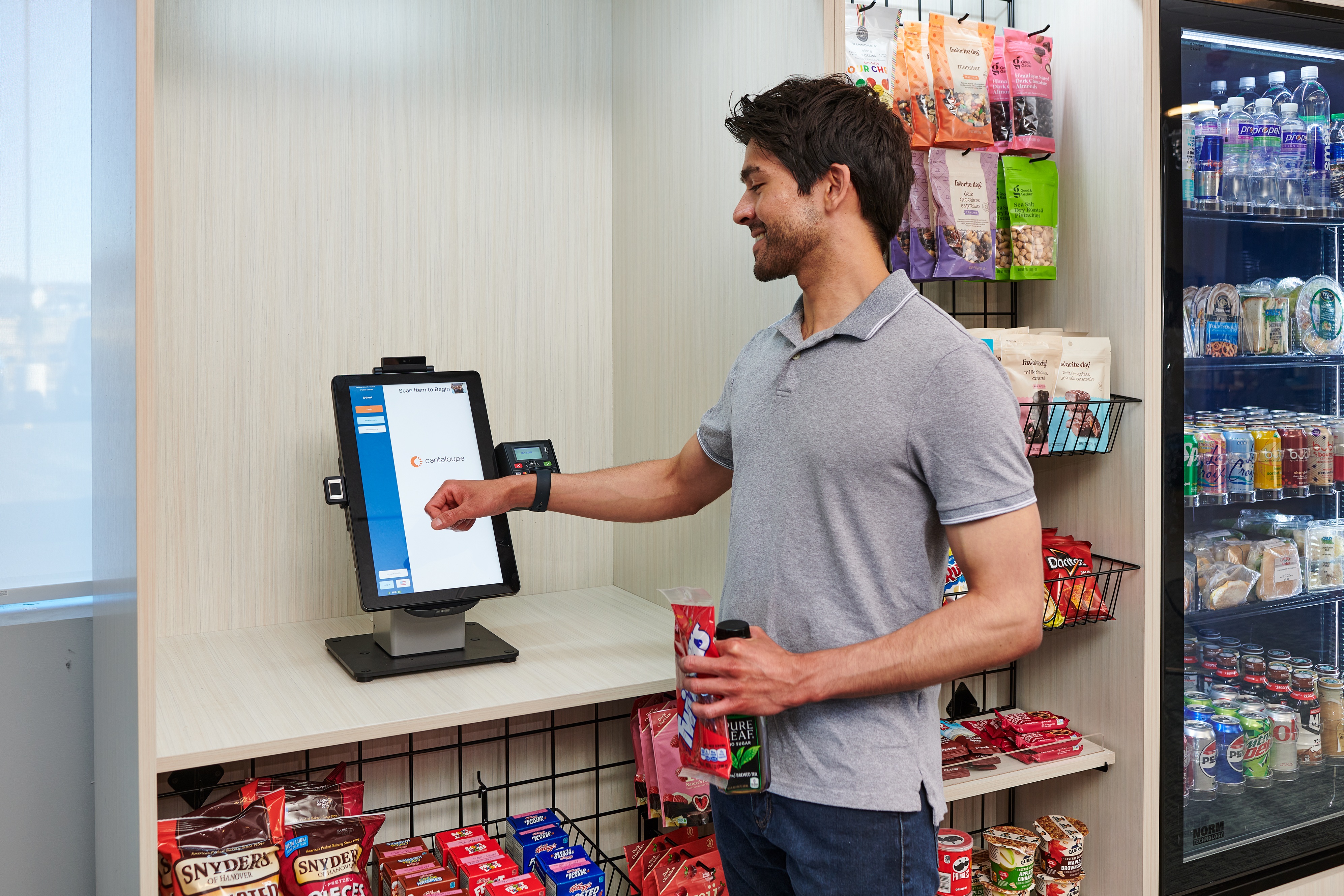
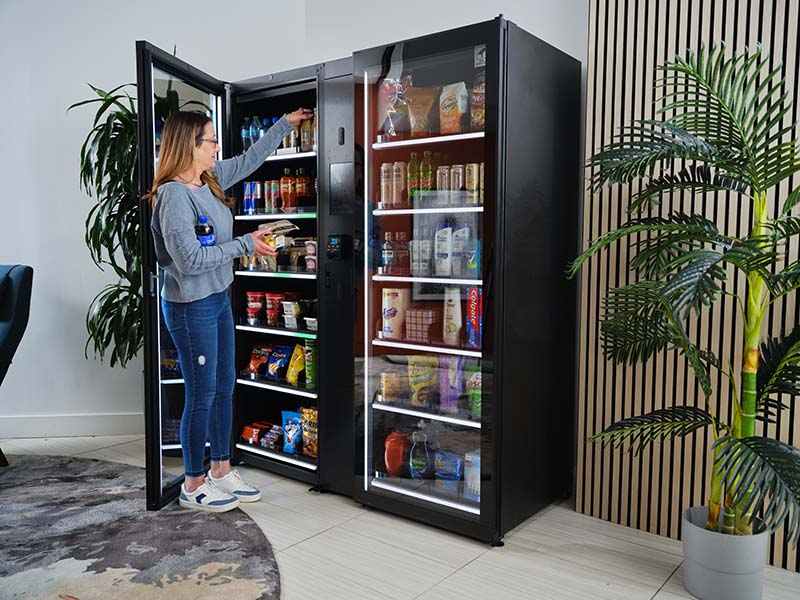
Not every unattended shop has a spiral coil. A micro market lets people take items from shelves and coolers and check out at a kiosk. A Smart Store puts access control on the cabinet itself. Present a card to unlock it, take products and close the door. Weighted shelves and cameras help identify the removals so the customer can be charged.
The format changes the location question. On Cantaloupe’s product page, Barrett Vending owner Ron Barrett says the Smart Store opened opportunities in places where he had felt limited with micro markets. A locked cabinet offers a different approach to access and loss control than an open shelf. It still needs sensible product selection, replenishment and equipment maintenance.
The company has also moved into environments where the queue, rather than the delivery route, is the immediate nuisance. It bought Cheq, a venue POS and mobile-ordering business, for $4.75 million in cash in February 2024. A May 2025 Carnival partnership announced Sail & Sign integration at Celebration Key, allowing purchases through destination kiosks to connect to guests’ onboard accounts. The unattended-commerce idea had acquired a distinctly holiday complexion.
Convenience comes with a monthly invoice
Cantaloupe sells equipment, software access and payment processing. Subscription and transaction fees supplied 87% of fiscal 2025 revenue; equipment supplied the remaining 13%. Recurring activity is therefore central to the model. The reader is an entry point into an ongoing commercial relationship.
Cantaloupe One bundles hardware and software into subscriptions. Its public pricing page lists an Engage Pulse kit from $18.95 a month and a reader-and-VMS starter kit from $19.95. The initial contract lasts 36 months, and Cantaloupe keeps ownership of the equipment. Warranty coverage is part of the proposition.
At the advertised starter price, 36 monthly payments total $718.20. That arithmetic covers only the stated monthly amount: an operator still needs to establish processing charges, shipping, taxes and applicable terms. Spreading a bill makes it easier to start; it does not make the bill disappear. The right comparison is the total cost against the sales and operating savings that the location can support.
The scale is substantial without requiring mythology. At June 30, 2025, Cantaloupe reported about 1.28 million active devices and 34,896 active customers. Fiscal 2025 revenue was approximately $303 million, and transaction dollar volume reached $3.4 billion. Transaction volume is money flowing through the system, not company revenue.
When the breakroom became a competition case
365 Retail Markets announced its agreement to acquire Cantaloupe in June 2025. The deal closed on May 8, 2026, and the combined business operates under 365. The buyer is backed by Providence Equity Partners. The approximately $848 million figure was the equity value of an acquisition, not a funding round for a startup.
The FTC said the combination would unite the two largest providers of micro-market kiosks and related software and services. Its proposed consent order required divestiture of Cantaloupe’s Three Square Market business to Seaga. A breakroom checkout might look like furniture. The regulator regarded competition over that checkout as consequential for operators and consumers.
This changes the comparison a buyer should make. 365 belongs in the ownership explanation now, rather than on a list of wholly independent alternatives. Product availability, integrations and contractual terms deserve a current conversation with the supplier as the businesses combine.
Copy the connection, then do the arithmetic
The transferable idea is simple: make a sale inform the next operational decision. Begin with one location or route, establish what visits and stockouts cost, then check whether better information changes those outcomes. A small fleet may need reporting more than an enterprise scheduling system. A lightly used location may never generate enough improvement to cover a subscription.
Cantaloupe’s 2026 report offers context, rather than instructions for every machine. Across its United States and Canada sample, cashless accounted for 78% of vending sales in 2025. The average cashless ticket was $2.45, compared with $1.57 in cash. Those differences do not establish that a reader alone caused higher spending. Location, selection and purchasing habits still enter the picture.
A useful trial therefore measures the whole operation: transaction costs, restocking time, waste and sales. Connectivity must work; inventory records must be maintained; the warehouse must act on the information. The pleasure of the model is its modesty. It asks the operator to make tomorrow’s delivery a little less of a guess. The customer, meanwhile, is already eating the crisps.