The enterprise cloud commerce platform that quietly runs the checkout, the compliance log, and the loyalty card for legal cannabis.
Somewhere in California, a budtender taps a screen. The strain is verified against the state's seed-to-sale registry. The tax is calculated to the cent across three overlapping jurisdictions. The customer pays with a card - not a wad of cash - and earns loyalty points that land in a digital wallet before they reach the door. The receipt prints. The inventory ticks down. An auditor, somewhere, could reconstruct the whole thing tomorrow without breaking a sweat.
None of that is glamorous. That is the genius of it. Cannabis is one of the most heavily regulated retail categories on the planet, a business where a paperwork error is not a nuisance but a license-threatening event. Treez built the software that makes the hardest retail in America feel boring - in the best possible way.
In 2016, John Yang looked at the newly legal cannabis market and saw a paradox. Demand was exploding. The product was premium. And the people selling it were running their stores on spreadsheets, calculators, and the constant low-grade terror of a compliance slip. Other founders chased the plant. Yang, with co-founder Shareef El-Sissi, chased the back office.
The first product was a point of sale system, SellTreez. It was not trying to be flashy. It was trying to be the thing that did not break on a Saturday afternoon when the line was out the door and the state required every transaction logged. Within two years, Treez software was ringing up roughly 15% of all California cannabis sales. That is not a marketing claim that ages well by accident - it is the kind of number you only get when the boring stuff works.
From there, Treez did what good infrastructure companies do: it expanded outward from the core. Payments came next, because "sorry, cash only" was costing dispensaries real money. Analytics followed, because operators who could see their data made better decisions than those who couldn't. Then ecommerce, then loyalty. Each module made the others stickier. Rip out the POS and you lose the payments, the reports, the online store, and the loyalty wallet all at once.
The money agreed. An $11.5M Series A in 2018. A $13M Series B in 2020. And in April 2022, a $51M Series C led by Long Ridge Equity Partners - with Kayne Anderson and Synchrony joining - that valued the company north of $260M, on the back of 82% revenue growth the year before. Inc. 5000 and Deloitte's Fast 500 both came calling.
The competitive set is real - Dutchie (which absorbed Greenbits and Leaflogix), Flowhub, Cova, BLAZE, Meadow and BioTrack all want the same dispensary counter. Treez's wager is depth over breadth: rather than be one tool a retailer logs into, be the system every other tool plugs into. Operators like Solful and Cloud 9 Cannabis run on it. The platform now spans more than a dozen states - California, New York, Texas, Maryland and beyond - plus a Canadian footprint, with revenue estimated around $80M and roughly 160 employees keeping it humming.
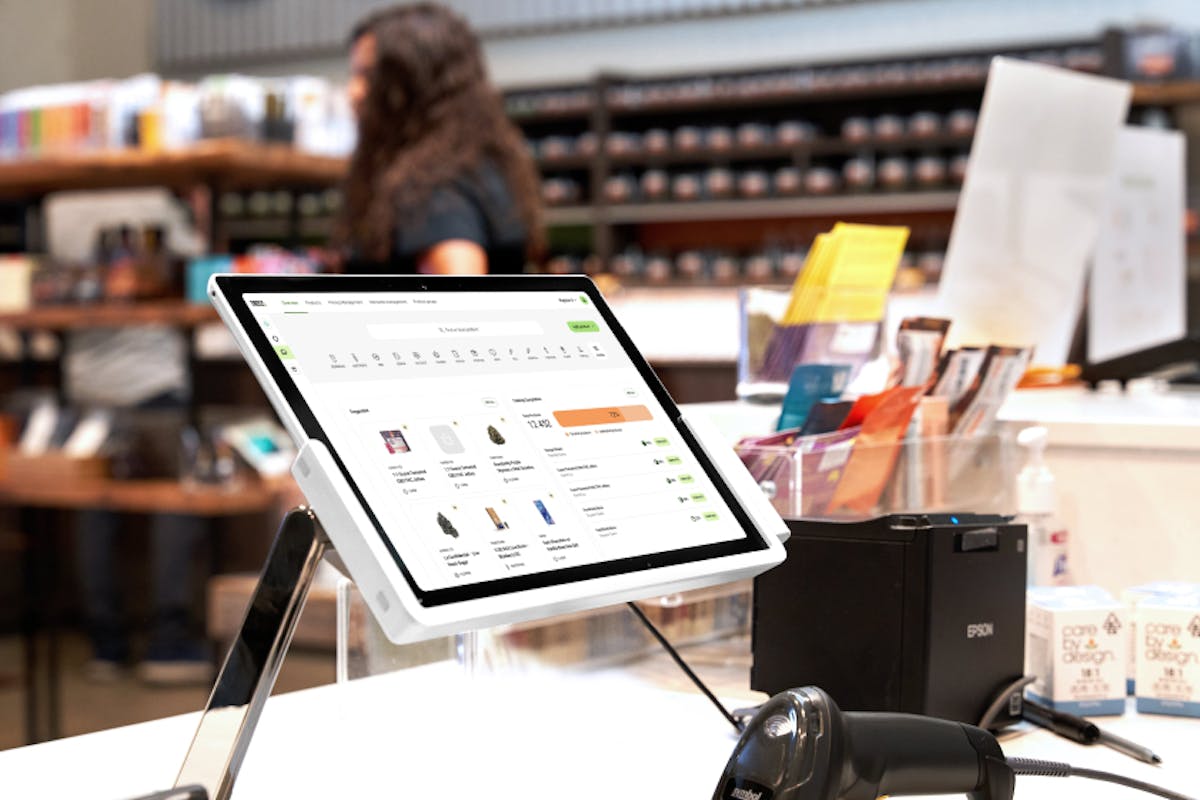
For a dispensary operator, Treez collapses a stack of vendors into a single system. Here is the kit.
The cloud POS at the center of it all - checkout, inventory, and state compliance reporting (including Metrc), advertised at 99.99% uptime. The thing that has to not break.
Cashless payments with the TreezPay Gateway, letting stores run multiple payment types. Marketed as lifting average order value ~40% by retiring "cash only."
Real-time KPIs across sales, inventory, and customers - for the single shop and the multi-store operator who needs one dashboard for all of it.
A retailer-first online store with SEO-friendly pages and deep POS integration. Launched in 2024 and reinforced by the Gap Commerce acquisition.
An AI-powered, digital-wallet loyalty platform launched in 2025 with partner Sticky Cards - points that follow the shopper instead of living on a punch card.
Delivery, marketing, supply chain - an ecosystem of 275 industry partners plug into the platform so retailers aren't boxed in.
The 2022 Series C was led by Long Ridge Equity Partners, joined by Kayne Anderson and Synchrony, with earlier backing from Intrinsic, AFI Capital Partners and Welcan Capital. Treez later used capital to acquire fintech startup Swifter (2023) and ecommerce firm Gap Commerce (2024) - buying its way deeper into payments and online retail.
John Yang and Shareef El-Sissi found Treez; launch the SellTreez POS.
$11.5M Series A. Software already powers ~15% of California cannabis sales.
$13M Series B; expands into Canada; introduces TreezPay.
$51M Series C at a $260M+ valuation; opens a software hub in India.
Acquires fintech startup Swifter; operating across 12 states.
Launches Treez Ecommerce; acquires Gap Commerce for online-to-offline retail.
Launches Treez Loyalty with Sticky Cards; expands into New York, Texas and Maryland.
Treez is led by co-CEOs John Yang (founder) and David Yan, who joined in 2019 as CFO before stepping up to run core operations. The culture runs on five stated principles: stay curious, present solutions, embrace simplicity, empower candor, drive outcomes. Roughly 160 people, with engineering spanning the U.S. and an India development hub.
The budtender taps the screen one more time. Same gram, same 1.8 seconds. But the store it sits in is different now - it has online orders waiting to be picked, a loyalty program that actually retains people, a dashboard the owner checks from home, and books clean enough to survive any audit the state cares to run. The shop did not get bigger overnight. It got an operating system.
That is the quiet trade Treez offers. You keep selling the product. It takes the chaos. Most shoppers will never know the name on the back-office software - and a decade in, that anonymity is the whole point. The best infrastructure disappears. Treez has been busy disappearing into about 15% of the American cannabis counter, one boring, reliable, 1.8-second transaction at a time.