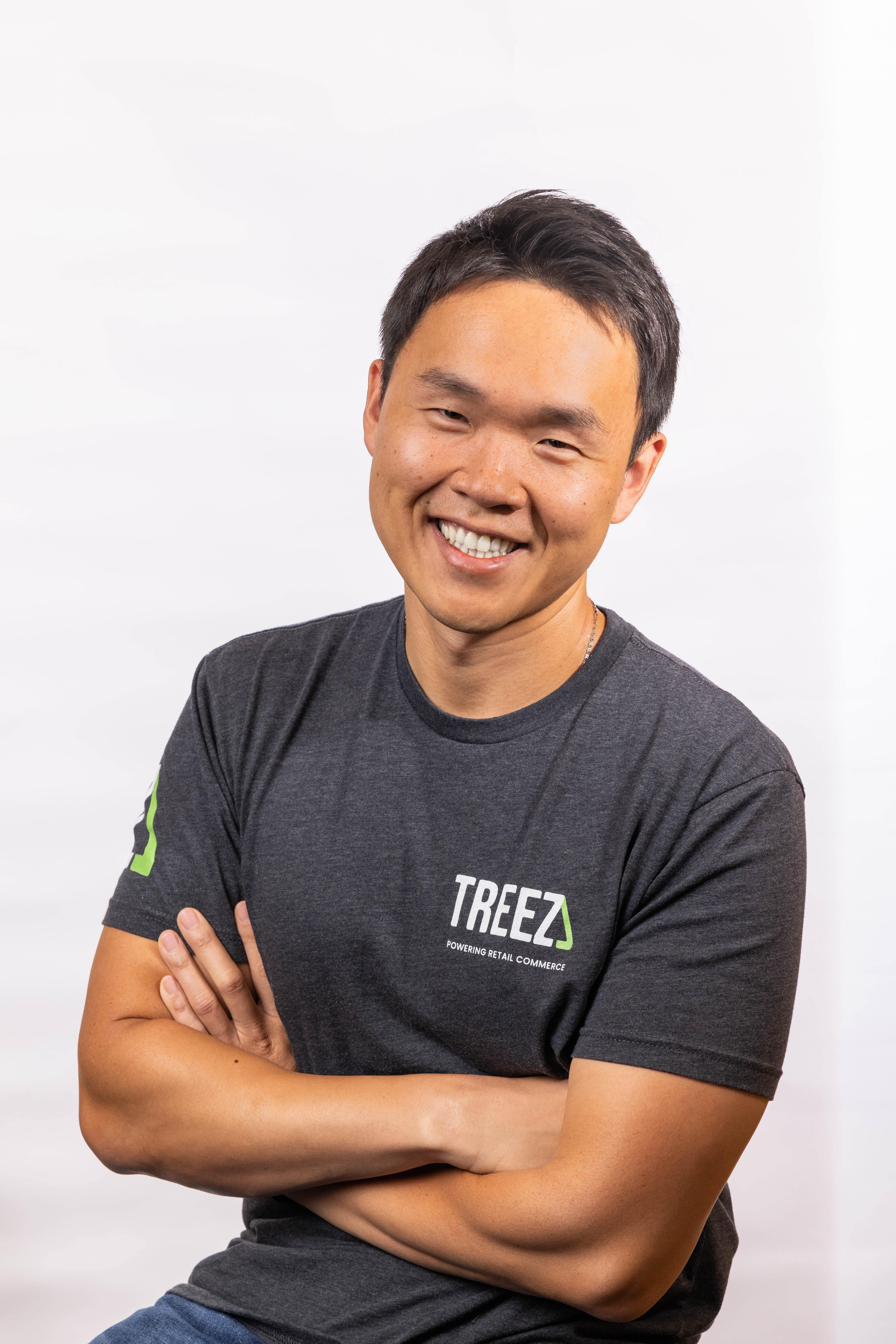
The dispensary was Garden of Eden, in Hayward, California. His future co-founder Shareef El-Sissi was running it. And it was, by any operational measure, a mess. Patient intake was slow. Inventory tracking was manual. Compliance reporting ate staff hours that should have gone to customers. The point-of-sale software wasn't built for cannabis - it was borrowed from adjacent industries and forced to fit.
Yang had spent a decade at Accenture and Slalom Consulting building software systems for Fortune 500 companies. Walking into Garden of Eden, he saw the same problem he'd spent his career solving - just in a market that had never had anyone like him show up to solve it.
With a line out the door and two point-of-sale terminals transacting about 400 tickets a day, I quickly saw how underserved the cannabis industry was.— John Yang, Co-Founder & CEO, Treez Inc.
The first version of Treez was built specifically for Shareef's dispensary. Purpose-built, not pivoted into. That specificity is now Treez's most important feature - a platform designed around real cannabis retail problems, not retrofitted from something else. By the time the pair decided to commercialize it in 2016, the bones were already load-bearing.
Reno, Nevada, Computer Shop, Age 12
To understand why Yang builds the way he builds, you have to start in his father's computer shop. He was born Hai-Meng Yang in Shanghai, China. His family immigrated to the United States when he was seven, landing in Reno, Nevada - a city built on service businesses and low margins. His father opened PC Service Center. By age 12, John was working there after school.
That shop was his original laboratory. Not coding academies or hackathons. Real customers with broken hardware, genuine frustration, and no patience for complexity. Yang learned what technology actually means in a small business context: it's either working or it's costing you money. There's no third option.
He took that frame to UC Davis, where he studied Managerial Economics. Then to Accenture, where he applied it to Fortune 500 enterprise clients for four years. Then to Slalom Consulting, where he deepened work in CRM, business intelligence, and program management. By the time he founded IM360 in 2013 - a tech consultancy serving restaurants and early medical marijuana dispensaries - he'd spent seven years watching big businesses use software as a competitive weapon.
Cannabis dispensaries weren't using any weapon at all. They were handwriting things.
Key insight: Treez was not a pivot or a bet on cannabis legalization. It was a direct response to a specific operational failure at a specific dispensary. Shareef El-Sissi asked Yang to solve a problem. Yang solved it. Then they decided the solution was worth selling to an entire industry.
Building the Platform, Not the Hype
Cannabis tech in the mid-2010s attracted a lot of founders chasing the "green rush" narrative. Yang wasn't one of them. His pitch was never about cannabis. It was about operations. Specifically: how to get a customer through a dispensary transaction in the fewest keystrokes, with full regulatory compliance, and zero human error.
Treez launched SellTreez - its flagship point-of-sale system - in 2016. By 2018, it was processing 15 percent of all California cannabis sales. That's not a marketing claim. That's market share built on a product that worked in the most regulated, most complex, most operationally demanding retail environment in American commerce.
The 2018 Series A raised $11.5 million. It was followed by steady product expansion: inventory management, employee tools, compliance automation, and eventually cashless payments through TreezPay in 2020. Each addition followed the same logic - what do cannabis retailers actually need to run better? Not what sounds fundable. What works at the counter.
Our mission is to solve for our customers in the least amount of keystrokes, with utmost accuracy.— John Yang
The Series C Moment - and the Discipline Behind It
April 2022. Treez closes a $51 million Series C led by Long Ridge Equity Partners, with Kayne Partners and Synchrony Financial joining the round. Total funding: $76.7 million. Valuation: approximately $260 million.
What's notable isn't the number. It's what Yang said about it afterward. The Series C was, in his framing, the company's last planned raise - intended to give Treez a three-year runway to profitability without another funding round. In a market where cannabis tech companies were raising aggressively and burning fast, Yang was talking about restraint.
That same year, Treez expanded from 6 states to 14, opened an engineering hub in Trivandrum, India (30 engineers, with plans to scale to 100), and acquired Swifter - a fintech payment platform - to strengthen its cashless payment capabilities. By the end of 2022, Treez was in 14 states and still growing.
The growth was deliberate. Yang has been explicit about the tradeoff: Treez focuses on the POS layer and specific markets rather than trying to serve every vertical and every geography simultaneously. Competitors like Dutchie took a different path - broader, more consumer-facing, more brand-oriented. Treez stayed retailer-first.
We can empower brands with data, but we don't forget who our customers are - and our customers are the retailers.— John Yang
Choosing Depth Over Breadth
There's a particular kind of founder discipline that doesn't get enough credit: the willingness to not do something. Yang practices it visibly. When asked why Treez doesn't chase every market, every product line, every adjacent opportunity, his answer is consistent.
The Treez approach: "We choose to focus on POS and certain states vs. being everything to all customers and live in all states." - John Yang. In a sector full of platform plays chasing total addressable market, Treez is building depth in the markets where it's already winning.
The 2023 and 2024 additions reflect this. A retail analytics platform providing real-time operational data. An Integration Hub that connects third-party solutions to the Treez ecosystem. The acquisition of Gap Commerce in 2024 to enable ecommerce integration. Each one is an extension of the retail layer, not a departure from it.
The 2025 launch of Treez Loyalty - a digital wallet loyalty platform - follows the same pattern. Dispensaries were managing customer retention with third-party tools that didn't integrate cleanly with their POS. Treez built the integration and called it native. That's the playbook.
On Small Operators and the Industry's Future
Yang's view of cannabis retail is shaped by his Reno upbringing as much as by his consulting career. He saw what consolidation did to American retail in adjacent industries. He doesn't want to see it replicate in cannabis without a fight.
I think cannabis can be the same as liquor - we need to keep the mom and pops afloat.— John Yang
That's not just sentiment. Treez has made concrete commitments in this direction. The company partnered with New York's CAURD (Conditional Adult-Use Retail Dispensary) program to provide technology training and operational support for equity cannabis operators - new licensees who often have cannabis backgrounds but limited retail and technology experience. Yang's platform becomes, in that context, a tool for leveling a historically uneven playing field.
AI and What Comes Next
Treez's About page describes Yang's current focus as leading the company's artificial intelligence initiatives, "building the next generation of operational intelligence for retail." The vague phrasing is typical of early-stage AI positioning across the industry, but the direction is coherent for a company sitting on the kind of transaction and inventory data Treez has accumulated.
A platform processing $4 billion in annual cannabis transactions across 600+ locations in 15+ states has seen purchasing patterns, inventory cycles, compliance exceptions, and sales velocity across an entire regulated market. Applied thoughtfully, that's not just reporting - it's prediction. What a dispensary should stock before a holiday weekend. Which promotions drive retention versus one-time traffic. Where compliance reporting is most likely to create friction.
Yang anticipates major technology companies eventually entering the cannabis market as federal legalization progresses. He's publicly framed that prospect as legitimizing rather than threatening - when the giants arrive, it confirms the market was always real. Treez's advantage, in that scenario, is nine years of domain-specific knowledge that no newcomer can replicate quickly.
That's the bet. Not that cannabis stays marginal and Treez stays niche. But that cannabis goes mainstream, and when it does, the infrastructure layer is already built - and Treez built it.