For most of the last two decades, the phrase "digital transformation" in retail meant work that happened almost everywhere except the sales floor. Websites got faster, warehouses got smarter, and marketing got personal - while the store, the place where the majority of shopping still happens, ran on point-of-sale hardware that had barely changed. NewStore, a company founded in Boston in 2015, was built on a contrary premise: that the store is not the past of retail but a large piece of its future, provided you connect it to everything else.
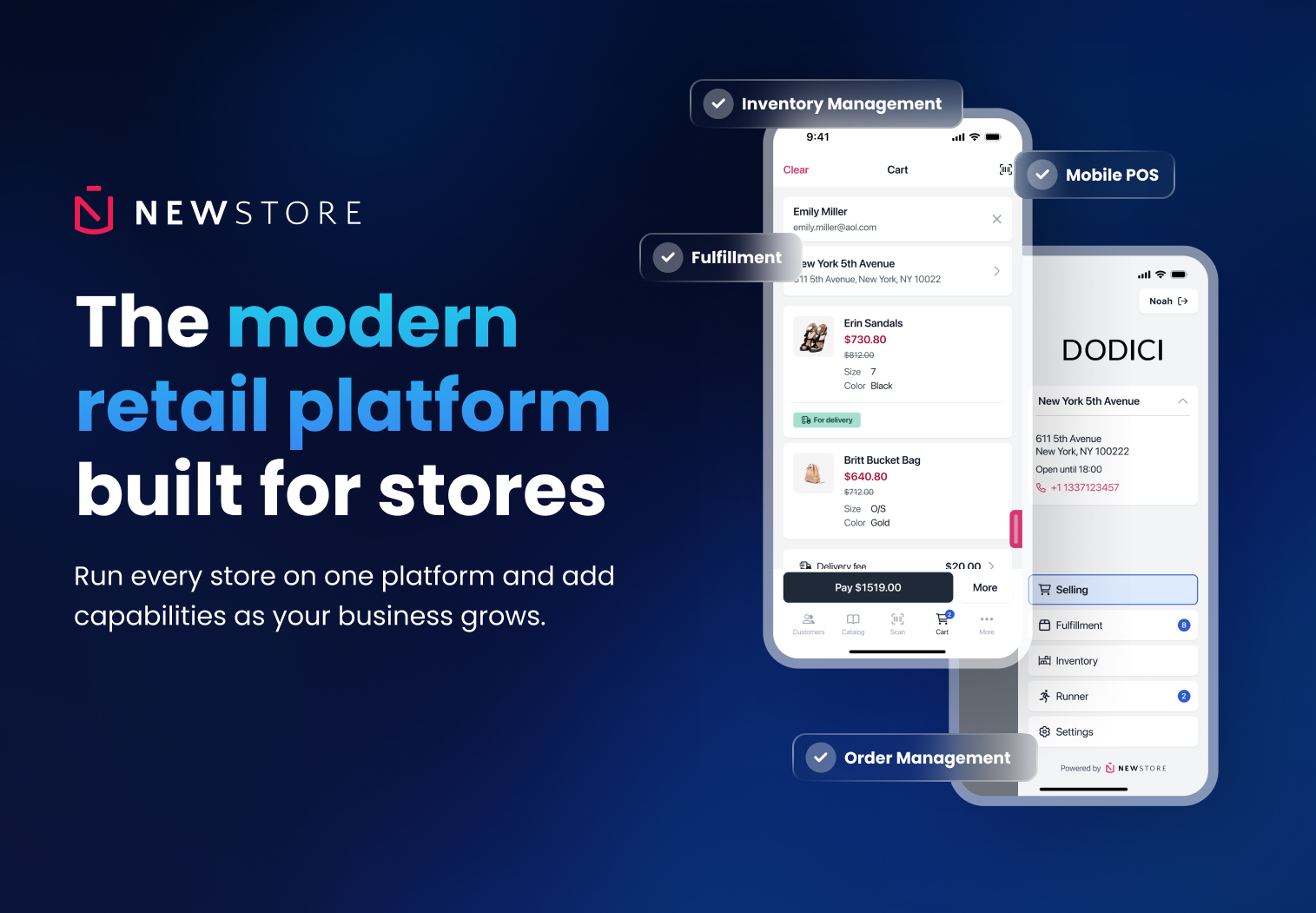
The company's answer is a mobile-first, cloud platform it calls Omnichannel-as-a-Service. In plain terms, NewStore takes the systems a modern brand normally has to buy separately and stitch together - an order management system, a point of sale, inventory, store fulfillment, clienteling, and a branded consumer app - and delivers them as one modular platform that runs, for the associate, largely on an iPhone.
"Customers see one brand and expect seamless experiences whether they are in-store, online, or on mobile."
That framing matters because it defines the problem NewStore is trying to solve. A shopper does not think in channels. They browse online, walk into a store, expect the associate to know their size is in the back, and, if it is not, expect to have it shipped home before they reach the door. Behind that simple expectation sits a tangle of inventory feeds, order routing, and payment plumbing that most brands were never built to coordinate. NewStore's platform aims to make that coordination the default rather than a custom project.
The founder is a useful clue to the ambition. Stephan Schambach built one of the first online stores in Germany in 1992, and later founded Demandware, the cloud commerce platform that Salesforce acquired in 2016 for about $2.8 billion and rebranded as Salesforce Commerce Cloud. Having spent a career on the digital side of retail, he turned his attention to the part he had not yet rebuilt: the store itself.
NewStore's design choice - to make the associate's smartphone the center of gravity - has practical consequences. An associate is no longer tethered to a fixed register. They can check inventory across the whole store network, ring up a sale anywhere on the floor, process a return, look up a customer's history, and fulfill an online order for shipping, all from a device that fits in an apron pocket. The company describes this as turning associates into "points of sale, websites, and customer support channels" at once.
Payments illustrate how far the mobile-first idea can go. Through a partnership with Adyen, NewStore was an early adopter of Apple's Tap to Pay on iPhone, which lets a store accept contactless cards and wallets on the phone itself - no terminal, no dongle. The uptake has been notable: NewStore has said that roughly half of all credit-card transactions across its live stores now happen this way. It is a small statistic that hints at a larger shift in what retail hardware even needs to be.
The other half of NewStore's pitch is about how brands adopt technology, not just what it does. Retail is littered with "replatforming" projects - multi-year migrations that swap out core systems in one high-risk push. NewStore's modular model is a deliberate rejection of that. A brand can start with, say, mobile POS and store fulfillment, prove the value, and then add clienteling or a consumer app later, without ripping out what already works. The company markets this as going live in weeks rather than months.
None of this happens in a vacuum. NewStore competes with a crowded field - Shopify's POS and enterprise tiers, Aptos, Manhattan Associates, Oracle Retail, Fluent Commerce, and the legacy vendors brands would otherwise assemble themselves. Its differentiation is less about any single feature than about integration and posture: one platform, mobile-first, adopted incrementally, built around the associate rather than the back office.
Who actually runs on it says something too. NewStore's customer roster leans toward specialty and direct-to-consumer brands with strong identities - Burton in snow sports, Vince and Veronica Beard in apparel, Marine Layer and Faherty in casualwear, Clarks in footwear, G-Star Raw and UNTUCKit and GANNI in fashion. These are companies for whom the in-store experience is part of the brand promise, which is precisely where a connected store earns its keep. NewStore says it delivers this across more than 40 countries.
The business behind it is straightforward B2B software: subscription revenue for the platform, with the modules a brand chooses, and payments handled through partners. Investors have found the thesis credible. NewStore has raised roughly $185 million over its life, from General Catalyst, Activant Capital, and - in a neat closing of the loop - Salesforce Ventures, the venture arm of the company that bought Schambach's last one.
What NewStore is ultimately selling is not a gadget but a point of view: that the smartphone already in a store associate's hand is the most underused tool in retail, and that connecting the store to everything else is the work that still matters. Whether that view wins the market is unsettled. But it has put a Boston company, and a founder on his third act, at the center of one of retail's more consequential arguments.