At the independent supply store, memory is a form of infrastructure. Someone knows which contractor gets the special price, which farmer pays after harvest, which can of paint matches a wall mixed six years ago. The trouble arrives when that memory must survive a busy Saturday, a new cashier, and a ledger that lives somewhere else. A wrong number can sit undisturbed for weeks. A customer can quietly stop buying. Neither event announces itself at the register.
Rundoo, based in Redwood City, sells the plumbing for that problem: a browser-based point of sale joined to inventory, purchasing, payments, customer records and accounting. Its target is unusually precise. These are independent hardware, paint, garden, farm and feed, and lumber stores - places where a sale may end on a charge account, a quote, a delivery truck or a tint machine rather than with a bag and a receipt.
At a glance
- Rundoo says more than 500 independent stores use its platform across the US, Canada and the Caribbean.
- Its AI assistant, Dooey, works from each store’s own transaction and account data.
- A $30 million Series B in August 2026 brought reported total financing to $48 million.
- The buying decision turns on the full bill: software, card processing, hardware and the switch itself.
The first register was in a paint shop
Nick Hershey and Andrew Beckman founded Rundoo in 2021. The first live customer, King’s Paint & Paper in Capitola, California, came aboard in December 2022. It is a fitting beginning. A second-generation paint store does not choose software because it admires software. It chooses software that can preserve the peculiar arrangements by which the store earns its living: supplier catalogs, contractor prices and customer histories that stretch back further than most startups.

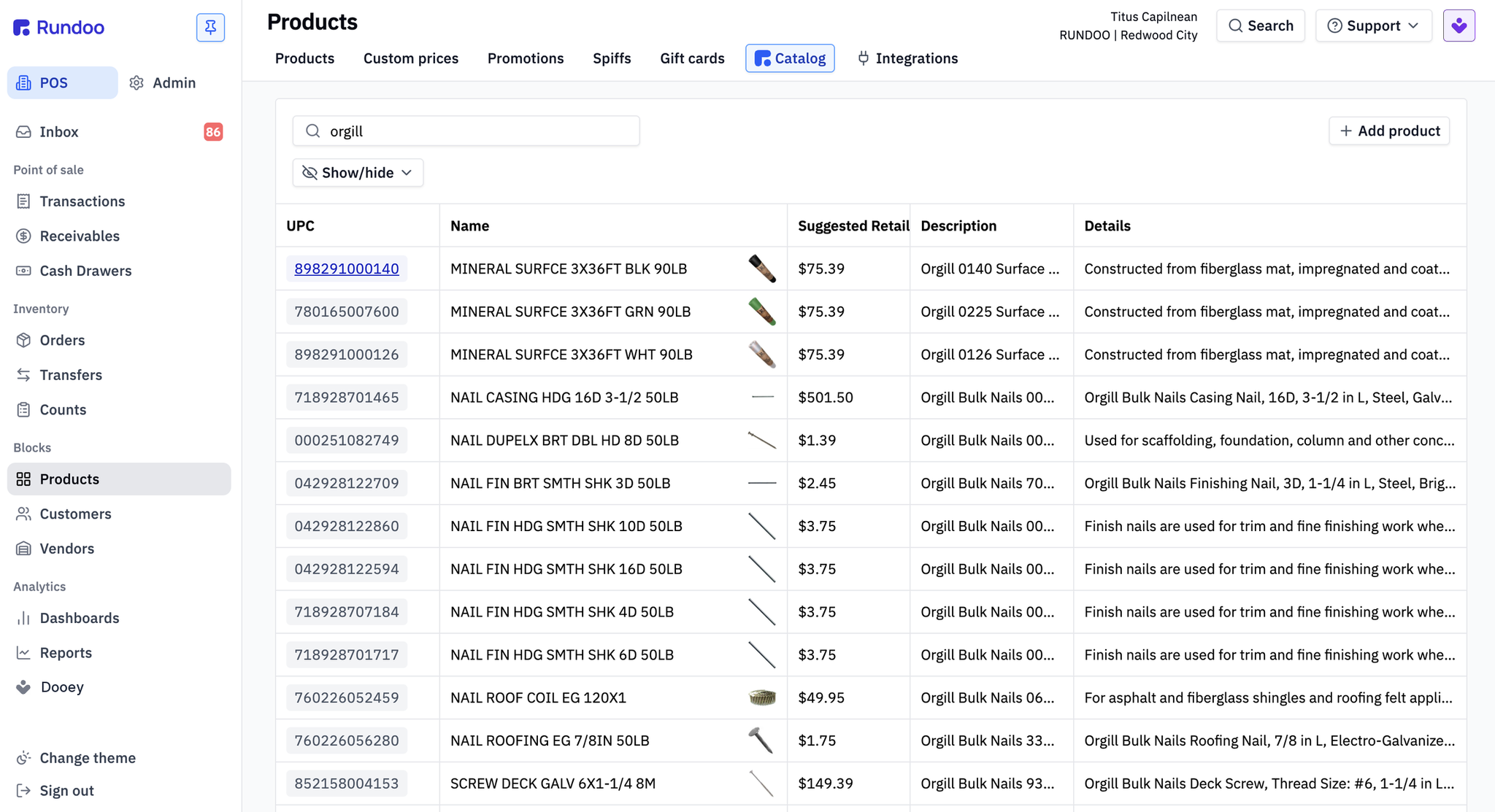
That specificity shapes the product. A general retail system can ring up a hammer. Rundoo also needs to know whether the hammer is in a distributor catalog, whether a contractor has a negotiated price, whether the item is already on order and where the sale belongs in the books. Its catalog indexes more than a million vendor products, the company says, and includes feeds from Benjamin Moore, Orgill, AllPro and other suppliers. A searchable listing can become a stocked item with the shop’s own cost, price and count. The distinction matters: knowing a supplier sells something is different from knowing your store has it.
The same logic extends online. Rundoo’s storefront reads from the inventory used at the counter, while signed-in account customers see their own prices. The contractor ordering caulk at six in the morning should not require a second catalog for the shop to maintain. For employees, a mobile app brings stock counts, orders and account information onto the floor. For customers, another app puts invoices, payment history and payment options on a phone.
Dooey knows whose numbers they are
In late 2025, Rundoo changed its slogan from an all-in-one POS to an AI-first POS. Hershey has said improving language models, particularly their growing ability to use tools, changed his view of what software could do for a store. In July 2026 the assistant acquired its own name: Dooey. The useful part of the pitch is less theatrical than the name. Dooey can read the store’s sales, prices, customer accounts and transaction history. An owner can ask which large buyers have drifted away or where margins have slipped, then ask the system to take the next step or schedule a recurring check.
At AllPro Paint in Atlanta, owner Ron Soto used it to identify high-value customers who had slowed their buying. Rundoo says the analysis surfaced 20 such accounts and that half bought again within three months after follow-up. Another owner’s daily summary exposed a custom price set at cost for ten weeks; the shop recovered more than $4,200. These are company and customer accounts, not controlled experiments. They do show the kind of question an ordinary sales report often leaves to a patient human with spare hours.
“I wouldn’t have even known how to look that up without the AI.”Ron Soto, AllPro Paint
The trick is that the AI inherits the quality of everything beneath it. If the product records, account balances and prices are scattered across programs, the clever answer may be confidently wrong. Rundoo’s more consequential wager is therefore the boring one: make the register, catalog and ledger agree first. Even its founders have revised that architecture. Hershey wrote that the company replaced separate payment and inventory ledgers with a single general-ledger model as Rundoo accounting matured.
The money is in the missed details
Rundoo’s own before-and-after analysis of stores that switched reports average revenue growth of 17 percent, a 25 percent reduction in receivables and a two percent improvement in gross margin over the following year. Hershey cautions that the revenue figure carries selection bias: stores willing to invest in a new system may already be set on growth. The receivables result has an everyday explanation. A contractor who can see a statement and set up autopay on a phone is easier to collect from than one who must find a paper bill and call the back office.
Rundoo’s reported averages for stores before and after switching; the company flags selection bias in the revenue result.
There is a cost to getting there. Rundoo uses annual agreements and custom pricing, so a single public monthly figure would mislead. Its own buying guide lists six lines to price: hardware, software, payment processing, migration, training and support, and the cost of leaving an old system. Card readers are a required hardware purchase for Rundoo payments. Migration is part of onboarding, and the company says it can extract data from an existing system more than 90 percent of the time. A sensible buyer would ask for the full first-year sum, the processor rate and the exit terms in writing.
The other constraint is connectivity. Rundoo has no offline mode. Hershey says an experimental local version raised sync and maintenance problems, so the company recommends a mobile hotspot or another backup connection when a store’s internet fails. For a counter where a stalled sale can walk out the door, that detail belongs near the top of the buying conversation.
A partnership business disguised as software
The integrations explain where Rundoo sits in the market. Benjamin Moore links its product catalog, electronic ordering, tint workflows and contractor programs to the platform. AllPro offers member pricing and consolidated billing. These are distribution relationships as much as product features: the independent retailer needs its existing supplier network to work on day one. The alternatives include broad POS tools such as Square and Clover and long-established industry systems such as Epicor Eagle, Paladin and Decor Fusion. Rundoo’s claim is a narrower fit for the supply counter and a modern, joined-up data model.
It also has to supply people. Rundoo says every employee works at a client store during their first week, and engineers pilot features directly with customers. Signed client T-shirts hang in its office after go-live days. That charming ritual has a hard operational counterpart. In May 2026, Hershey wrote that support queues and implementation backlogs had grown because the company had not hired enough people to match demand. The confession is useful: software that runs a register is a service promise made every morning, not merely a download.

The August 2026 $30 million Series B, led by Battery Ventures with Bessemer Venture Partners and CRV participating, gives Rundoo money to expand engineering in Redwood City and its go-to-market team in Chicago. It also gives the company a less glamorous assignment: keep the help desk, the implementation calendar and the product moving at the same speed. More than 500 stores now rely on it, according to the company. Every one still has a counter where the next customer is waiting.
For another business, the copyable lesson is simple. Start with the workflow that leaks money quietly. Join the records that describe it. Let people ask questions in plain language only after the records agree. Then price the change in full, including the labor of switching and the cost of a bad day. The local expert behind the counter has always been valuable. Rundoo’s bet is that better information lets that expert spend less time hunting for numbers and more time remembering the customer.