A cemetery’s paperwork has a peculiar shelf life: the people who wrote it may be long gone, but somebody still needs to know exactly what they meant. A name in a register, a rectangle on a map and a promise made to a family must continue to agree. PlotBox has made a business out of bringing those things together.
The Northern Ireland company sells cloud software to cemeteries, crematories and funeral homes. Its central idea is practical: connect the physical place of burial to the records and tasks attached to it. Staff can inspect a plot, check its status, retrieve documents and coordinate work through the same platform. For families, the benefit can be as ordinary - and as welcome - as getting an answer without another phone call.
The map has a day job
A conventional map tells you where something is. A cemetery operator also needs to know whether a space is available, reserved or occupied, and which documents support that answer. PlotBox combines mapping with inventory and administration. The photograph of the grounds becomes an entry point into the business running them.
Its mapping process brings together drone images, geographic positioning and cemetery data. Images are assembled into an aerial view; individual places of rest are located and connected to records. Verification matters because a tidy digital copy of a mistaken record is still a mistaken record. The work involves surveying and checking as well as software development.
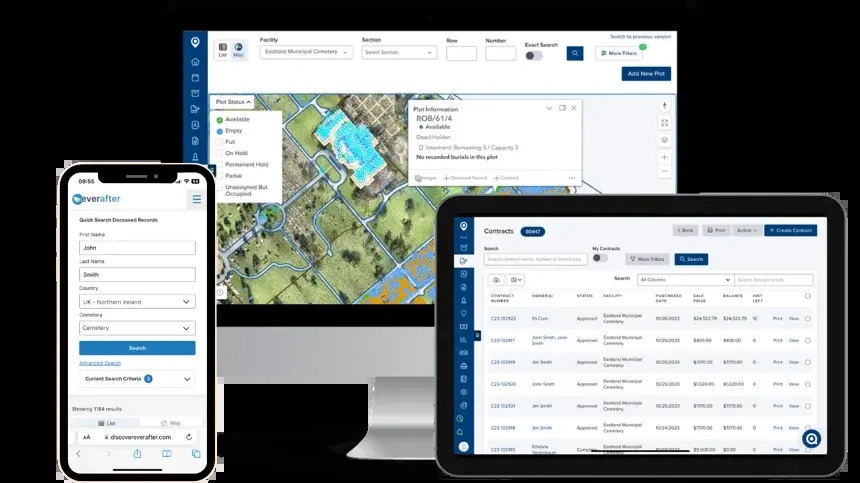
From there, the product spreads across the working day. Sales staff can prepare contracts against inventory. Administrators manage documents and bookings. Grounds teams receive work orders linked to locations. Finance staff handle invoicing and reporting, while PlotBox Pay connects payment processing to the wider system. These are familiar business functions with unusually specific details: deeds, interments, memorials and the capacity of individual burial spaces.
There are spatial complications, too. A mausoleum is not a lawn. PlotBox’s Vertica Mapping offers 360-degree views of mausolea and columbaria, where inventory extends vertically. For outdoor aerial mapping, deciduous trees make the calendar relevant: the company recommends leaf-off flights for its 2D imagery. A winter appointment can produce a clearer view than a summer afternoon.
The useful unit is a place plus its history.
A parish job, an American opening
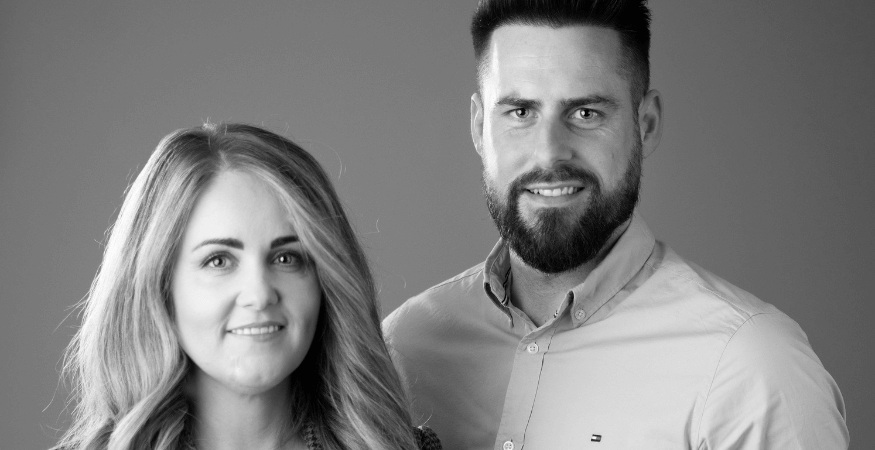
The original insight came from a local parish graveyard survey in 2009. Sean McAllister, whose background was in surveying and engineering, encountered fragmented cemetery information. He and his wife, Leona, developed the business that became PlotBox. Her experience in auditing and governance complements his interest in location and measurement.
The early commercial gamble was geographical. In a 2016 interview, the founders recalled being advised to concentrate on their home market. They pursued the United States anyway. On their first research trip, they met the Archdiocese of San Francisco’s cemetery director, who needed both software and digital mapping. Winning that contract gave them credibility.
They also admitted to an early mistake: being too protective of the product, potentially constraining growth. Their change of mind was toward greater openness. It is a useful corrective to the polished founding story: discovering a neglected problem does not automatically teach a company how to sell its solution.
When the diary stayed at the office
For customers, the first failure was often access. Flintshire County Council had newer information in an administration system, older records in spreadsheets and registers, and deteriorating paper plans. Then remote working exposed the arrangement’s limits.
“Covid was the biggest driver behind the change.”
Richard Blake / Flintshire County Council
In PlotBox’s August 2023 customer account
Flintshire chose to bring all 15 cemeteries into the project, combining migration, drone mapping and verification. Training began before data import was complete. The council described quicker processes and easier document handling after adoption. Its account is a vendor-published customer experience, but the sequence is instructive: inaccessible records created urgency; a coordinated implementation made the change usable.
Wirral had a different bottleneck: a paper cremation diary. Remote working meant scanning diary pages for a manager or collecting the information in person. The council accelerated the cremation part of its PlotBox rollout. Before introducing the Funeral Director Portal, it explained the change months ahead and involved 30 local funeral directors in testing groups.
Wirral’s reported adoption in its April 2023 customer story. The council described fewer calls and a smaller Monday backlog.
Funeral directors could check available times while meeting families and request slots beyond office hours. The reported portal adoption suggests that the outside participants actually used the new process. That is the part another organization can copy: invite the people who send work into your office to help design the new route.
The bill before the subscription
PlotBox sells subscriptions through packages suited to different operational needs. Implementation has its own scope: mapping, migration, configuration and training require work before the everyday convenience arrives. Buyers are purchasing a changed administrative process as well as access to software.
A public Tameside proposal makes the distinction concrete. It budgeted £84,000 upfront for technical implementation of hardware and software, followed by £16,000 annually for support and user licences. Those figures describe a particular council project, including hardware, rather than a universal PlotBox price.
Hardware + software
Support + licences
Separate costs, separate decisions. A public budget example, not a list price or a confirmed final invoice.
The council’s existing software version was approaching the end of support. Its report considered an upgrade from that supplier, but argued that other systems would still be needed to fill functional gaps. The purchasing question therefore extended beyond the annual licence: how much work, and how many separate systems, would remain?
For a buyer evaluating a similar project, the useful comparison is the complete job. Ask vendors to demonstrate a real booking, a historical record search and a work order against your own circumstances. Price the preparation and staff time alongside the subscription. An inexpensive licence can coexist with an expensive migration.
Nearly 400 cemeteries put the idea to work
Everstory Partners provides a larger test of the model. In March 2025, it announced that nearly 400 cemetery locations had moved to digital contracts during 2024 through its work with PlotBox. Most also had aerial drone mapping. Previously, employees had written contracts against paper maps that could be decades old.
The company described a counselor arranging services with a family at a hospital, allowing them to remain with their loved one. That example makes the commercial proposition unusually clear. Mobile access changes where the conversation can happen. The records travel with the employee.
Growth funding followed its own sequence. PlotBox announced a £5 million investment led by Guinness Ventures in May 2023, with Par Equity participating. Serent Capital announced a strategic investment in April 2025 to support expansion, product development and customer service. In October 2025, PlotBox acquired HMIS, also called MIS, from Batesville, extending its US funeral and cemetery software presence.
That expansion places PlotBox among specialist business software providers for deathcare. Alternatives include Chronicle, CIMS and Cemsites, alongside older administrative systems. Mapping linked to records is available elsewhere; Chronicle explicitly offers it. PlotBox’s case rests on the breadth of connected operations, its implementation expertise and evidence of deployment across substantial groups of facilities.
The records now reach the family website
The public-facing side is EverAfter Connect, which brings cemetery and funeral websites closer to the back office. It supports services such as burial searches, memorials, obituaries and e-commerce. Walk-to-grave directions give visitors a practical way to reach a location, while public searches can reduce routine inquiries to staff.
Funeral home management extends the same principle across arrangements, scheduling and family records. A business that operates both a funeral home and cemetery can coordinate those services without maintaining separate versions of the same information. PlotBox’s published funeral home offering also includes online arrangements and family access to balances and payments.
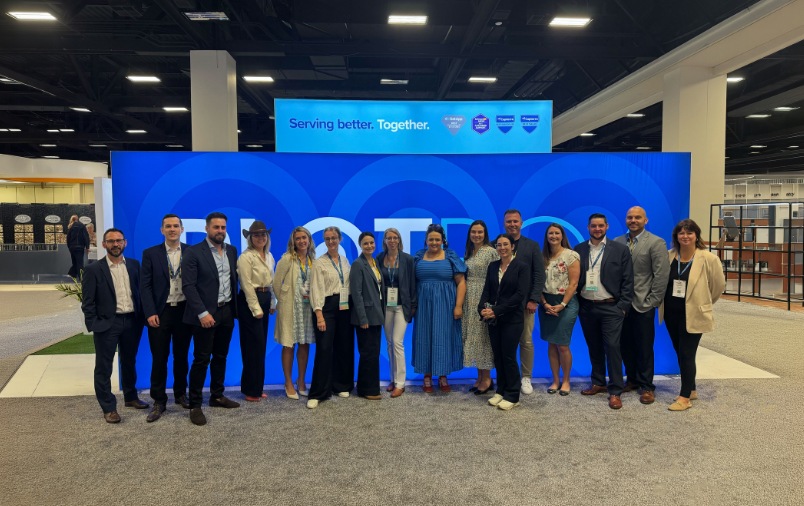
At ICCFA 2026, PlotBox launched Eva, its AI deathcare assistant. The company describes administrative help and obituary drafting, with the funeral home team reviewing outputs before publication. That division of responsibility matters in a product whose text may become a family’s public remembrance.
The work that survives go-live
Falkirk Council’s experience offers a useful check on the speed of the software story. It implemented PlotBox in 2019, yet its 2024 account still described a staged journey. Mapping old information, involving staff and deciding which functions came first all required attention. The service could not suspend burials and cremations while everyone concentrated on the project.
The implication is straightforward: this approach depends on time to reconcile records and help people change routines. A team expecting a software installation to settle every historical inconsistency will still have work to do. A smaller operation with limited needs should examine the scope carefully; more modules only help when someone can use them.
PlotBox’s stated values are tenacity, teamwork and trust. Its careers material describes autonomy, feedback, charity activities and employee support. In this business, those claims meet a specific test: can the company help an operator through the unglamorous work after the sale? The cemetery will continue receiving families while the new system takes shape.
The map, meanwhile, keeps its day job. Someone needs to find a grave, prepare a service or answer a question about a promise made years ago. PlotBox’s opportunity is to make the information ready when that person asks.