Stephen Bradshaw had an electrical business and a problem with getting bigger. The work was there. Keeping track of it was becoming the difficulty. Recalling the early days, he put the threshold at just three or four employees: beyond that, control began to slip. Anyone who has tried to remember which van has the right part can appreciate the distinction between having work and having a business that can handle it.
- Simpro connects quotes, schedules, field work and invoices for trade businesses.
- Its appeal grows with complicated projects, stock and recurring maintenance.
- Budget for implementation as well as the subscription; customer results vary.
The fourth employee problem
In 2002, Bradshaw teamed up with Vaughan McKillop, a software engineering student. McKillop had been delivering pizza and then doing data entry for the electrical business. An initial conversation about making a website became a conversation about writing software. They began with job lists, then added scheduling for technicians. Other electrical contractors tried the tools. Eventually, they bought them.
“We only had three or four staff - any bigger than that and you started to lose control.”
Stephen Bradshaw, recalling Simpro’s beginnings
What failed first was the owner’s ability to coordinate everything through paper and memory. The useful discovery was that fellow contractors recognized the same problem. Simpro’s founding story offers a modest instruction for anyone building business software: begin with a task somebody already struggles to finish, then see whether their peers struggle too.
One job, fewer handoffs
Today, Simpro sells cloud software for electrical, plumbing, HVAC, fire protection, security and other field service businesses. Its expertise sits in the awkward territory between office administration and physical work. A project may need an estimate, purchased materials, several visits, asset records and progress invoices. A recurring maintenance contract creates another calendar entirely. Simpro brings these activities into a connected operational record.
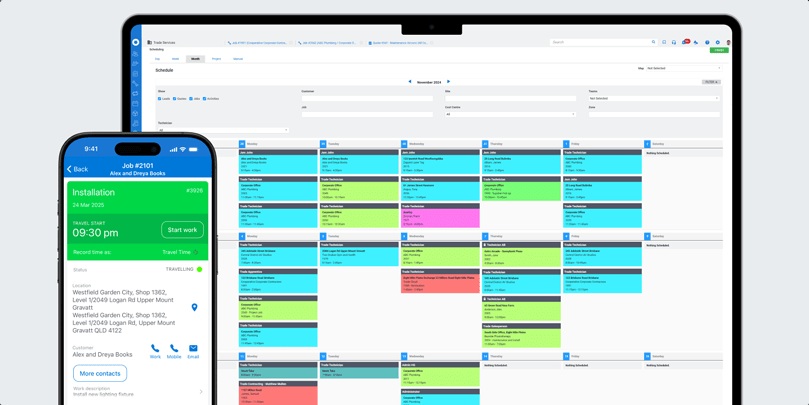
The office platform handles quoting, job costing, inventory, purchasing and reporting. Simpro Mobile puts schedules, job details, notes and time recording into technicians’ hands. Accounting integrations include Xero, QuickBooks, MYOB and Sage. Square supports payment collection in the field. The practical attraction is continuity: information gathered while doing the work can travel onward into billing and accounts.
- 01 Estimate
- 02 Dispatch
- 03 Record work
- 04 Invoice
Each handoff carries the job record forward.
Simpro occupies the crowded field service management market alongside ServiceTitan, BuildOps, Jobber and Housecall Pro. Its case rests on the combination of service work, projects, maintenance and materials management. These capabilities are also contested by competitors. A buyer needs to compare an actual workflow: a complex installation followed by a maintenance contract is a different software test from a straightforward repair visit.
Scale needs a careful label here. Simpro’s website reports more than 250,000 users for its software. The broader group reports more than 24,000 businesses and 450,000 users across Simpro, AroFlo, BigChange and ClockShark. Those are different populations. For the customer, the relevant question is which product, integrations and support arrangements will serve their particular team.
The fifteen-minute quotation
Ranger Fire & Security supplies a concrete example. In a Simpro-published customer video, CEO Mark Bridges describes the needs of a group containing seven businesses. The reported changes include live information for technicians, integration with Xero and quotation time falling from three hours to 15 minutes. That is a customer account, rather than a promise about every installation.
The interesting measurement is elapsed time. A contractor waiting for a quotation is waiting for several smaller decisions to become one usable document. When those steps share information, the office has less reconstruction to do. That is the hypothesis a prospective customer can test: take a recently completed job into the demonstration and follow its estimate, parts, hours and invoice.
Buying the next handoff
Simpro’s own expansion has involved acquisitions as well as product development. In 2016 it secured AUD 40 million from Level Equity. In November 2021 it announced more than USD 350 million from K1 Investment Management, with Level Equity participating, alongside the acquisitions of AroFlo and ClockShark. BigChange joined in October 2024. The group now spans several products serving different field service requirements.

Under chairman and CEO Fred Voccola, who joined in October 2025, the ambition has widened. The company now identifies Miami as its international headquarters. It acquired customer engagement provider Delight in January 2026, then launched Lightning in May. Lightning adds an AI layer across Simpro, AroFlo and BigChange, including an assistant called Cooper and agents for tasks such as job preparation and documentation.
There is a clear business idea behind that direction. The records used to run today’s job can help prepare tomorrow’s visit or prompt an overdue customer follow-up. In August 2026, the group announced a Montréal AI research centre, backed by planned investment of tens of millions of dollars. Its stated mission is to double contractor profitability. That remains a target, not an established result for its customer base.
A spreadsheet still needs an owner
Simpro charges subscriptions with monthly or annual billing, tailored to users and add-ons. Setup fees cover onboarding, training and migration. The Lightning launch announcement quoted a standard 25% contract uplift following its promotional window, with annual increases capped at CPI plus 3% under the associated guarantee. A buying decision needs a written quote covering the whole arrangement.
The implementation guide makes the organizational cost visible too: managers, future users and a designated Simpro champion have preparation and training responsibilities. More complicated workflows and multiple locations can require extra training days. A small operator with simple jobs may find that burden hard to justify. A business unwilling to maintain its records gives any connected system little dependable information to connect.
Inside Simpro, the published values include accountability, customer focus and working as one team. The careers pitch describes collaboration across brands and time zones. Those are employer statements, but they point to a familiar challenge: as the portfolio expands, keeping the people who build and support the software coordinated becomes a version of the customer’s own problem.
The transferable lesson is practical. Map one job, name the person responsible at each handoff, and measure where time disappears. Then ask the software to improve that sequence. Bradshaw began with a job list because he needed to know what was happening. The question still makes a good place to start.