A roofing business has a peculiar inventory. There are the shingles, of course. There are also promises: an inspection on Tuesday, an estimate by Friday, a delivery before the crew arrives. The materials can sit in a warehouse. The promises tend to sit in somebody’s head. Eventually, that somebody becomes the busiest person in the company.
- The job: connect customer records, estimates, production, and payment.
- The audience: roofing and exterior contractors, in the office and in the field.
- The bet: a repeatable handoff is worth paying for.
- The catch: the team still has to agree on the process.
JobNimbus, the Utah software company, lives in this gap between doing the work and remembering everything around it. Its proposition is wonderfully unromantic. Put the customer, the documents, the status, and the next task together. Let the salesperson and the production manager look at the same job. Give the office fewer reasons to interrupt the person on the roof.
01 The whiteboard could not ride along
In a 2025 Utah Business interview, co-founder Ben Hodson recalled meeting roofers over lunch in 2013. Their work moved between sites; their software often stayed in the office. When he asked to see the app, the answer was memorable: “There was no app.” A program installed from a CD was a poor companion for someone spending the day in a truck.
Hodson went on to interview scores of contractors. Together with Nick Wood and Jason Wood, he built JobNimbus around their working lives. Nick brought programming experience; Jason came from chemistry and moved into technology and product innovation. The company’s own history dates the start to 2013.
The founders’ diagnosis put business coordination at the center of the product. A contractor might know how to replace a roof and still struggle to coordinate the estimate, customer messages, crew, and bill. The company’s mission, to make contractors heroes, takes on a rather practical meaning here. Reliability is easier to deliver when the necessary information travels with the work.
02 Give the next step an address
The clearest demonstration comes from Red Roofing & Gutters in Georgia. Its company-published case study describes an operation that began with four employees in 2024 and grew to 28. At the beginning, the owners could keep the business in their heads. More people meant more opportunities for a detail to disappear between roles.
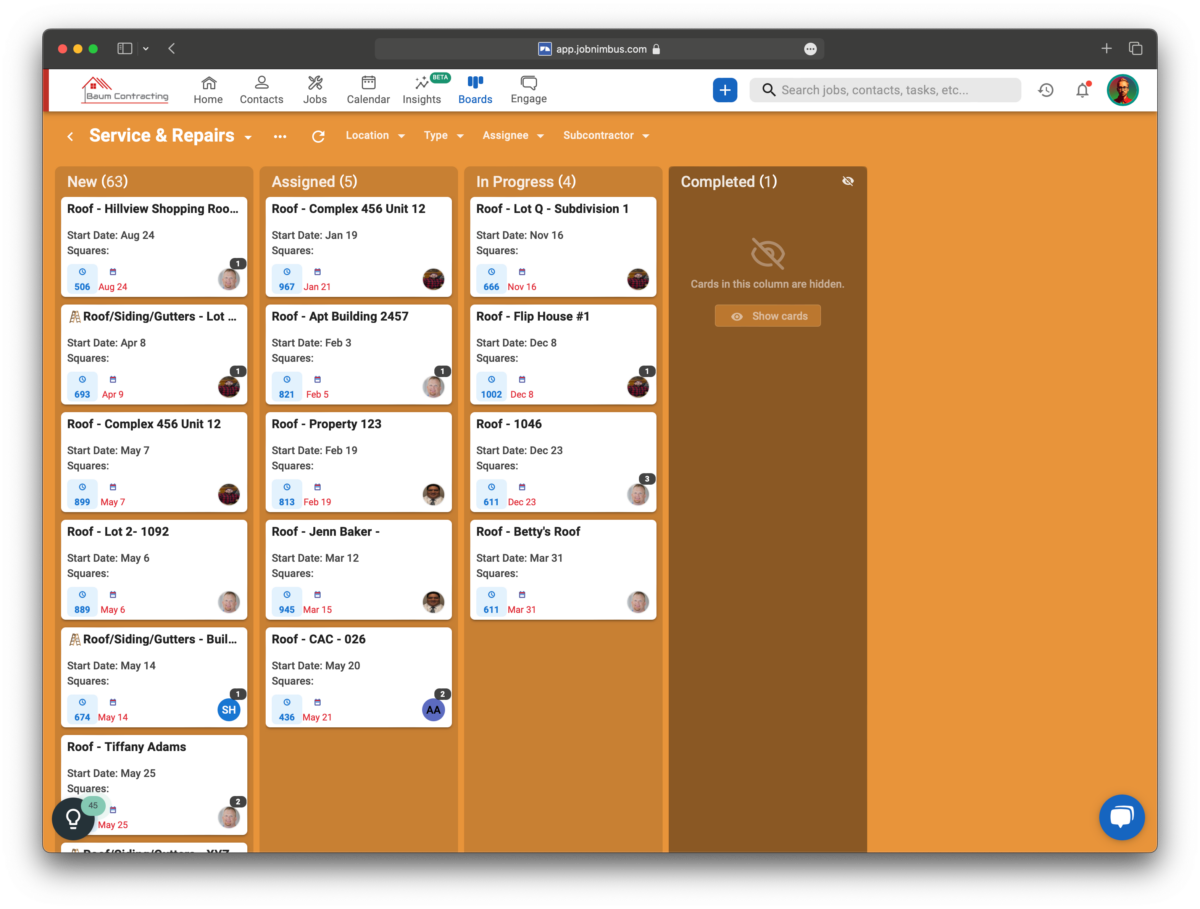
Co-owner Jason Hicks built job boards with a status for each stage. Approval could move a job into the next part of the workflow automatically. He also put costs, maximum discounts, and selling prices into custom fields, giving new inside salespeople defined boundaries. The practical change was that a new hire could follow an established process instead of borrowing an owner’s judgment at every turn.
“The automations definitely took a little getting used to”
Christian Kuhns, Red Roofing & Gutters
Kuhns describes stronger follow-up once the team learned the system. That detail matters more than a triumphant growth percentage. Adoption took learning. The company reports growth alongside these changes, but its account is a customer testimonial published by the vendor. The useful thing to copy is concrete: visible stages, automatic handoffs, and pricing guardrails.
- 01LeadCapture the contact
- 02EstimateScope and price
- 03ApprovalSign and advance
- 04ProductionOrder and schedule
- 05PaymentInvoice and collect
Illustrative sequence. Contractors configure their own stages.
JobNimbus’s automation lessons show how modest the first step can be: a reminder before an inspection, a follow-up after an estimate changes status, or a billing reminder after a defined interval. These are jobs for a clock and a rule. The training material also tells users to review message templates. A precisely timed email with the wrong words is still the wrong email.
03 Buying the missing pieces
JobNimbus expanded by acquiring products and services around the core workflow. EngageCRM added communications in 2022. Roofer Marketers brought digital marketing in 2023. The SumoQuote acquisition was announced in January 2024, adding estimating and polished proposals. Mainsail’s history dates that transaction to December 2023.
There is a business logic to this collection. Marketing helps produce the lead. Communications help keep it alive. A proposal explains the work and asks the homeowner to commit. The CRM keeps the resulting job moving. Each addition gives JobNimbus another place in the contractor’s day.
SumoQuote also changes what the customer sees. A homeowner encounters the proposal before encountering the finished roof. The acquisition announcement emphasizes readable, professional presentations. By March 2024, JobNimbus’s new sales experience could request a deposit as a fixed amount or percentage on the authorization page, reflected in the signed estimate and final PDF contract.
The platform also connects to specialists. QuickBooks handles accounting records; CompanyCam supplies jobsite photography; EagleView provides aerial measurements; QXO connects material pricing and orders; Sunlight Financial connects homeowner financing. The distinction is the surrounding workflow. Buyers should assess which connections they need, how those connections behave, and where another subscription remains necessary.
04 The subscription is only part of the bill
JobNimbus sells subscription packages called Essentials, Pro, Premium, and Enterprise. Its current pricing page asks buyers to request a quote. Team size, boards, automations, locations, and support vary by package. Marketing and communications bundles extend the offer, and professional services can be an additional purchase.
For an operator, the meaningful price is the cost of running a real job through the system. Include the subscription, optional services, relevant partner tools, and payment processing. Then include the time spent importing records, deciding on statuses, and training the team. Those hours belong in the calculation even when they do not appear on the vendor’s invoice.
JobNimbus Payments accepts cards and ACH/eCheck within the workflow. Its product page says the payments service has no monthly or annual fees; transaction charges still matter. Linking payment to a job record offers a practical benefit: the office can work on collection where it already holds the customer and invoice information, with fewer errands for physical checks.
The competitive set includes AccuLynx, Roofr, Jobber, ServiceTitan, and other contractor platforms. JobNimbus positions itself around roofing and exterior work, configurable workflows, mobile access, and connections across sales and production. That is a useful shortlist criterion. A buyer still needs to demonstrate their particular job, accounting setup, and crew routines before choosing.
05 A smaller target, a larger company
JobNimbus spent its early years bootstrapping. Mainsail announced a $53 million growth investment in January 2021, after the company had more than doubled customers and employees during 2020. The announcement planned roughly 100 additional hires, especially in product, development, and customer support. Growth required people who could help customers use what the engineers built.
Investment amounts, not valuations or annual revenue.
Mainsail’s account describes a narrower ideal customer profile, changes to pricing, a larger sales team, and a transition to a new payments provider with dedicated onboarding. The revealing lesson is that adding a feature and getting customers to adopt it are separate pieces of work. A payments button needs a merchant willing and ready to press it.

Sumeru Equity Partners announced a further $330 million investment in November 2024. The founders and Mainsail remained investors. The announcement earmarked resources for product development, AI features, and expansion of engineering and support. Together, the two announced investments total $383 million. The figure measures the backing for this business; it cannot tell a contractor whether tomorrow’s crew will use the app.
The company’s workplace policies suggest an interest in habits as well as output. Its careers page describes weekly all-hands, a quarterly day for reflection, and at least three days of paid time off each quarter. A company selling relief from administrative overload has a sensible reason to make rest an explicit rule.
06 The latest improvements are decidedly practical
In September 2026, JobNimbus announced two-way synchronization with RepCard. A salesperson’s customer or appointment can enter JobNimbus in a mapped stage, while changes in JobNimbus flow back to RepCard. A separate ReferPro integration sends referral leads into the job board and ties later revenue to the introduction. Both tackle the familiar expense of entering a customer twice.
On September 25, the company introduced Analytics as the eventual replacement for Insights. Prebuilt dashboards cover sales, workflow, production, receivables, and other areas, with data refreshed every ten minutes. The two reporting experiences will coexist during the transition. For a manager, that can shorten the distance between asking what is happening and seeing a usable answer.
07 Try one job before changing the business
The practical test is small. Take a genuine lead through an estimate, approval, material order, production handoff, invoice, and collection. Give each transition an owner. Check the accounting connection. Let a field employee try the mobile steps. JobNimbus offers a 14-day trial without a credit card, which gives this exercise a defined window.
This approach needs accurate records and people willing to update them. If the team cannot agree on what “ready for production” means, automation can move confusion faster. A small operator with a simple, reliable process may have less to gain from a broad platform. A business with several crews and recurring handoff problems has a clearer problem to test.
The pleasing idea behind JobNimbus is that a contractor’s reputation depends partly on very ordinary things happening on time. The estimate arrives. The crew knows the scope. The bill reflects the work. Give those promises a visible place to live, and the owner may finally stop being the only person who knows what happens next.