The first useful thing ServiceTitan did was tell a contractor whether the phone rang because of the Yellow Pages or Google. Not exactly the stuff of a keynote laser show. But for Ara Mahdessian's and Vahe Kuzoyan's fathers, both immigrants who built residential contracting businesses, it answered a costly question hiding in plain sight: which marketing dollar actually produced a job?
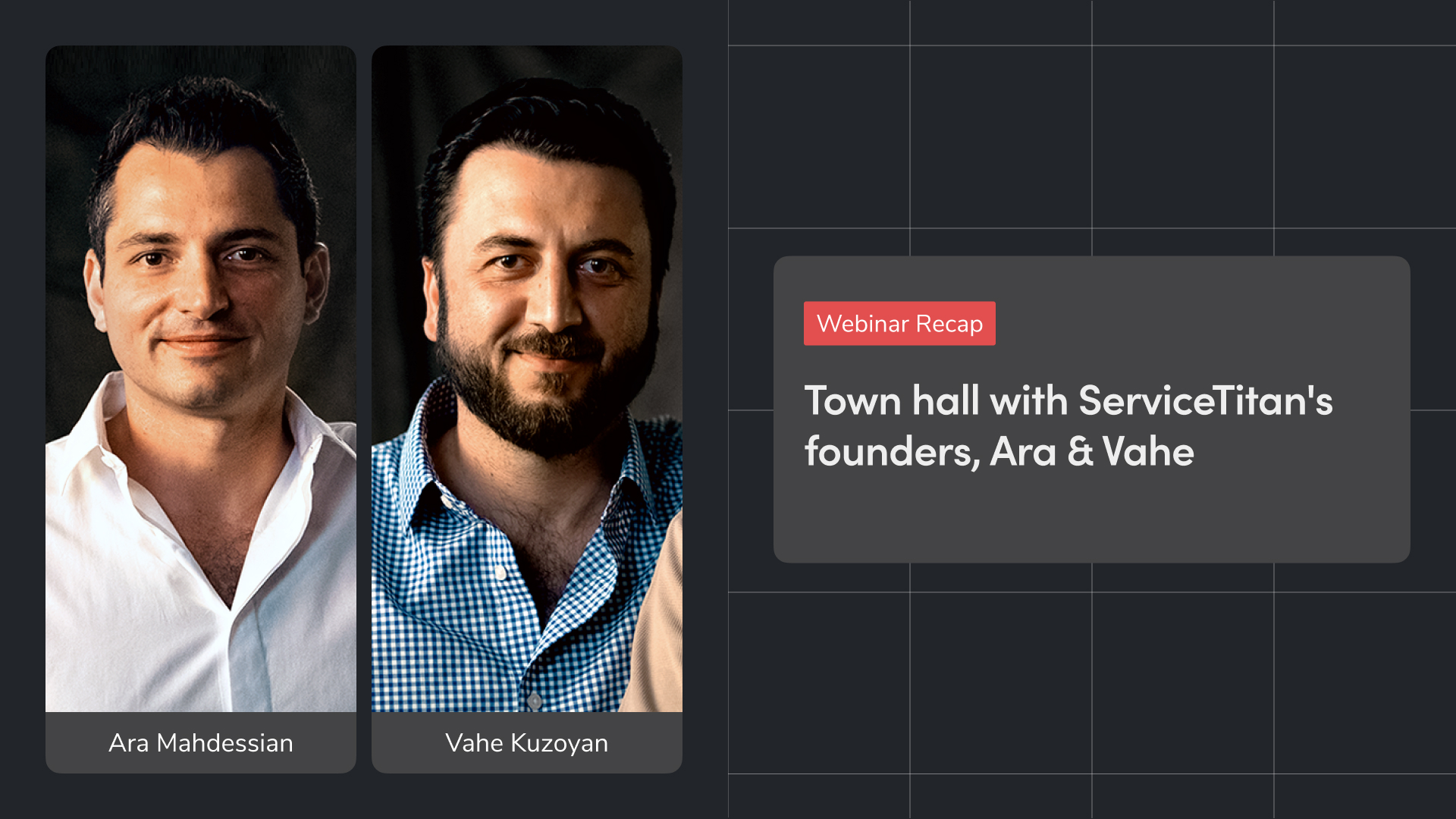
Their sons had watched the whole after-hours ritual. A day in the field ended, then the unofficial second shift began - balancing books, preparing invoices, scheduling technicians and trying to remember which customer had heard which ad. Mahdessian and Kuzoyan met on an Armenian student ski trip and recognized the same family story in each other. In 2007, they started writing the missing software.
The call tracker became a cloud platform in 2012. Five years of work with local contractors turned one small wedge into dispatch, scheduling, CRM, estimates, mobile field tools, reporting and payments. By fiscal 2026, ServiceTitan had more than 11,800 trade customers, $961 million in revenue and $82.1 billion of gross transaction volume flowing through customer invoices. The clipboard did not disappear. It swallowed the office.
A trades business, drawn as five systems
ServiceTitan is often called field-service software, which is accurate in the way that “kitchen” describes a restaurant. The public filing is more revealing. The company organizes a contractor around five “centers of gravity”: customer relationship management, field service management, enterprise resource planning, human capital management and fintech.
A homeowner sees the polished edge: online booking, a text that the technician is coming, a digital estimate, financing choices and a payment link. Behind that are dispatchers matching skill and location to jobs, managers tracking conversion and ticket size, marketers attributing revenue to campaigns, and owners checking margin before the month is over.
This breadth is the difference. Jobber and Housecall Pro can be easier entry points for small crews. FieldEdge, WorkWave, ServiceTrade, BuildOps and trade-specific tools attack overlapping pieces. Generic platforms such as Salesforce and SAP have more horizontal range. ServiceTitan's bet is that a contractor would rather buy workflows already shaped around a service call, a truck, a technician, a pricebook and a homeowner than assemble those nouns from scratch.
The bill follows the contractor
ServiceTitan does not hang a neat monthly price card in the shop window. New customers generally sign annual or multi-year subscriptions lasting 12 to 36 months. Price depends on the package and the size of the business, usually the number of field technicians, though some products connect pricing to end customers or revenue. Payments add usage-based revenue; Pro products add automation across marketing, contact centers, scheduling, dispatch, fleets, field sales and pricebooks.
The cleanest view of the model is the company's effective earn rate. Across its current products, ServiceTitan says it captures about 1% of the gross transaction value its customers run through the platform. A contractor grows, hires more technicians, books more jobs, processes more payments and buys more automation. ServiceTitan grows along the same route. Net dollar retention remained above 110% in each of the past three fiscal years.
That model also explains the product map. Integrated payments and financing reduce handoffs and add monetization. Accounts-payable automation reaches backward into the office. Aspire, FieldRoutes and Convex extended the company into landscaping, pest control and commercial sales. Conduit Tech adds HVAC design. Each move puts another operational loop inside the same database.
Building that loop was not cheap. Before the public offering, ServiceTitan raised more than $1.4 billion from firms including Bessemer, Battery, ICONIQ, Index, TPG, Thoma Bravo and Sequoia. A $165 million round in 2018 valued the company at $1.65 billion. In March 2021, another $500 million arrived at an $8.3 billion valuation. Three months later, a $200 million investment alongside the Aspire acquisition pushed the private mark to $9.5 billion.
The last private financing also carried an anti-dilution mechanism that made the timing and price of a future offering matter. ServiceTitan explored the public market, waited through a colder period for software listings, then sold 8.8 million shares at $71 each in December 2024. The $624.8 million deal priced above its revised range. The stock jumped on its first day, but the more durable achievement was access to public capital for a company still spending heavily on product, sales and market expansion. The funding history is a reminder that “vertical” does not mean capital-light once the ambition becomes an operating system.
AI arrived after the data
ServiceTitan's AI pitch is unusually easy to understand because the inputs are already sitting on the dispatch board. Titan Intelligence can estimate job value, weigh technician performance, account for drive time and help assign the next call. Marketing tools can optimize ads toward sales rather than form fills. A missed-call workflow can identify likely recoverable leads. Regional data can tell a contractor whether a service is priced above or below nearby peers.
Atlas, introduced in 2025, gives that system a conversational layer. Max bundles newer agents and automation around the broader platform. The point is not a chatbot perched beside the product. It is software that can read capacity, customer history, pricebook data and job outcomes before acting. ServiceTitan says early Pro users saw improvements such as less drive time and higher booking or ticket rates, but those figures come with an important qualifier: individual results vary.
Here is the lesson worth copying. Do not begin with “AI for an industry.” Begin with the ugly, repetitive workflow that determines whether the business made money. Earn the data by solving it. Connect the adjacent workflows. Add intelligence only when the system knows what a good decision looks like.
What cracked first
Complexity eventually collected its fee. During rapid growth, customers complained about poor support. In a 2023 town hall, Mahdessian did not soften the problem. He called the service level “completely unacceptable.” The founders committed to recurring forums and grouped the response into prevention, self-service and assisted service: make the product more intuitive, improve the paths customers can use alone, and make human help work when they need it.
That episode changed the operating conversation. A vertical platform can become mission-critical faster than its support organization matures. For a contractor, a dispatch problem is not an abstract software ticket. It is a technician waiting, a customer cooling off and revenue leaking by the hour. ServiceTitan's intimacy with the trades created its advantage; preserving that intimacy at public-company scale is harder than discovering it.
The company has other scars. Its first customer conference took place in Kuzoyan's backyard and was called Dispatch until dispatch.com sent a cease-and-desist. A funny nuisance, but also a useful symbol: the original company could be described by one verb. Today's company needs five systems, more than 70 commercial integrations and a marketplace to explain itself.
When the operating system is too much system
A broad platform works when the customer's complexity is real. Multi-location contractors, large call centers, mixed residential and commercial operations, fleets of technicians and management teams hungry for consistent numbers can benefit from one data model. A three-person shop may not. The subscription is only part of the cost. Data migration, pricebook design, process changes, training and field adoption all consume attention.
The product is a poor fit when the owner wants software to preserve an informal business exactly as it is, when technicians will not use the mobile workflow, when reporting data is not maintained, or when a simpler scheduler and invoicing tool already solves the actual problem. Automation amplifies a defined process. It does not define one for an unwilling team.
Start with a costly, measurable workflow. Work beside customers long enough to learn the exceptions, then expand into adjacent systems that reuse the same data.
All-in-one depth creates migration, training and support obligations. Build the service layer at the same time as the product surface.
The customer has multiple roles, repeatable operations, enough transaction volume and a manager who owns implementation.
The team is tiny, processes live in people's heads, adoption is optional or the buyer mainly wants the cheapest calendar.
ServiceTitan's market position is now clear. It is not merely software for sending plumbers to houses. It is vertical infrastructure for businesses that sell skilled labor in the field. The company went public in December 2024 at $71 a share after raising more than $1.4 billion privately. By early 2026 it had crossed a $1 billion annualized revenue run rate, while still aiming at a trades economy far larger than the software company attached to it.
The most durable part of the story remains smaller. Two sons noticed their fathers doing valuable work all day and invisible work all night. They chose the night shift. Everything else - the funding, the acquisitions, the AI agents, the Nasdaq ticker - grew from making that hidden work count.
Open the toolbox