The least glamorous object in a commercial building may be the most revealing: a fire extinguisher with a paper tag. Someone has to inspect it, document it, report a deficiency, quote the repair, send the right technician back, find the part, invoice the work and collect the money. Multiply that sequence by alarms, sprinklers, chillers, boilers and rooftop HVAC units across thousands of sites. The result is not merely a scheduling problem. It is a relay race in which every dropped baton becomes a delayed invoice, an irritated customer or a safety risk.
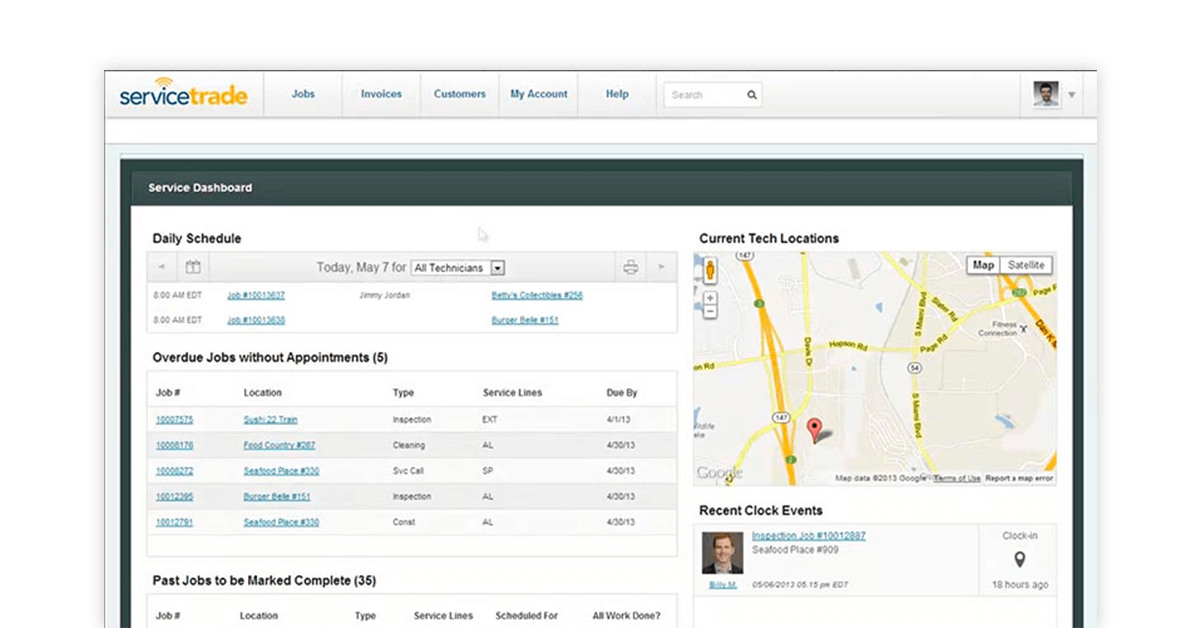
ServiceTrade sells the software that keeps those batons moving. Based in Durham, North Carolina, the company serves more than 1,300 commercial fire-protection and mechanical contractors. Its platform connects proposals, recurring agreements, dispatch, technician work, inspections, asset histories, parts, projects, billing and customer portals. In 2026, it pushed further into AI agents for quoting, scheduling, invoicing and collections. This is enterprise software with steel-toe boots.
01 / The originThe software escaped from the contractor
ServiceTrade's origin is unusually literal. Its roots sit inside DunnWell, a national service company that had built technology for its own operations. Billy Marshall and Brian Smithwick recognized that other commercial contractors were suffering through the same clumsy handoffs, so they spun the technology into a separate company on September 26, 2012. They were not guessing at a persona. They had watched the work misbehave in the wild.
The original pitch was plain: mobile and cloud software could help maintenance and repair companies deliver better service, make technicians more productive and reduce administrative drag. The focus mattered. Residential home-service businesses and commercial contractors may both own vans, but commercial work involves longer-lived assets, recurring agreements, code-driven inspections, multiple sites, complicated approvals and invoices that can wait in a bureaucratic swamp. ServiceTrade chose commercial only.
“Before we started ServiceTrade, commercial and industrial service contractors were forced to rely on software that wasn't designed for their businesses.”Billy Marshall, co-founder
02 / What failed firstThe market-size slide did not travel well
The first serious failure was not the product. It was the financing story. After roughly two years of selling, ServiceTrade had signed about 100 customers, yet breakeven remained distant. The founders wanted more engineering capacity. Early institutional investors wanted a clean estimate of the total addressable market. Commercial service contracting was large in practice and poorly measured on paper. The pitch kept getting stuck at the spreadsheet.
That tension could have pushed the company toward a broader, more fashionable category. Marshall and Smithwick refused. They believed the workflows and data model only worked because the customer definition was strict. Instead, they asked a small group of their most engaged customers to invest. Within weeks, the company had the capital it needed on friendlier terms, plus advisers who knew exactly where the product pinched.
What it cost
A reported $4.1 million customer-backed equity round arrived in 2015. Marshall later said the founders carried roughly $100,000 in credit-card debt and unpaid expenses when the early round closed.
What changed minds
Not a prettier market map. Customer growth, working software and contractor economics turned an awkward niche into evidence. By 2020, growth investors were competing to understand the focus rather than asking the founders to abandon it.
Frontier Growth and Bull City Venture Partners supplied institutional growth capital in 2020. In December 2021, JMI Equity led an $85 million investment, joined by the existing investors. Third-party funding trackers put total capital raised near $119.8 million. Valuation has not been disclosed. The current product uses quote-based pricing, mainly tied to technician count and suite, with unlimited office users. Select, Premium and Enterprise packages make the economic logic visible even if the dollar figure stays behind a sales call.
03 / The productA work order is only the middle
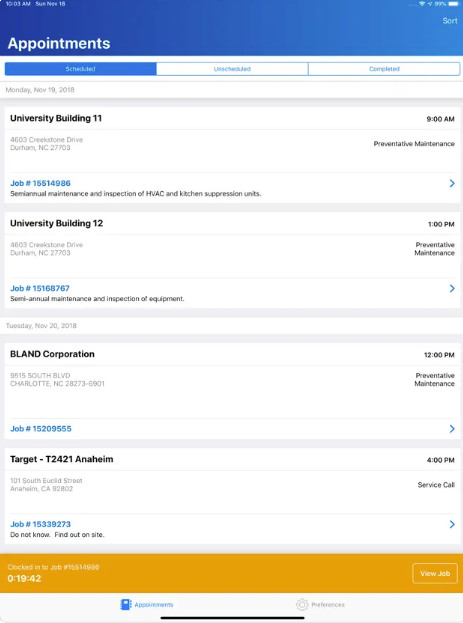
Most field-service descriptions begin with scheduling and dispatch. ServiceTrade does those jobs, but its distinction is the material on either side. SalesManager turns equipment lists into preventive-maintenance proposals with standardized pricing. The core platform converts accepted work into contracts, appointments and technician assignments. The mobile app carries service history and captures photos, notes, signatures and deficiencies. Inspections produces compliance-ready reports. PartsManager follows inventory and purchase orders back to job cost. Invoicing and a customer portal finish the loop.
The commercial-specialist claim becomes concrete around inspections. A generic form builder can record a failed sprinkler valve. A useful fire-service system also understands the relevant form, preserves an audit trail, turns the finding into a deficiency, builds a repair quote and shows the building owner what changed. ServiceTrade acquired specific Asurio assets in 2022 to deepen that inspection and NFPA expertise; the acquired software had been used across more than five million facility inspections.
The company bought NorthBoundary in 2022 to connect asset-based selling with mechanical service delivery. In 2026 it acquired Mura, adding AI automation for invoices, collections and purchase orders. The acquisitions follow one customer journey rather than a random software shopping spree: inspect, sell, serve, bill, collect.
04 / The AI wagerSpecific beats chatty
ServiceTrade's AI argument is not that contractors need another blank chat box. Its Stella agents sit inside existing workflows. Stella Quote assembles deficiency-quote drafts from asset details, parts, labor and scope language. Stella Schedule weighs skills, availability, travel, service deadlines and workload. Mura's capabilities became Stella Invoice and Stella Collect. Other assistants prepare technicians by summarizing scattered job and asset history.
The proposed moat is Trade Intelligence, a data layer shaped by 14 years of commercial-service history and 48 million managed assets. That does not automatically make every recommendation correct. It does make the premise more credible than sprinkling a general language model over a dispatch screen. A fire-protection quote has vocabulary, pricing rules and compliance context that the open internet rarely packages neatly.
Those figures come from ServiceTrade's aggregate 2025 platform data, not audited company revenue, so they should be read as customer activity. The more useful operational signals are equally practical: the company reported 15 percent more weekly work orders, 25 percent higher margins on planned work and 27 percent fewer emergency calls among relevant customer cohorts. One 2026 case study says Toronto contractor Adaptive Climates found $200,000 in previously unbilled work within four months, doubled technician productivity and cut invoice lag from months to the same week. Vendor case studies are selected success stories, but the failure mode they expose is real: work can be completed and still vanish between operations and accounting.
05 / What to stealCopy the method, not the dashboard
The transferable lesson is not “build HVAC software.” It is to find a costly chain of handoffs and own the context between them. ServiceTrade started from operating software, stayed with customers who shared a data model, let sophisticated users finance the awkward middle years and expanded into adjacent products only when the same buyer already felt the pain.
- 01Begin inside the workflow. Observation beats a persona assembled from six sales calls.
- 02Name the customer narrowly. Commercial-only created constraints that shaped better inspection, asset and contract workflows.
- 03Turn users into design partners. Customer investors supplied money, references and pressure to solve valuable problems.
- 04Expand along the same ledger. Each product follows revenue from proposal through collection.
- 05Put AI where delay has a price. A faster quote or invoice is easier to value than a clever paragraph.
06 / The boundaryWhen this playbook does not work
A narrow platform is not a universal recommendation. A six-person residential shop may prefer Jobber, Housecall Pro or a lighter service tool. Larger contractors will also compare ServiceTitan, BuildOps, Simpro and Salesforce Field Service. ServiceTrade earns its complexity when the customer manages recurring commercial agreements, regulated inspections, many technicians, many assets and expensive coordination between field and office.
Implementation is the other condition. A platform cannot rescue undocumented processes by importing them. Asset records must be cleaned, accounting ownership decided, milestones documented and technicians trained. AI assistants inherit the quality of the operational context beneath them. If leaders will not standardize pricing, close jobs consistently or decide which system owns a field, the software becomes an expensive mirror.
That is what makes ServiceTrade interesting. It is not a story about sprinkling technology on “the trades.” It is about respecting the peculiar mechanics of one market long enough for the peculiarities to compound. The company began with a contractor's internal fix, endured the period when the niche looked too small to outsiders, and now sells a connected operating layer from proposal to payment. The fire extinguisher still has to be inspected. ServiceTrade's wager is that every step after the tag can become data - and every useful piece of data can keep the next baton off the floor.