Finster AI is for the finance team whose real bottleneck lies between finding an answer and keeping it connected to the filing, spreadsheet cell, broker note and internal precedent that made it defensible. The London-born enterprise platform gathers those ingredients, lets analysts question them, and sends the result toward familiar deliverables such as a company profile, an investment memo, a model or a deck. If your working day ends with a PowerPoint open beside six data tabs, this is aimed squarely at you.
That makes the product relevant to investment banks, asset managers, private-credit teams and institutional research groups. It makes far less sense for retail investors, solo stock pickers or anyone shopping for a cheap market-data subscription. There is no self-serve plan or public monthly fee. Finster sells through demos and negotiated order forms, and its terms say subscriptions are generally paid annually in advance. This is software that expects procurement, security diligence and a rollout plan to join the meeting.
Why it exists: the costly last mile
Finance has plenty of information. The awkward part is turning it into something a colleague or client can use without losing the lineage. Public filings sit in one place, private-market data in another, research notes somewhere else, and years of firm knowledge hide in old decks and shared drives. A general-purpose assistant may write a fluent summary, but fluency does not tell a managing director which source supplied a number or whether the junior analyst used the current house template.
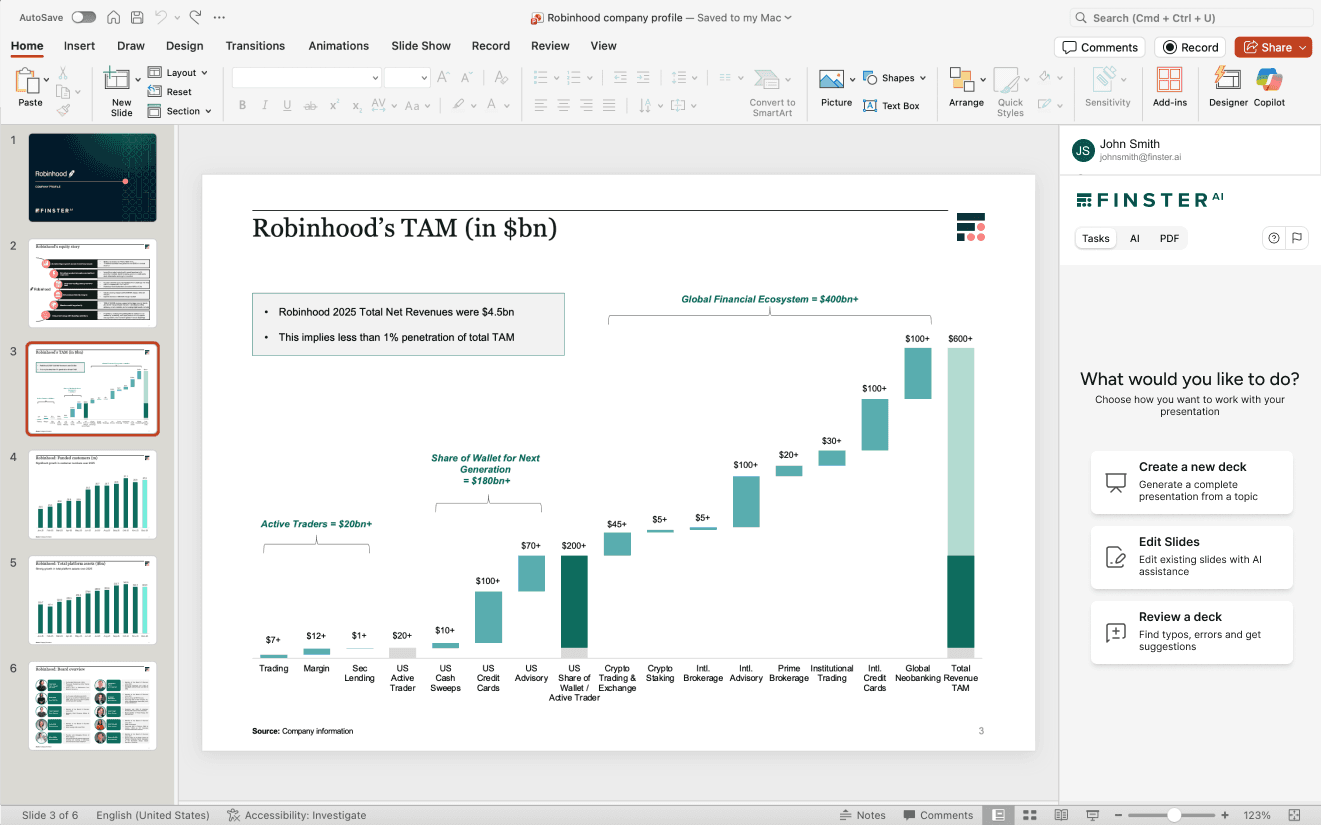
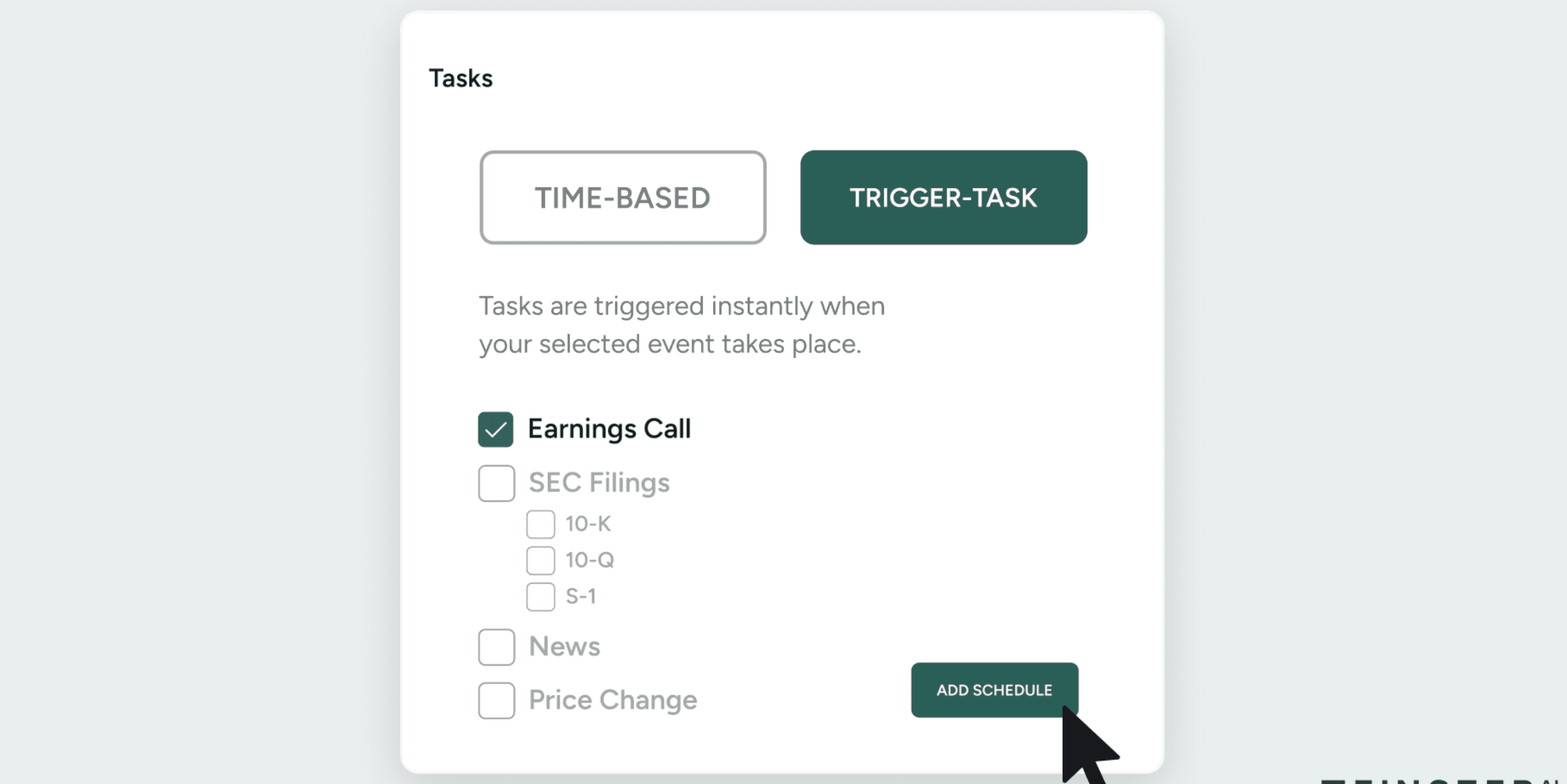
Finster's answer is a workflow layer built around financial context. Its Explorer handles open-ended, analyst-style questions across documents, structured data and uploaded filings. The Dashboard gives a continuing view of covered companies and what changed. Tasks can be scheduled or tied to triggers, so a filing, rating change, price move or M&A announcement can start a sequence before somebody remembers to ask. Interactive Outputs generate charts, summaries and other views around the current question. PowerPoint automation turns the underlying research into the artifact everyone was going to build anyway.
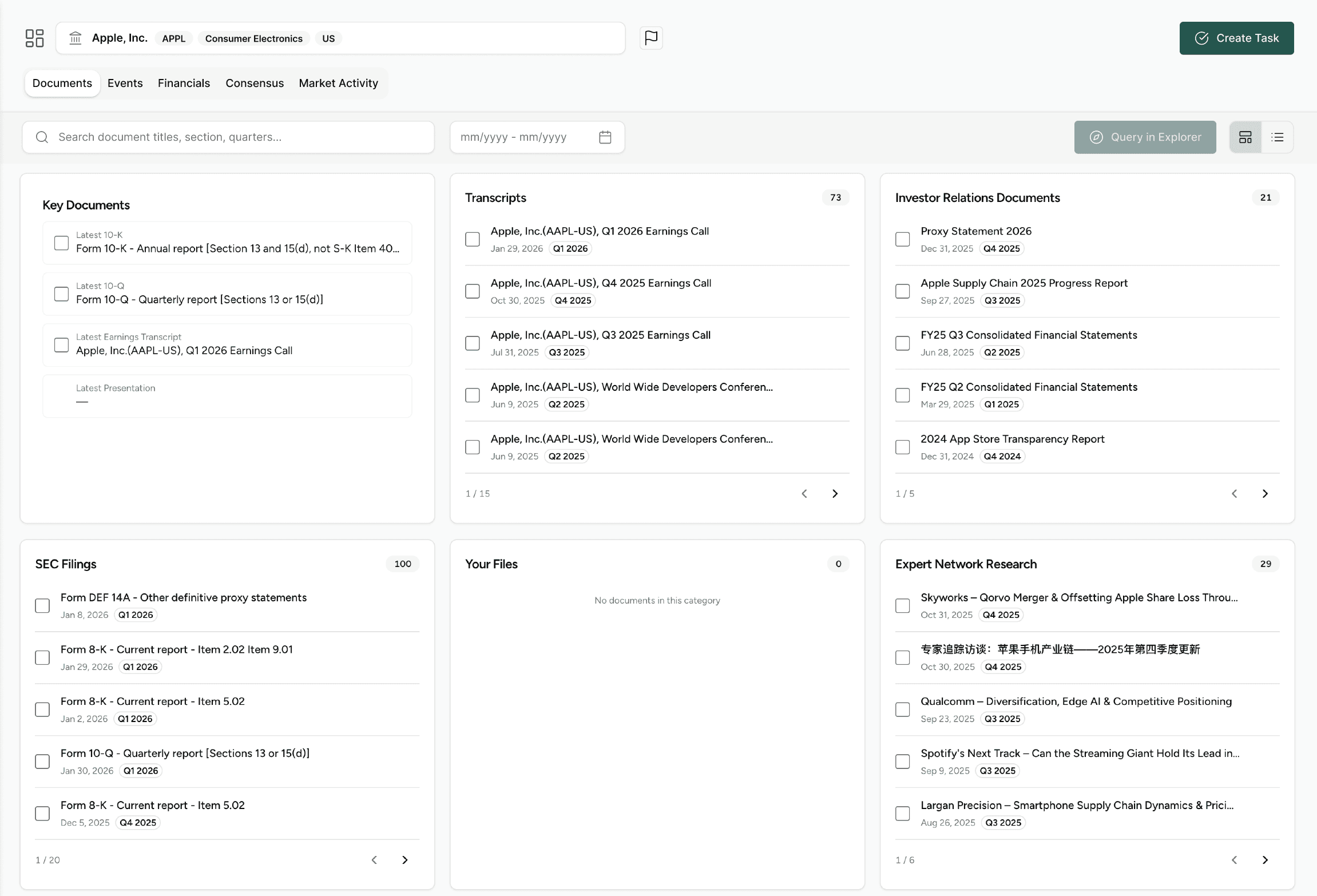
One plausible morning on the platform
The feature that matters is the receipt
The phrase “AI for finance” can cover everything from a filing search box to an autonomous modeling system. Finster's clearest distinction is provenance. The company says a generated fact can link to the exact sentence or spreadsheet cell behind it, and its task agents expose their plan and steps. A source trail cannot guarantee a correct output, but it turns checking into a defined action rather than a scavenger hunt.
This is also why the integrations matter more than a leaderboard score for any single language model. Finster does not market one named “latest model.” It describes multi-model orchestration, no model lock-in and support for customers bringing their own LLM in private deployments. The useful question is therefore not whether it runs Model A or Model B this quarter. Ask whether the system can route the job, respect each user's permissions, preserve citations and deliver a result in the software where the team already works.
“What are the six that I really need to know today?”Sid Jayakumar, describing personalized financial intelligence on Bloomberg Daybreak Europe
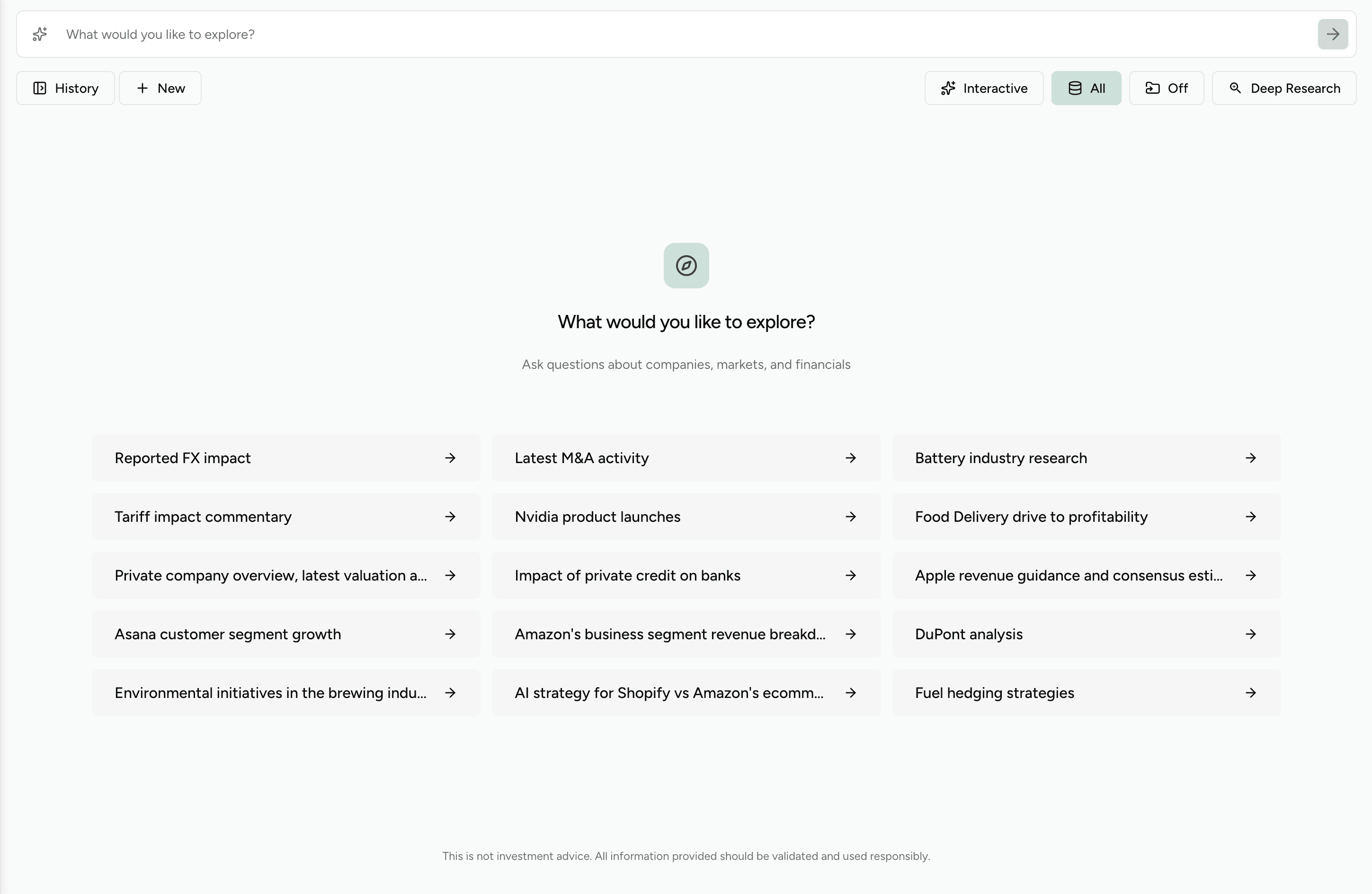
From DeepMind to the deal room
Founder Siddhant “Sid” Jayakumar came to the problem by an unusual route. After studying computer science at Cambridge, he joined DeepMind in 2016 as its first undergraduate intern and remained for seven years, working largely on language models. He founded Finster in 2023. The early team deliberately mixed AI and finance experience: Jishnu Mukhoti brought research work from Meta AI and a doctorate focused on safely scaling AI systems; Seán Kilgarriff had led LLM work within J.P. Morgan's corporate and investment bank.
The executive bench later added Morgan Stanley research COO Chris Andrews and former Revolut wealth and trading leader Veeral Manek. That résumé parade matters only if it appears in the product, and here it shows up in the obsession with permissions, auditability, house style and deliverables. The software does not ask a bank to abandon Excel and PowerPoint for a futuristic cockpit. It tries to bring the intelligence into those old, unavoidable rooms.
Outside validation has arrived mostly through partners and investors rather than a broad review-site audience. Finster announced $15 million in combined Seed and Series A financing in October 2025. FactSet launched FactSet AI for Banking in alpha in March 2026, built in collaboration with Finster, with wider rollout planned through the year. UBS Investment Bank joined Finster's Series B in August, alongside FactSet. Later that month, Finster expanded its PitchBook integration to the Premium Connector for eligible PitchBook customers.
Those relationships are meaningful because premium data rights are a stubborn part of enterprise AI. The PitchBook connection can bring company, deal, investor, fund, valuation and research data into the same governed workflow as filings and internal material. FactSet's product adds its signals, real-time spreadsheet formulas and broker research. But a partnership is not a customer review. Public, independent comments from day-to-day Finster users remain scarce, and the company does not publish customer counts. Buyers should read named partnerships as evidence of integration and institutional interest, not as a substitute for their own proof of concept.
What you can actually make
For bankers, the attractive loop runs from research to deliverable. A team can pull a company primer, build a set of comparable transactions, draft a confidential information memorandum or update a market map. Triggered agents can watch a sector and send sourced analysis when conditions change. A deck can inherit the firm's narrative structure, tables, charts and visual rules. Through the FactSet collaboration, live FDS formulas can keep model cells connected to changing data rather than frozen at copy-and-paste time.
For asset managers and private-credit teams, the same machinery shifts toward monitoring, thesis testing and committee work. Explorer can cross-reference a filing with uploaded material; the Dashboard can act as a living coverage view; a task can watch for developments that alter a thesis. None of this removes judgment. It moves more of the fetching, reconciling and first-draft assembly ahead of the moment when judgment is needed.
The competitive set
| Product | Center of gravity | Put it on the shortlist when... |
|---|---|---|
| Finster AI | Finance-specific agents, cited research, monitoring and artifacts inside firm workflows | You need external and internal data joined to repeatable banking or investment workflows. |
| Rogo | Agentic workflows and finance-formatted banking deliverables | Your evaluation is led by investment-banking output and workflow automation. |
| Hebbia | Large-scale document analysis and diligence | Data rooms and evidence-heavy document synthesis dominate the job. |
| AlphaSense | Broad market intelligence, premium content, search and expert material | External content breadth and established research discovery come first. |
| Fiscal.ai | Public-company financial data and investor research | You need a more accessible public-markets research tool rather than an institution-wide deployment. |
This table is a map, not a winner's podium. The products overlap, their feature lines move quickly, and some customers will keep an incumbent data terminal while adding an AI workflow layer. Run the comparison around your ugliest recurring job. A polished demo built on a famous company tells you less than a week of contradictory sources, stale templates, awkward permissions and last-minute comments.
The buyer's due-diligence list
Finster advertises SOC 2 Type II compliance, Zero Trust principles, SAML single sign-on, SCIM provisioning, multi-factor authentication, role-based controls, audit logging and regular third-party penetration tests. It offers single-tenant environments and containerized virtual private cloud deployments in US and European regions. The company also says customer data is never used to train its AI. These are useful starting points, not the end of a security review.
- Measure citation precision on tables, footnotes and conflicting documents.
- Map source entitlements to real users, teams and confidential deal groups.
- Test a messy PowerPoint template and the model nobody wants to touch.
- Record correction time, not merely the time to generate a first draft.
- Ask which models handle each task and where their data is processed.
- Price the licenses, data rights, implementation and ongoing governance together.
Also ask what happens when sources disagree, when a provider changes its schema, and when an employee loses permission halfway through a scheduled workflow. Request export and deletion procedures. Inspect the audit trail yourself. For each promised integration, identify whether the license is included, separately required or available only through a partner product. PitchBook's Premium Connector, for example, is limited to eligible PitchBook clients and remains subject to their entitlements.
The verdict
Finster AI is a credible shortlist product for institutional teams trying to connect research, internal knowledge and finished work without giving up auditability. Its central idea is practical: the AI should remember the firm's context, watch what changes and show its receipts. The tradeoffs are equally plain. Pricing is opaque, deployment will demand internal ownership, and independent user commentary is thin. Buy only after a realistic pilot proves that citation quality and correction time hold up on your material.
There is a nicely human premise beneath the machinery. Jayakumar argues that finance technology should clear away repetitive work so people can spend more time on relationships, theses and meaningful judgments. That outcome will depend less on a dramatic chat response than on hundreds of small handoffs working correctly. The filing arrives. The right people see it. The relevant precedent is found. The number lands in the right cell. The slide looks like it belongs there. Nobody has to ask where it came from.