Consider the engagement letter. Before a lawyer can send one, somebody must gather the matter details, find a suitable precedent and decide which earlier fee arrangement provides a sensible comparison. Newcode.ai illustrates this small scavenger hunt with a proposed workflow: take the matter information from Outlook, consult historical letters in SharePoint, produce a draft. The interesting part is the journey between those systems. An answer can sound convincing while having missed the document that makes it useful.
- Connect firm knowledge to research, drafting and repeatable workflows.
- Build custom agents in Aurora; use them through familiar working environments.
- Keep deployment choices, permissions and human review in the design.
That journey is Newcode’s chosen territory. Founded by Maged Helmy in 2021 and headquartered in Oslo, the company describes its platform as a configurable AI harness. The term is rather mechanical for a business dealing in words, but it fits: a harness connects power to something that needs moving. Here, the load is a firm’s accumulated knowledge, scattered among documents, applications and people.
The answer is somewhere in the building
A firm may possess an excellent precedent and still struggle to put it in front of the right lawyer. Newcode’s product overview names email sprawl, lost context and fragmented workflows among the problems it targets. Its proposition is to bring sources, models and matter context together. What the lawyer receives should reflect the firm’s materials and practices, with a route back to the relevant passage.
Customers include law firms, corporate legal departments and government agencies. Newcode’s current customer page says it works with more than 100 legal organizations globally and lists DLA Piper, Reed Smith, Robinson+Cole and Wiersholm among its relationships. These are organizational relationships, rather than a count of people actively using the software. The range explains the emphasis on permissions: connecting knowledge is valuable only when access follows the rules.
The software brings a colleague
In June 2025, DLA Piper announced a partnership covering its offices in Sweden, Norway and Finland. One detail makes the arrangement unusually instructive. A Newcode team member would work alongside the firm’s legal professionals, designing workflows around their actual tasks. Workshops had already begun. The project treated implementation as collaborative work, with someone close enough to ask why a process looked the way it did.
“This partnership is about building capability, not just capacity.”
Magnus Oskarsson · DLA Piper Sweden
DLA Piper’s Finnish managing partner said the firm had evaluated several AI tools and sought a broader partnership. That explains the choice without inventing a failed pilot or a conversion on the road to Oslo. The observable decision was to combine software, technical help and changes to working practice. Buying access would be the easy part; deciding what to build would require the lawyers.

Three doors into the same knowledge
Nova is the workspace for asking questions and doing legal work. Its tools include research, transcription, reusable knowledge bases and semantic searches across document repositories. Matrix review organizes document sets into a comparative view. In the company’s lease-portfolio illustration, agreements occupy rows while fields such as parties, effective dates and terms occupy columns. A lawyer can inspect differences instead of beginning every comparison with a blank page.
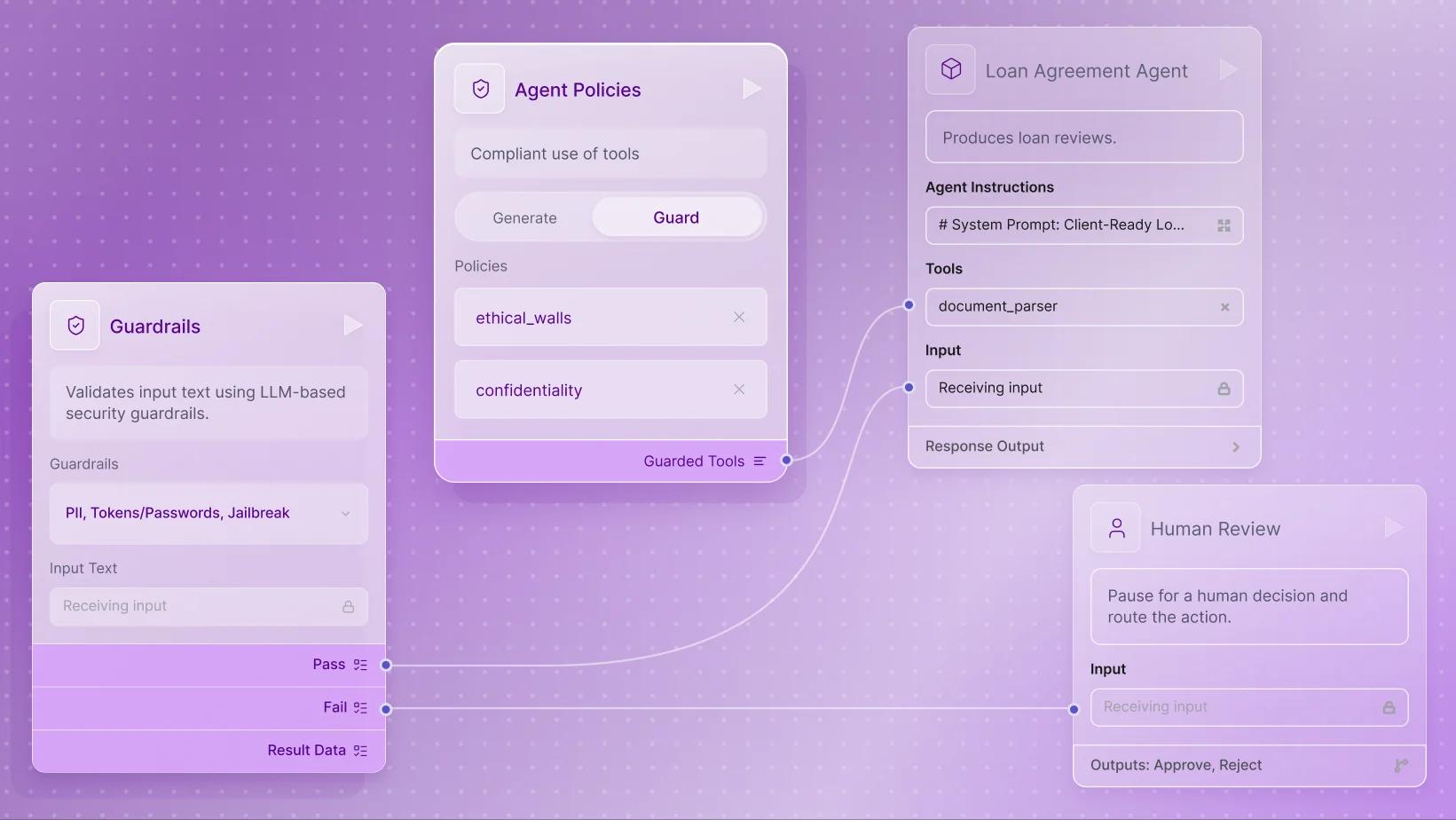
Aurora is where teams construct the process itself. Its visual builder combines language models, agents and deterministic steps. A workflow can carry firm policies, guardrails and an explicit human review stage, then be published for use through Nova or an API. The practical attraction is repeatability: the instructions and decision points can survive beyond the person who first assembled them.
documents
agent
review
deliverable
The Word add-in brings those capabilities to the drafting desk. Lawyers can apply playbooks, inspect redlines, populate documents from earlier material and anonymize information for reuse. One published example turns a term sheet into material for a loan agreement. This is an enterprise software proposition with implementation and education around it. Its interfaces meet professionals where much of their work already happens.
The bill behind the answer
The competitive neighborhood includes Harvey and Legora, both selected by law firms in the same period. Newcode argues for firm-controlled infrastructure, configurable workflows and flexibility over models and deployment. These are its stated priorities; a purchase decision still needs a task-specific comparison. In his August 2026 interview with Artificial Lawyer, Helmy located the company at the intelligence layer linking a firm’s agents, workflows and knowledge.
He also discussed an unglamorous constraint: token costs. Complex, high-volume workflows make repeated model calls, which can raise spending. Helmy described model routing, cost controls and reusing structured knowledge as ways Newcode addresses that problem. The useful lesson for a buyer is to assess the cost of the completed process, including review. A cheap individual answer says little about the economics of hundreds of documents.
Newcode’s August Series A brought reported 2026 funding to $20 million. OnDean Forward led the round, with The LegalTech Fund, Antiportfolio Ventures and Relativity’s Rel Labs participating. The company said the money would support US expansion, product development and customer support. It also reported that annual recurring revenue had more than tripled over twelve months. That growth claim describes momentum without supplying the underlying revenue figure.
A classroom, then a clause
September supplied two concrete additions. Newcode announced a six-week Irish enablement programme involving 475 legal professionals across 30 firms, progressing from AI literacy to practice-specific skills and leadership governance. Later that month, an American Arbitration Association alliance brought established arbitration and mediation clause language into its drafting workflows. Both moves make the same practical argument: useful AI needs knowledgeable users and appropriate materials within reach.
For another firm, the copyable move is modest. Choose one recurring task, identify the approved documents, write down the house rules and name the reviewer. Then test the whole journey. My reading of Newcode’s approach is that it asks for process owners and time to configure the work; a team seeking an occasional summary may need less machinery. Its promise becomes interesting when a firm wants yesterday’s knowledge to improve tomorrow’s deliverable.