The Scene Today
A help desk at 2 a.m., and the answer is finally right
Somewhere right now, a customer-service agent at a meal-kit company types a question into a chat window. The answer comes back in under a second - accurate, current, sourced from the one document out of forty thousand that actually applies. The agent never sees the machinery. That machinery is Shelf.
Shelf sells trust in your own data. It is an AI-driven knowledge and data-quality platform that sits between an enterprise's sprawling pile of documents and the generative AI tools everyone suddenly wants to deploy. The pitch is refreshingly modest for an AI company: it does not promise to think for you. It promises that when your AI thinks, it is working from clean material.
That distinction matters more than it sounds. In 2026, every company has an AI strategy. Far fewer have data worth pointing it at.
“Shelf brings answer automation to world-class enterprises and is rated #1 in Knowledge Management.”
- Company description, shelf.io
The Problem They Saw
Content rot is real, and it is everywhere
Walk into any large enterprise and you will find knowledge scattered like socks after a long trip: a policy in SharePoint, a contradicting policy in a 2019 PDF, a third version in someone's inbox, and a Slack thread insisting all three are wrong. HelloFresh, before Shelf, was juggling answers across twelve disconnected knowledge bases. Twelve. That is not a knowledge base; that is a scavenger hunt.
For years this was merely annoying. Then generative AI arrived and turned annoyance into liability. Feed a large language model your contradictory, duplicated, out-of-date content and it will confidently hand the mess back to a customer, beautifully phrased and completely wrong. The industry has a tidy euphemism for this - “hallucination” - which makes it sound charming rather than expensive.
“The platform employs 23 proprietary diagnostics to analyze content section by section, identifying duplications, contradictions, and out-of-date information.”
- Shelf platform overview
Shelf's founders had seen the rot up close. Before they wrote a line of product code, they were knowledge-management consultants - the people organizations call when nobody can find anything. They had advised institutions as varied as The World Bank and Harvard Business School. The lesson stuck: the problem was never a shortage of information. It was a shortage of information you could trust.
The trade has a name for the slow decay - content rot - and it behaves like rot. Nobody decides to let a knowledge base go stale; it just happens, one un-updated policy and one forgotten folder at a time, until the average answer is older than the intern reading it. The cost stays invisible until the day an AI surfaces the wrong version to a customer at scale. Shelf's wager was that someone would eventually have to measure the rot before they could fix it. So they built the instrument that measures it.
The Founders' Bet
Three consultants who got tired of bad answers
In 2017, Sedarius Tekara Perrotta, Colin Kennedy, and Tobias Jaeckel made a bet that sounds obvious now and sounded niche then: that the boring layer beneath AI - the data hygiene, the governance, the deduplication - would turn out to be the part that decided whether AI worked at all.
Their backgrounds read like a deliberately balanced team. Perrotta, the CEO, is a Georgetown graduate, a former US Peace Corps volunteer, and a recognized voice on knowledge management who has written for Fast Company and Forbes. Kennedy arrived as a two-time software entrepreneur. Jaeckel brought more than a decade running engineering teams, including time at Accenture. Consultant, builder, operator. It is a tidy division of labor, which is rarer in startups than anyone admits.
“Before starting Shelf, the founders worked as knowledge-management consultants - helping companies identify, organize, and disseminate information across their organizations.”
- Hartford Business Journal
The bet was unfashionable for a reason. “We clean your data” does not light up a pitch deck the way “we built a brain” does. But Shelf was untangling enterprise knowledge years before ChatGPT made hallucinations a topic at dinner parties. By the time the rest of the market discovered that AI is only as smart as its inputs, Shelf had a head start measured in years.
■ THE SHELF FILE: A TIMELINE
- 2017Perrotta, Kennedy & Jaeckel found Shelf, turning years of knowledge-management consulting into software.
- 2020Early growth rounds bring in Base10 Partners, Connecticut Innovations & Contour Venture Partners.
- 2021 · Aug$52.5M Series B led by Tiger Global & Insight Partners - total funding reaches $60.7M.
- 2021Ranked #1 in Knowledge Management by Gartner Digital Markets.
- 2024Reported ~$32.5M revenue and roughly 8,000 customers; pivots hard toward GenAI data quality & RAG.
- 2025Named a Gartner Cool Vendor and an IDC Innovator for Data Intelligence Platform Software.
The Product
What it actually does, minus the buzzwords
Strip away the category labels and Shelf does three things. It ingests unstructured data from wherever it lives - file shares, SharePoint, semi-structured databases - and builds a single representation of it. It runs that content through 23 diagnostics that hunt for duplicates, contradictions, similarities, and material that has quietly expired. And it enriches what survives, adding context and business meaning so that a large language model retrieving it actually understands what it found.
That last layer is the clever part. Shelf's semantic layer behaves like a context engine, mapping relationships between data entities into a graph. The model stops seeing a flat wall of text and starts seeing how things connect - which is, roughly, the difference between a librarian and a paper shredder.
The architecture is deliberately indifferent to where your data sleeps. Shelf ingests from any source and prioritizes what matters, so it enriches only the content a given use case actually needs rather than boiling the whole ocean. The result lands inside the tools people already live in - the answer arrives in the chat window, the agent console, the workflow - instead of asking anyone to learn yet another portal. It is a quiet philosophy for an AI company: the best knowledge tool is the one nobody notices using.
DIAGNOSEContent Intelligence
23 proprietary diagnostics scan content section by section to surface duplicates, contradictions, and out-of-date answers.
GROUNDRAG Solution
Cleans and enriches unstructured data with 20+ enrichment capabilities so retrieval-augmented answers stay accurate.
ORGANIZEKnowledge Management
A centralized, AI-powered knowledge base that lets agents find vetted answers inside the tools they already use.
CONNECTSemantic Layer
A context engine that graphs relationships between data entities to give LLMs richer comprehension.
Four products, one stubborn idea: fix the data first, brag about the AI later.
“Shelf doesn't generate answers. It makes sure the right answer exists in the first place.”
- The Shelf thesis, paraphrased
The Proof
Tractors, meal kits, and a churn number nobody believes
A thesis is easy. Customers are not. Shelf's roster reads like an unlikely dinner party: John Deere talking to HelloFresh, DSW comparing notes with Glovo, Equitable/AXA and Gerber somewhere near the punch bowl. What they share is scale and a content problem big enough to threaten their AI ambitions.
John DeereHelloFreshDSWGlovoEquitable / AXAGerberDiageo
Then there is the number that makes investors squint: zero reported customer churn across three consecutive years. In enterprise software, where switching costs are high but patience is low, near-zero churn is either a sign of a deeply embedded product or a typo. Shelf reports it as the former.
Numbers as reported across public sources. Treat the precise decimals as enthusiastic rather than audited.
FUNDING, ROUND BY ROUND
Approximate capital raised · USD millions · cumulative total $60.7M
The Series B did the heavy lifting. The earlier rounds were the warm-up nobody photographs.
Backing the story is a cap table with taste. Tiger Global and Insight Partners co-led the Series B, with Base10, Connecticut Innovations, and Contour Venture Partners returning. The angel list is its own endorsement: Austin McChord, who built Datto, and Tooey Courtemanche, who built Procore - founders who know what an embedded enterprise product looks like from the inside.
“Shelf has experienced rapid growth - reported zero customer churn over three years and strong year-over-year expansion.”
- Series B coverage, 2021
The Mission
Make the machine tell the truth
Ask Shelf what it is really selling and the answer is not software. It is the precondition for trusting AI at all. The recognition has started to follow the thesis: a Gartner Cool Vendor nod in 2025, an IDC Innovator listing the same year for data intelligence platforms. Analysts, who are paid to be skeptical, have started agreeing that the boring layer was the important one.
The mission scales as awkwardly as the problem does. Every new model, every new agent, every new “let's just point it at our docs” experiment raises the cost of bad data. Shelf is betting that the more powerful AI becomes, the more it will need a chaperone for its inputs.
“The problem was never a shortage of information. It was a shortage of information you could trust.”
- The founders' founding insight
Why It Matters Tomorrow
The agentic future runs on clean fuel
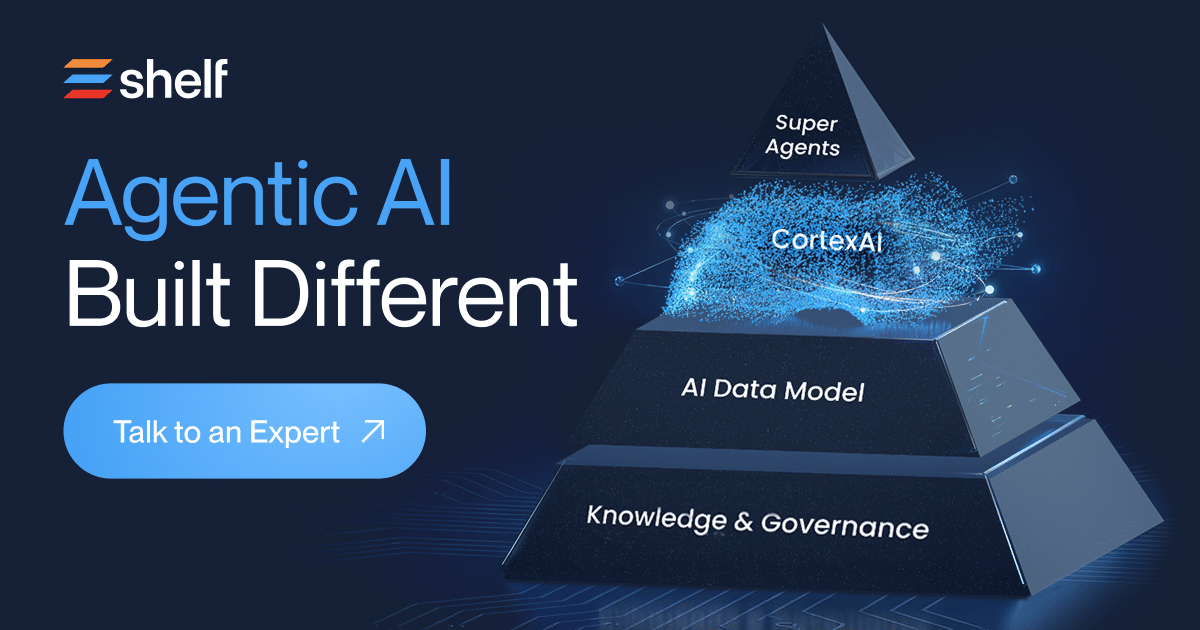
The next wave of enterprise AI is agentic - software that does not just answer but acts, chaining decisions together without a human checking each step. An agent that books the refund, files the ticket, updates the record. The upside is enormous. So is the blast radius when the underlying data is wrong, because now the mistake is not a bad sentence; it is a bad action, executed at speed.
This is the world Shelf has been quietly preparing for since 2017. If agents are going to act on enterprise knowledge, that knowledge has to be clean, current, and governed before they touch it. The unglamorous layer becomes the load-bearing one.
Back to that help desk at 2 a.m. The agent gets the right answer, the customer gets off the line satisfied, and nobody thinks about the forty thousand documents that did not get surfaced. That invisibility is the whole product. Shelf's ambition is to make good answers feel inevitable - and to make the mess they came from somebody else's problem, permanently.