The AI copilot that finally learned to read a blueprint - and remembers everything your best engineer forgot to write down.
The TwinKnowledge platform in the wild - where CAD files, RFIs and decades of project archives stop being dead PDFs and start answering questions. Midtown Manhattan, 575 Lexington Ave.
Picture the moment: a project engineer opens a 400-page submittal at 6pm. The spec calls for one thing, the drawing shows another, and the contract - signed months ago by people who have since moved on - quietly disagrees with both. Nobody notices. Not yet. The disagreement will surface in eight weeks as a Request for Information, then as a change order, then as the reason the project is late. Multiply by a thousand jobsites and you get an industry that loses an estimated $177.5 billion a year to knowledge that never made it out of someone's head.
This is the world TwinKnowledge walked into. Not with a bigger crane or a shinier dashboard, but with a deceptively simple bet: the answer was already in the building's paperwork - the firm just couldn't read it fast enough. So they taught an AI to do it.
Founded in New York in 2023, TwinKnowledge builds custom AI copilots for the people who design and build the physical world - architects, engineers, contractors, owner-operators. The platform plugs into a firm's own data wherever it lives (Procore, Autodesk Construction Cloud, SharePoint, Revit, Slack, the shared drive nobody has cleaned since 2014) and trains agents that actually understand construction documents. Not generic chatbots. Agents tuned to your projects, your standards, your decades of hard-won judgment.
The genius is in the framing. Most software wants to be another system of record - one more place to type things. TwinKnowledge does the opposite. It sits on top of everything you already have and turns the pile into a colleague. Ask it whether a design meets code. Ask it what the spec says about a curtain wall detail. Ask it how you solved this exact problem on a job three years ago. It answers in seconds, with sources, so you can trust it enough to act.
The company calls the vision a "digital twin" - but not of a building. Of the firm's mind. A living representation of an organization's collective knowledge that updates itself as the work happens, so the expertise stops walking out the door every time a senior engineer retires.
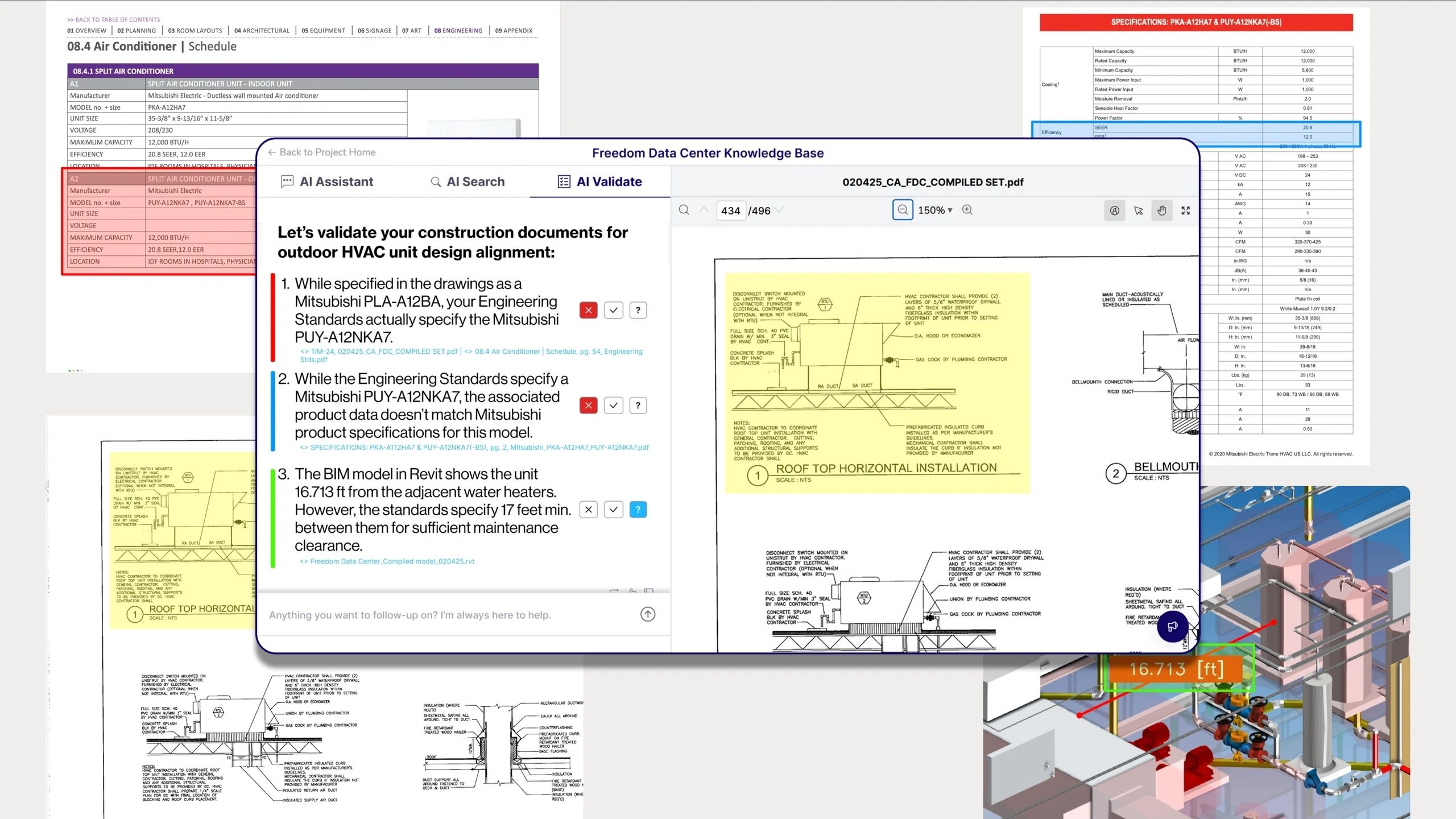
TwinKnowledge isn't a demo that impresses in a boardroom and dies in the field. Each capability maps to a line item that currently bleeds money.
AI assistants index and connect your knowledge base, so a sourced answer is one question away - not a two-hour hunt through folders.
Validates drawings, CAD files and BIM models against codes, standards and project requirements - flagging non-compliant designs early, before they become rework.
Trained on decades of historical projects, it compresses a 6-to-10-day RFI cycle into a same-minute answer.
Analyzes project trends to surface scope misalignment and keep delivery on-time and on-budget.
Every past decision becomes a lesson, so junior staff learn from the firm's whole track record - not just the one partner nearby.
30+ connectors - Procore, Autodesk Construction Cloud, AutoCAD, Revit, SharePoint, Salesforce, BigQuery, Redshift, Slack - securely.
Our technology significantly reduces errors, accelerates project timelines, and raises the bar for accuracy, efficiency, and productivity.
Ivan Panushev isn't a tourist in this industry. He co-founded Horizontal Systems, acquired by Autodesk in 2011 to help lay the foundation for BIM 360 - the tool a whole generation of the industry still runs on. He then led Engineering, Construction & Real Estate partner solutions at Amazon Web Services, and today sits on the U.S. National BIM Program Steering Committee at the National Institute of Building Sciences.
The pattern is hard to miss: the person who helped digitize construction's models is now going after its knowledge. TwinKnowledge is the sequel he's uniquely qualified to write.
Seed-stage, sure - but the customer list reads like an industry who's-who. When your buyers include a branch of the military and the firm behind some of Manhattan's most complex facades, "move fast and break things" is not on the menu.
How the platform bottles institutional knowledge before it retires.
Ivan Panushev's second act, from an Autodesk acquisition through AWS.
Landing government clients in a risk-averse industry.
Inside the computer-vision + LLM pipeline behind the copilots.
Rewiring construction's slowest bottleneck - and what it does to margins.
How 90% of downstream problems trace back to the contract.
The same engineer opens the same 400-page submittal. This time a copilot has already read it - all of it - and flagged the spot where the spec, the drawing and the contract stop agreeing. The answer arrives with sources, in seconds, in language a builder trusts. The RFI never gets written. The change order never gets filed. The project stays on schedule, and thirty years of judgment that used to live in one person's head now lives where the whole firm can reach it.
That's the quiet revolution TwinKnowledge is after. Not replacing the people who build the world - just making sure they never lose what they already know.