● BREAKING8 out of 10 buildings lack accurate as-built plans/ Integrated Projects digitizes 52M+ sq ft/ 7,000+ buildings online via IPX/ $3M seed led by 186 Ventures/ Scan tech on-site in 3-5 days/ Point cloud → LOD300 BIM in under an hour/ 725% YoY building growth in 2022/ ● BREAKING8 out of 10 buildings lack accurate as-built plans/ Integrated Projects digitizes 52M+ sq ft/ 7,000+ buildings online via IPX/ $3M seed led by 186 Ventures/ Scan tech on-site in 3-5 days/ Point cloud → LOD300 BIM in under an hour/ 725% YoY building growth in 2022/
New York, N.Y.  ·  Building Intelligence Desk Est. 2018  ·  Company Profile
Reality Capture  /  Scan-to-BIM  /  Proptech

Teaching Buildings to Describe Themselves

Integrated Projects will send a technician with a laser scanner to your building, and a few days later hand you a model accurate to the inch. The premise is almost aggressively reasonable: before you renovate what a building should be, you have to know what it is.

Integrated Projects IPX product - turn any building into accurate as-built plans
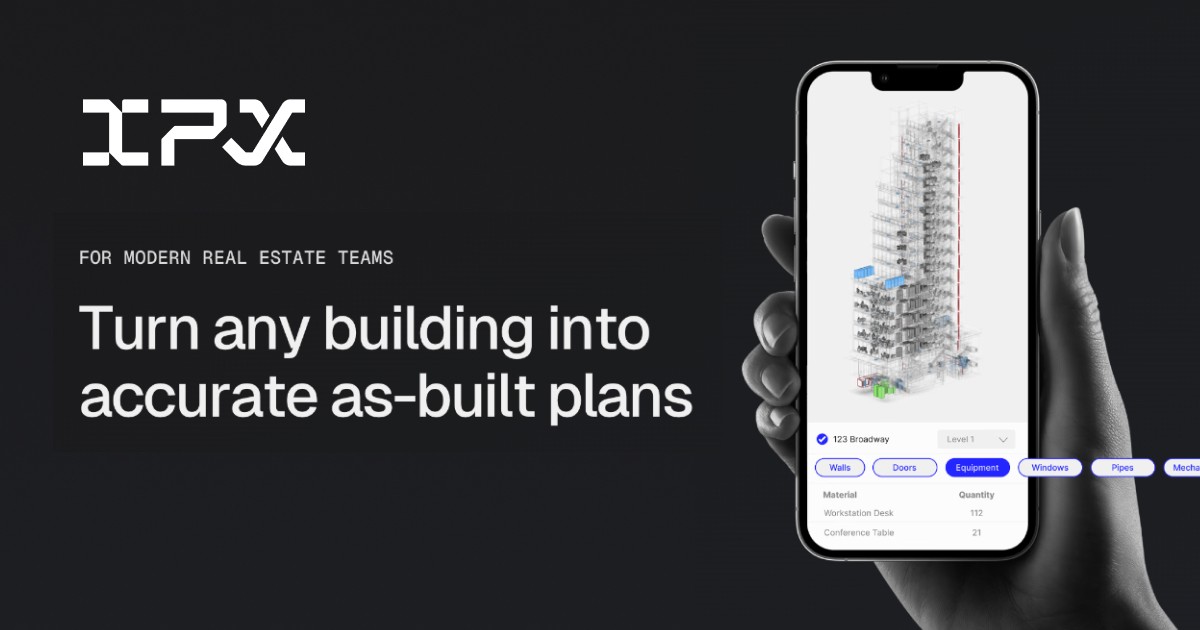
The pitch, on a phone. A tower reduced to queryable data - walls, doors, equipment, a bill of quantities. The hand is doing the thing the whole company is about: holding a building you can search. IPX, the flagship platform, is the browser window into all of it.

The File

  • What: Building-digitization company (scan-to-BIM)
  • Founded: 2018, New York
  • Founder/CEO: Jose Luis Cruz Jr.
  • Flagship: IPX platform (SCANIT + BIMIT)
  • Raised: $3M Seed (May 2023)
  • Team: ~45 people
7,000+
Buildings Digitized
52M+
Square Feet Captured
1,400+
AECO Organizations
97%
On-Time Delivery
The Story

A very expensive way to be surprised by a wall

There is a statistic Integrated Projects likes to cite about its own industry, and it is the kind of statistic that sounds made up until you think about it for a second: eight out of ten buildings do not have accurate as-built plans. The drawing on file, if there is one, describes a building that was intended, not the building that exists. Somewhere between the architect's PDF and the finished structure, a contractor moved a wall, an engineer rerouted a duct, and nobody updated the record.

This is fine, mostly, until someone wants to do something with the building - renovate it, convert it, sell it, comply with a new energy code. Then the gap between the drawing and reality becomes a line item, usually a large and unpleasant one. Renovation budgets rarely blow up on the new work. They blow up on the surprises hidden in the old work.

Integrated Projects, founded in New York in 2018 by Jose Luis Cruz Jr., sells the boring and useful fix. It sends a trained technician with a LiDAR scanner to your property - anywhere in the US, typically within three to five days - and captures a construction-grade 3D scan. Then it converts that scan into standardized BIM and CAD files: the digital, queryable, dimensionally accurate model of what is actually there. You view it in a browser. You measure it, share it, export it.

The clever part is less the laser and more the second step. Turning a point cloud - millions of dots suspended in 3D space - into a usable building model has historically been slow, manual, expert work. Someone traces walls by hand. Integrated Projects points machine learning at the problem, reconstructs the geometry automatically, and keeps humans in the loop for verification. The company says its engine can produce automated floor plans in under an hour.

"Before building owners can proactively design and renovate what should be, we need to first understand what is."

That sentence, from founder Jose Cruz Jr., is the entire company compressed into one line. It is not a mission statement about disruption or the future of anything. It is a claim that the built world is under-documented, that this costs real money, and that the fix is a data-collection problem worth industrializing.

The results, at least by the company's own numbers, suggest the market agrees. Integrated Projects says it has digitized more than 7,000 buildings and over 52 million square feet across North America, Europe and Australia, serving upward of 1,400 AECO organizations - architecture, engineering, construction and operations. In 2022 alone it digitized more than 1,700 buildings, which it framed as 725% year-over-year growth. It reports a 97% on-time delivery rate, which in a services business is arguably the number that matters most.

None of this is glamorous. It is logistics, scanning hardware, machine-learning pipelines, and quality control, aimed at a problem most people never think about because they assume, wrongly, that the plans already exist. That assumption is the whole opportunity.
The Product

One platform, three verbs

IPX - the Integrated Projects Exchange - is the browser where buildings come online. Underneath it are two ways in: send a scanner, or bring your own point cloud.

IPX

The Platform

The building-digitization hub. Order scans, then visualize, query, measure, share and export space documentation - BIM, CAD, or point cloud - from a browser window. One building becomes one searchable profile.

SCANIT

Reality Capture

On-demand LiDAR. A trained scan technician mobilizes to any US property in 3-5 days and produces a construction-grade 3D scan. Pricing starts around $0.20-$0.60 per square foot, scaled to building size.

BIMIT

Scan-to-BIM Engine

Already have a scan? Upload E57/XYZ point clouds (under 10GB) and get standardized LOD200-LOD300 BIM & CAD - automated floor plans in under an hour, with human model verification on top.

In The Field

The two-week skyscraper

To understand why speed is the product and not a feature, consider 25 Water Street in Lower Manhattan - a $500M project that set the record for the largest office-to-residential conversion in the United States, roughly 1,300 apartments carved out of a former office tower. Pavarini McGovern, part of the STO Building Group, needed an accurate existing-conditions model to plan the conversion.

Integrated Projects coordinated multiple scanners at once and delivered an LOD300 existing-conditions BIM in under two weeks. On a project of that scale, the alternative - weeks or months of manual measurement and drafting, with the errors baked in - is not just slower. It is the difference between a schedule that holds and one that doesn't.

The customer list runs through the same logic: institutional landlords, construction managers, architects and operators who own or touch a lot of space and need to know, precisely, what they have. Several of them are also investors, which is either a strong signal or a conflict of interest, depending on how cynical you are feeling. In this case it reads mostly as a signal - the people who own the buildings put money into the company digitizing them.

Speed here is not a feature. On the largest office-to-resi conversion in the US, it was the entire value proposition.
The Money

Funded by its own customers

$3,000,000
Seed · Closed May 11, 2023

Led by 186 Ventures. The round's most telling detail is who else showed up: commercial real estate firms and landlords who are also, conveniently, the customers.

186 Ventures (lead) Founder Collective Connexa Capital Four Acres Ventures The Fallon Company Atlantic Management JLL Newmark

Stated use of funds: scale scanning capacity from roughly 6 buildings a day toward 60. The company was largely self-funded for its first several years before this round.

  • 2018Jose Luis Cruz Jr. founds Integrated Projects in New York, blending 3D scanning, 3D modeling and data science.
  • 20221,700+ buildings digitized across three continents - 725% year-over-year growth.
  • May 2023$3M seed round led by 186 Ventures, with JLL, Newmark and major real estate owners participating.
  • 2024ML scientist Thomas Czerniawski presents scan-to-BIM automation at Geo Week and on the Buildings 2.0 podcast.
  • 2025IPX Hackathon 2025 - building-data and scan-to-BIM automation - brings the community in.

We're on a mission to improve the world's buildings by bringing them online.

— Integrated Projects
Under The Hood

Where this fits in the stack

Integrated Projects sits in a crowded neighborhood - reality-capture and scan-to-BIM includes players like Matterport, OpenSpace and Avvir, plus traditional survey firms and the incumbent Autodesk toolchain. What distinguishes IPX is less any single component than the decision to run the whole loop as a service: capture, convert, verify, deliver, all through one platform, priced per square foot.

The machine-learning side is real and getting more attention. The company employs applied ML scientists - including Thomas Czerniawski, who has spent a decade in computer vision and digital modeling of the built environment - focused on automating the tedious middle of the pipeline. It is a member of NVIDIA's Inception program and works with USD-based 3D formats, aligning with the Omniverse ecosystem for interoperable building data.

If you want the one-sentence version of where proptech is quietly going, it is probably this: skip the flashy visualizations and build the reliable, queryable digital record of every physical building underneath them. That layer is unglamorous, expensive to produce, and genuinely useful. Integrated Projects is building it one scan at a time.

Amusing & True

  • The IPX wordmark stylizes the name as one angular monogram - I, P and X locked together.
  • Its BIMIT engine can turn a raw point cloud into automated floor plans in under an hour.
  • Several seed investors - JLL, Newmark, The Fallon Company - are also paying customers.
  • Founder Jose Cruz Jr. bootstrapped the company from 2018 before taking any outside money.
  • The company's favorite stat is a confession about its own market: 8 of 10 buildings lack accurate plans.
Watch

Scan-to-BIM, automated

Integrated Projects' Thomas Czerniawski on capturing reality with their scan-to-BIM tool - how machine learning is automating the middle of the pipeline.

►  Watch the interview & demo on YouTube   ♫  Buildings 2.0 podcast episode
The Rolodex

Find them here