Before AppFolio became the software behind millions of rent payments, work orders and owner statements, its founders went looking for an industry. Beauty salons got a look. So did auto repair shops, where the keyboards were greasy, the receipts lived in boxes and the operational pain was obvious. Yet mechanics would rather spend $10,000 on a hydraulic lift than buy software. Pain, AppFolio learned, is not a market. Pain plus a budget is.
Property managers had both. They were juggling trust accounting, regulations, rent rolls, maintenance calls, vacancies and other people’s money. A mistake could be more serious than a missed haircut appointment. Klaus Schauser and Jon Walker chose the category in 2006, interviewed residential managers before building, and launched a cloud product into an industry still thick with desktop programs and manual handoffs.
Two decades later, AppFolio is a public company with more than $1 billion in trailing revenue, 22,096 property-management customers at the end of 2025, and 9.6 million units under management by June 2026. The big idea was not to make accounting prettier. It was to put the entire daily loop of a property business in one place - then collect more value each time another resident pays rent, another applicant gets screened, or another workflow moves through the system.
The repair shop said no. The ledger said yes.
AppFolio’s founding method is unusually copyable. The team did not begin with a favored product and search for buyers. It walked through candidate markets, asked how work happened, and looked for a combination of ugly processes and recognized urgency. Auto shops had ugly processes. What they lacked was software willingness. Property managers already understood that better tools could protect client funds, reduce vacancy, speed collections and keep the operation compliant.
That distinction changed the company’s mind. The original ambition was broader: if each vertical software market could only become modestly large, AppFolio would enter several. Investors reportedly laughed at the small-business vertical thesis. AppFolio did build a second branch, MyCase, for legal practices. But the supposed ceiling proved imaginary. In 2020, it sold MyCase for $193 million and concentrated on real estate. What failed was not the product so much as the assumption that one vertical would be too small.
“We interviewed residential property managers before building AppFolio Property Manager to learn exactly what they needed to be successful.”AppFolio’s early product material
The subtraction mattered. Real estate is not one workflow. A property manager markets a vacancy, answers a prospect, screens an applicant, signs a lease, collects money, reconciles a ledger, dispatches a plumber, reports to an owner and communicates with a resident. Each task creates data needed by the next one. A narrow wedge opened into a broad operating system.

One record, several cash registers
Today the product comes in Core, Plus and Max. Core covers property accounting, marketing and leasing, work orders, inspections, communication, standard integrations and two Realm-X tools. Plus adds advanced accounting and analysis, affordable and student housing capabilities, configurable workflow automation and read-only API access. Max brings leasing CRM, broader data access and dedicated customer success for large operators. AppFolio Investment Manager handles fundraising, investor relations, reporting and portals on the asset side.
The business model explains why AppFolio can grow faster than a plain subscription vendor. Customers pay recurring, generally unit-linked software fees, while value-added services generate revenue from activity such as electronic payments, tenant screening and insurance-related risk mitigation. More units mean more subscriptions, but they can also mean more transactions. In 2025, annual revenue reached $951 million. In the second quarter of 2026 alone, revenue was $281 million, up 19 percent, with an 18.8 percent GAAP operating margin.
What does it cost? The honest public answer is: AppFolio wants a conversation first. Its pricing page discloses tiers but not dollar rates. Core requires at least 50 units and a minimum spend; higher tiers carry their own minimums. Add-ons, payments and other services can change the bill. Buyers should budget not only for software but for cleaning data, migrating accounting, training staff and redesigning the awkward processes the old system had quietly fossilized.
The platform is not entirely a walled garden. AppFolio Stack connects outside products and service firms, from package lockers and reputation tools to specialized maintenance software. APIs become more capable as customers move from Core to Plus and Max. That compromise is deliberate: keep the ledger and workflow spine inside AppFolio, while letting an operator preserve tools that genuinely earn their place. It also gives partners distribution into a customer base managing millions of units. The catch is familiar to any platform buyer - an integration logo does not guarantee that data travels in both directions, in real time, or at no extra charge. A serious evaluation should test the exact handoffs the team uses on a bad Monday morning, not the tidy ones in a demo.
The chatbot is the least interesting part
Realm-X, introduced in 2023, is AppFolio’s attempt to turn the operating system into an operator. Its Assistant can retrieve information and help complete tasks. Messages sorts resident communication and drafts replies. Flows standardizes repeatable processes. Specialized “Performers” are moving into leasing, accounting, maintenance and resident operations. An early 2024 survey of 36 users found average savings of 12.5 hours a week - promising, but based on a small company-run sample.
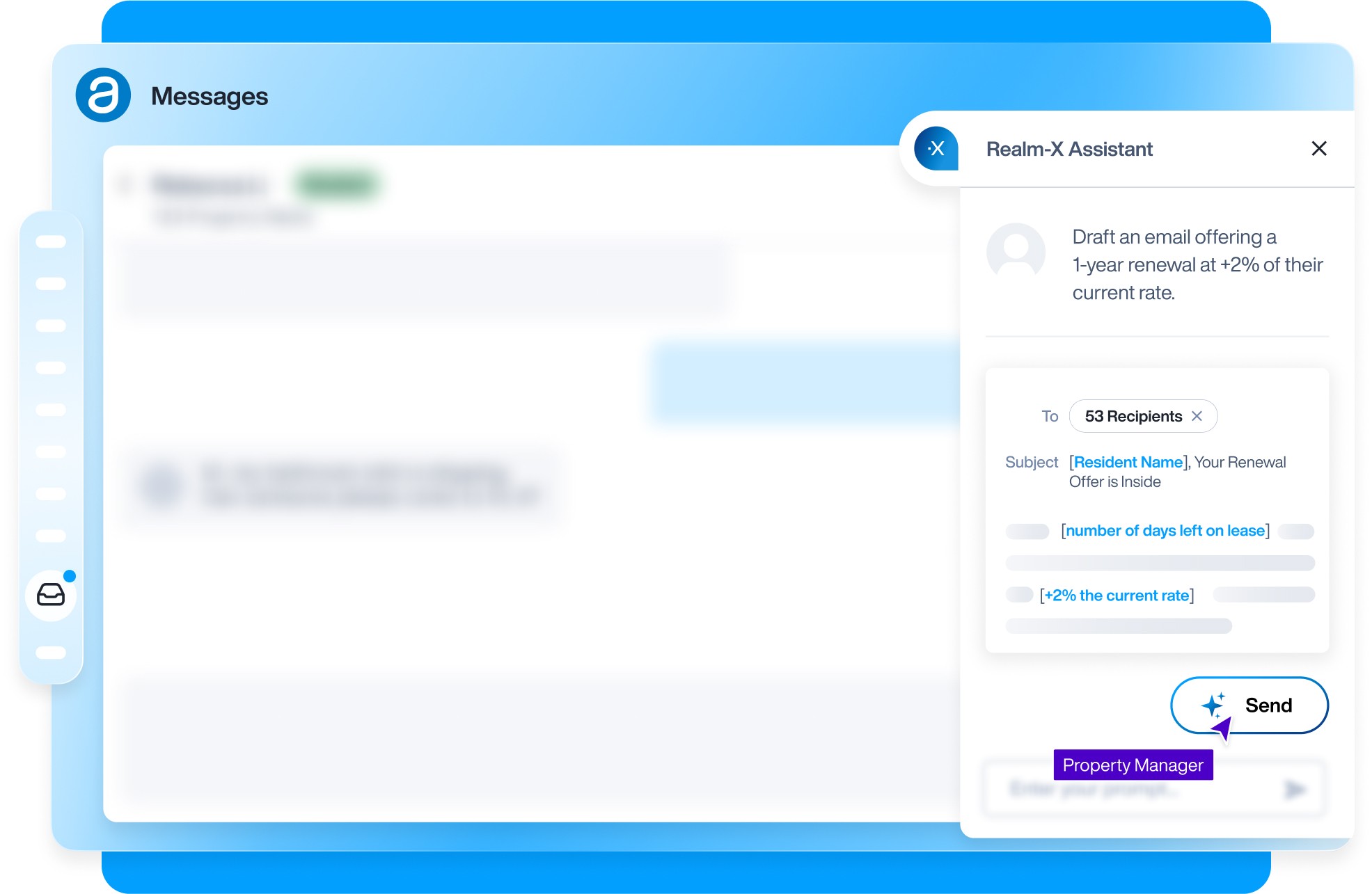
The defensible piece is not conversational polish. General AI can draft a polite renewal email. AppFolio can connect that draft to the correct lease, current rent, resident record, property rule, user permission and accounting workflow. In June 2026, the company announced a connector that lets Claude initiate work executed inside Realm-X, where AppFolio’s controls still apply. It is a neat inversion: the general assistant provides the front door; the vertical system decides what may happen in the building.
That approach also clarifies the risk. A wrong draft is annoying; a wrong payment, ledger entry or compliance action is expensive. Agentic software only earns its verbs when permissions, auditability and human oversight work. AppFolio’s terms explicitly tell users not to rely solely on AI output for important decisions. The company is selling labor-saving automation while acknowledging that the accountable human has not left the property.
Where it wins - and where it should lose
AppFolio sits between light landlord software and older, deeply configurable enterprise suites. Buildium, DoorLoop, Rent Manager and similar products court smaller portfolios and price-sensitive teams. Yardi, RealPage, MRI and Entrata compete for large operators with complex accounting, reporting, revenue management or institutional requirements. AppFolio’s pitch is a modern, unified experience that can scale without becoming a custom software project.
The platform is strongest when a growing U.S. operator wants accounting, leasing, maintenance, resident service, payments and integrations to share one source of truth. PURE HomeRiver offers the current showcase: after using AppFolio since 2020 and upgrading to Plus in 2022, the merged operator committed to consolidate more than 40,000 properties across 35 states on the platform as it aims for 60,000.
It will not work as well under several conditions. A landlord with fewer than 50 units cannot meet Core’s published floor. A buyer who values a cheap, transparent sticker price may dislike quote-based minimums and usage fees. An international operator should note AppFolio’s business is concentrated in the United States. A highly specialized enterprise may prefer the accounting depth or customization of an incumbent. And any company unwilling to standardize its processes can turn a unified platform into an expensive new home for old habits.
- Interview several markets before choosing one. Visible frustration is not enough; test willingness to pay.
- Choose work with consequences. Regulation, money movement and daily repetition make software harder to remove.
- Own the system of record first. Add transactions, integrations and AI only after the trusted data is there.
- Let evidence narrow the strategy. Selling MyCase was not an admission of defeat; it was focus with a $193 million receipt.
The boring-work dividend
AppFolio’s achievement is easy to misread as a story about catching the cloud wave, then the AI wave. The more durable lesson happened before either product trend. Two founders kept looking until they found customers whose work was painful, connected and valuable enough to change. Then the company spent twenty years accumulating the records and relationships that make newer technology useful.
The paper cuts were never small to the people suffering them. A late maintenance response can lose a resident. A confused ledger can lose an owner. A slow reply can lose a lease. AppFolio gathered those moments into one product, attached a business model to the activity flowing through it, and now asks AI to do some of the clicking. The market selection made the rest possible.