In the fall of 2017, roughly 2,000 people in a Southern California development were handed a new way to find a fitness class, reserve an amenity, read an alert, or see what was happening down the street. The app was called RanchLife, after Rancho Mission Viejo. It did not look like a scrappy Montana software company's growth experiment. That was the point. Within 90 days, more than 90 percent of residents were reportedly using it. April LaMon and Michael Swanson had found their business by letting the customer take the credit.
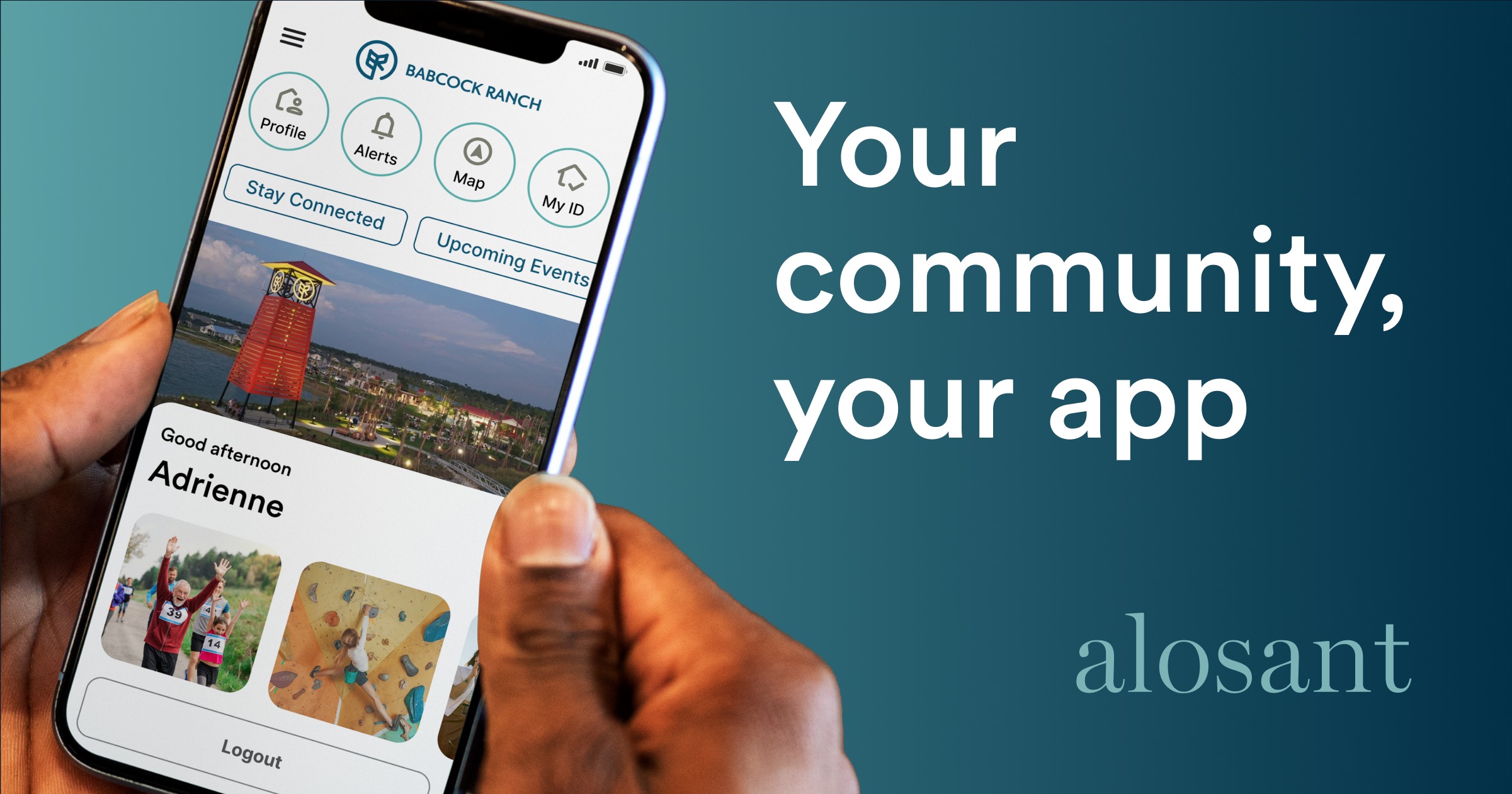
Alosant is now a vertical software company for master-planned communities: those large residential developments with pools, trails, clubhouses, builders, events, lifestyle directors, sales teams, gates, and enough operating complexity to make a group chat sweat. The platform puts that sprawl into a community-branded app, web experience, and on-site kiosk. A home shopper can browse homes and book a tour. A resident can RSVP for yoga, reserve a pavilion, follow a club, receive an alert, or use a phone as an access credential. A community team can change what each user sees without maintaining five disconnected systems.
The company says it now works with more than 100 communities. Its current homepage advertises 140-plus community partners, 500,000-plus active platform users, and 40 million personalized interactions. Those are company-reported figures, but the shape of the business is clear: Alosant sells the digital layer between a place and the people moving through it.
The custom job that escaped the agency trap
Before Alosant, LaMon and Swanson were working on data analytics for real-estate developers. Paul Johnson, then a senior vice president at Rancho Mission Viejo, approached them with a blunt challenge: the development needed to exist where residents already spent their time - on their phones. The founders could have treated it as a lucrative one-off. Instead, they negotiated for the possibility that the underlying product might travel.
Rancho Mission Viejo gave the pair something more valuable than a tidy brief. It opened up the operation. They spoke with developers, builders, marketers, salespeople, lifestyle staff, and property managers. That 360-degree access prevented the classic custom-software error of fixing one department's inconvenience by creating another department's headache. Swanson assembled specialists across iOS, Android, and server infrastructure. Nine months later, the native app launched.
Two choices survived the pilot and became the thesis. First, every app would wear the community's clothes. Residents search for Babcock Ranch, Sunterra, or RanchLife, not Alosant. Second, content would sit in one structured database but appear differently to a prospective buyer, a resident, a guest, or a staff member. The interface could feel local and personal without requiring a separate software stack for every audience.
“I don't think we would have had a chance of the adoption rate” if residents had been downloading the vendor's app.April LaMon, on white-labeling
What failed first: the password
The first failure was wonderfully ordinary. To protect a known resident population, the team invented a complex login with uppercase letters, lowercase letters, and numbers. It was secure in the way a locked pantry is secure when nobody remembers where the key went. Copying the credential on a small screen was awkward, especially for residents who did not live inside password managers.
Alosant had optimized for an edge case and made the common case worse. The team replaced the hostile string with a combination of variables familiar to each user. It also learned that a mobile-only worldview was too narrow and later added a web app powered by the same administrative system. The lesson is less glamorous than an AI feature and more useful: adoption is usually lost at the doorway.
Once inside, people had reasons to return. In a 2022 interview, LaMon said residents typically opened an Alosant-powered app at least weekly and spent roughly two and a half to three and a half minutes per session. That is not doomscrolling. It is closer to a utility visit: book the court, check the calendar, reserve the room, leave. Utility is precisely what keeps an app from becoming decorative landfill.
The six-month hangover after instant traction
A 90 percent pilot makes a clean pitch deck. It does not make real estate move faster. Alosant assembled a database from rankings of the country's fastest-growing communities, used the Urban Land Institute to meet industry executives, and sent LinkedIn messages asking for informational interviews. The respected Rancho Mission Viejo name supplied reference value. An early meeting with Johnson Development Corporation turned one community into eleven almost at once, under paid three-year contracts.
Then nothing closed for about six months. The company had to sell two ideas in each conversation: why a residential development needed its own app and why Alosant should provide it. Buyers worried about app fatigue. Sales cycles depended on the peculiar timing of communities that could take decades to build. LaMon's response was patience plus focus. After the category became legible, she said the company began adding 20 to 30 communities a year.
This is the company's most copyable growth maneuver. Master-planned communities are numerous, but the developers behind them are concentrated. Win one project, prove adoption, and the same buyer may have ten more. Alosant has cited Toll Brothers as another version of this land-and-expand motion. It also keeps monthly calls with community teams, a customer-success habit that updates content, teaches features, and makes the software part of operating rhythm rather than an annual invoice.
A business built on the long clock
Alosant charges per community through configurable subscriptions, commonly reported as three-to-five-year agreements. It does not publish list prices. Packages follow a community's stage: Launch for sales and marketing before many residents arrive, Scale for mixed prospect and resident operations, and Legacy for a mature, resident-focused community. In 2022, LaMon said Alosant had passed $2 million in annual recurring revenue, was profitable, and had been bootstrapped with a seven-person core team. The supplied company data now puts employment around 30.
That same year, Alosant reported a 100 percent renewal rate across 82 communities. Treat the figure as a snapshot, not a law of nature. Still, the structural advantage is hard to miss. A housing development may build for decades and operate indefinitely. Once most residents rely on the app for alerts, reservations, and access, replacing it is a neighborhood migration project, not a casual software swap.
The founders eventually changed their mind about outside capital. After years of emphasizing patient, self-funded growth, Alosant announced an undisclosed Series A in September 2024, led by former Summit Partners managing director Greg Avis and involving Bangtail Partners. The company said the money would expand its market presence, product, and support for more than 300,000 active residents, prospects, and commercial partners at the time. The shift came after the category, contract model, and customer base were established - a very different risk profile from financing the original hunch.
Bootstrapping let Alosant learn on real estate's slow clock. Outside capital arrived only after the company had a repeatable product, portfolio expansion, and long contracts to accelerate.
One app, three awkward handoffs
Most alternatives solve a slice. HOA portals store documents and payments. Booking tools reserve amenities. Access-control systems open gates. Email broadcasts announcements. Facebook groups absorb everything else, including arguments about landscaping. Alosant's bet is that the gaps between those tools matter more than another feature checklist.
At Sunterra, a 7,000-home community in Katy, Texas, the app begins with prospects. A shopper can explore homes, receive listings, navigate to a property, attend an event, or try an amenity before buying. When that person becomes a resident, the same interface can unlock resident content and groups. That continuity helps sales, lifestyle, and management teams share one journey without showing everyone the same screen.
The platform has widened accordingly. Alosant Marketplace connects users with builders, shops, and service providers. OneCredential turns a phone into a key for doors and amenities. Wellness Maps center trails and recreation around a resident's home, track routes, save notes, and connect walkers with groups. DataBridgeAI promises to turn siloed community data into usable customer profiles without a wholesale database rebuild. The common thread is not “more engagement.” It is fewer dead ends between intention and action.
What another founder can steal
- Borrow identity instead of imposing yours. White-labeling works when users feel more affinity for the customer's brand than the vendor's. The product can disappear while the contract remains.
- Ask for operational access, not merely requirements. Alosant watched every team touching the resident. That revealed handoffs a narrow software brief would miss.
- Sell informational interviews before demos. In a concentrated niche, learning the buyer's language and timing can outperform mass outbound.
- Use the first customer as a lighthouse. A respected pilot can reduce perceived risk across an industry, especially when the product category is unfamiliar.
- Design for portfolio expansion. The unit of entry was one community; the economic customer could own many. Similar multi-unit markets include clinics, schools, hotels, franchises, and warehouses.
The conditions matter. This playbook weakens when customers have little brand affinity, end users visit only once, contracts are short, switching is painless, or every deployment demands fundamentally different code. White-labeling can also create a maintenance swamp if configuration becomes bespoke development. Land-and-expand fails when the first unit has no credible metrics or the parent organization lacks centralized influence. And patient sales are easier to celebrate when the company has enough cash to survive the patience.
Alosant fits a useful middle ground in PropTech. It is not the accounting spine of an HOA, not a consumer social network, and not merely a custom app shop. It is the branded experience and orchestration layer sitting above a community's systems. Its competitive argument is quiet: the software should know whether you are shopping, visiting, living, working, walking, or trying to get into the pool - and it should help without reminding you who wrote the code.