In 2017, April LaMon and Michael Swanson were handed a request that sounded both modest and enormous: put a community into an app. Rancho Mission Viejo, a master-planned development in Southern California, wanted one digital place for the ordinary machinery of neighborhood life. Events. Pools. Trails. Maps. Reservations. News. Different people needed to see different things, and the result had to feel like Rancho Mission Viejo, not like a software vendor wearing a borrowed name tag.
LaMon and Swanson spent nine months building RanchLife. The audience was unusually broad, spanning residents comfortable with every new screen and people who had no interest in earning an honorary computer-science degree just to book a tennis court. The onboarding had to be obvious. Existing systems had to keep working. The app needed to sit above the assorted digital cupboards where community information had been stored and make the whole arrangement feel like one room.
Then came the number that changed the company. Within 90 days of launch, more than 90 percent of the roughly 3,000 residents were active users. An experiment had behaved like a habit.
The useful customer
Plenty of startup lore begins in a garage. Alosant began inside a client relationship, which is less cinematic and much easier on cash flow. Paul Johnson, then a senior executive at Rancho Mission Viejo, brought the problem and acted as both customer and mentor. He supplied feedback, validation and the kind of standards that prevent a pilot from becoming a polite demo nobody uses twice.
LaMon has a declared bias toward bootstrapping and toward beginning with a paying customer. Her argument is practical: a committed client forces the founder to settle the central questions early. Is the problem specific? Does it matter? Will someone spend money to solve it? The pitch stops being theatre because the product has somewhere to report on Monday morning.
She also brought an older lesson from Armstrong World Industries, where a chief executive reduced a thicket of corporate values to three words: deliver on promises. LaMon made that idea part of Alosant's culture. A young company borrows its credibility from its founders; every deadline and feature is therefore a small bond issue. Spend trust carelessly and the interest rate becomes appalling.
“Luck is spelled W-O-R-K.”Advice from LaMon's mother that became a founder's refrain
A marketer walks into an app store
LaMon did not arrive at software by the usual route. She studied communication and visual arts at the University of California, San Diego, then earned an MBA in marketing at Indiana University. Her corporate years included General Foods and Kraft, PepsiCo and Armstrong. Across consumer products and building materials, she kept returning to one puzzle: people are eloquent about what they intend to do, then behave differently in the wild.
That gap made consumer behavior irresistible to her. At Pepsi, the challenge was to place a drink within arm's reach whenever thirst arrived. Decades later, at Alosant, the object changed but the instinct held. If a resident wants to know whether the pool is open, the answer should already be in the device at hand. Good software, in LaMon's telling, pays attention to behavior before it asks behavior to change.
Her first company with Swanson, Lead In-Site, analyzed online research behavior in senior living. Their partnership began with LaMon's curiosity about a website Swanson had built. A client identified the developer with two words: “my son.” LaMon wanted to know how the young designer had arrived at such counterintuitive decisions. That question became a working relationship, then a company, and eventually the pair's entry into residential community technology.
One community, four conversations
The platform expanded from a resident tool into a common layer across the homeownership journey.
The advantage she nearly hid
LaMon was 50 when she and Swanson started their first company together; he was 25. She has described their 25-year difference as a source of productive tension. A millennial and a baby boomer arrived with distinct relationships to technology, business and risk, while shared values kept disagreement useful. The pairing helped them see edge cases without turning the product into a junk drawer.
Still, LaMon carried a private assumption into Alosant: buyers might not want software from a 50-year-old founder. The market corrected her. Real-estate executives understood her language. She knew how large organizations made decisions, how brands traveled through physical environments and how to translate a technical feature into a resident's Tuesday afternoon. The experience she worried would date her turned out to date the problem accurately.
The product itself made a similarly modest move. Alosant did not insist on being the name residents saw. Each app carried the community's brand. That decision placed existing affection ahead of vendor recognition. Residents were not being asked to join another general social network. They were opening the digital front door to a place they had already chosen.
Selling two things at once
After the first success, LaMon and Swanson branded the underlying platform Alosant and took it to market in 2018. Their difficulty was structural. They had to explain why community-branded apps should be a category, then explain why their company should win it. The first job lengthened the second. Six months could pass between deals while a small team waited on the leisurely clock of large real-estate developments.
LaMon responded with research rather than spray-and-pray outreach. She built a database from rankings of the country's fastest-growing master-planned communities, mapped the developers behind them, leaned on Rancho Mission Viejo's credibility and asked executives for informational interviews through LinkedIn. She also embedded herself in the Urban Land Institute, where the right industry conversation could replace a hundred cold introductions.
The pattern became land and expand. Prove value in one community, then earn the next property inside the same developer's portfolio. By 2022, LaMon reported roughly $2 million in annual recurring revenue, 82 communities and more than 200,000 active users. Alosant was profitable and bootstrapped, using multi-year contracts that matched the patient horizon of places built over decades.
When the street answered back
In 2020, the company's home city supplied another lesson in watching closely. LaMon saw Bozeman businesses confronting sudden communication problems. Parking lots emptied. Owners painted improvised “we're open” signs on old pallets. Social feeds were noisy and updates went stale. The observation fed a Neighbors Helping Neighbors feature that let locals follow businesses and receive immediate information inside community apps.
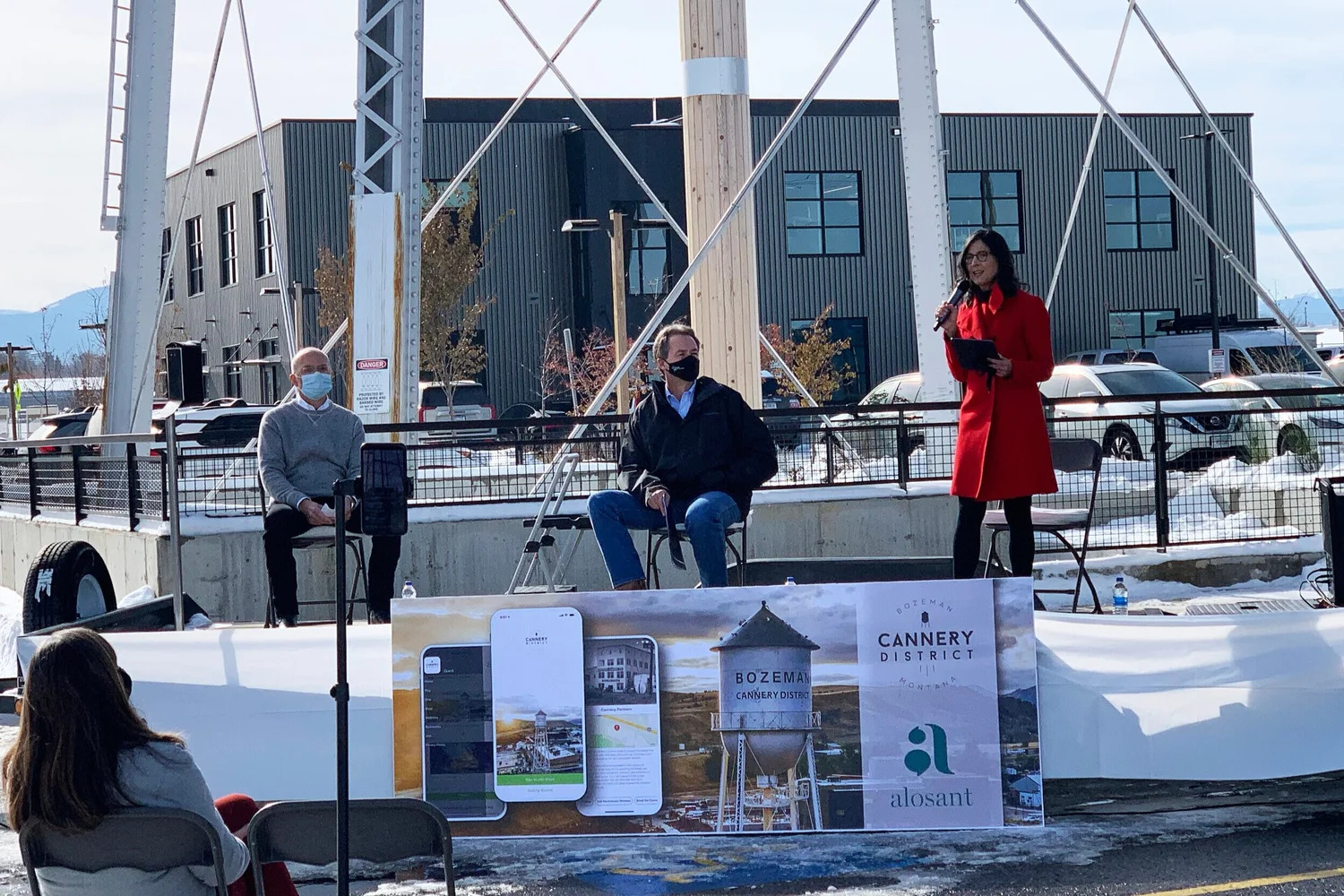
At the outdoor Cannery District launch that October, LaMon stood in a red coat beneath the old water tower and described the app as a unifying platform. It was a fitting setting. The district occupied a renovated canning complex; century-old industrial bones now housed technology companies, restaurants and apartments. An app was being introduced not as an escape from the place, but as a better way into it.
Alosant kept widening that doorway. The resident app extended upstream to people shopping for homes and downstream into access credentials, reservations, local marketplaces and communication. By September 2024, when the company announced Series A funding led by Greg Avis through Bangtail Partners, it reported more than 100 communities and 300,000 active users. The investment followed seven years of operating evidence rather than preceding it.
“We are always looking for the problem that we can uniquely solve.”April LaMon on the founder trait she values: curiosity
The steady keel
LaMon's public language returns often to curiosity, temperance and purpose. She describes conscious entrepreneurship as remaining in an eager state of learning, avoiding the comfort of “I already know.” During difficult stretches, she thinks of the founder as the steady keel: employees and customers study the chief executive's face for weather reports, so emotional whiplash becomes contagious.
That view has an early model. In graduate school, LaMon met executive Ann Fudge at General Mills and later followed her to General Foods. LaMon, who has spoken of her Mexican heritage, saw in Fudge an African American woman leading inside a Fortune 100 company and understood that authority did not require erasing identity. Her sharpest memory is small: Fudge at a coffee station with tears in her eyes because her child had started high school. Business power and ordinary tenderness occupied the same person.
That is also the quiet argument inside Alosant. A community is maps and gates and event calendars, but it is also anticipation, recognition and the relief of knowing where to go. Software can organize those feelings without pretending to manufacture them. LaMon's work puts the screen in service of the street. The final destination remains a clubhouse, a local shop, a trail, a new neighbor. The phone simply helps people arrive.