A yoga studio’s check-in desk is an excellent place to discover how many things can stand between a person and a class. There is the booking, the payment, the question that needs answering. Rachel Lea Fishman spent years working behind desks in California, watching the tools intended to make those transactions simple become part of the work themselves. She eventually helped build a company around that experience. In September 2026, she announced a plan to put the company back behind a desk.
Arketa, which she co-founded with Josh Archer in 2020, had spent six years selling software to studios. Its own New York studio project, Powered, would give the team a place to learn from operating one. For Fishman, the route from instructor to chief executive has acquired a pleasing circularity. Build the tools. Use the tools. See what the tools forgot.
The desk had other ideas
Fishman’s qualifications cross two working worlds. She is a UCLA graduate whose public professional profile lists cum laude honors, a 3.8 GPA and backstage work on the university’s 2016 Spring Sing. She also trained as a yoga instructor, including a 200-hour Power Yoga certification and CorePower Yoga credentials. The backstage detail is a small one, but an apt introduction to someone whose business concerns what happens around the main event.
She taught and managed at yoga studios, and worked in technology product management. The two experiences gave her a way to recognize a familiar studio frustration as a software problem. A class could be carefully prepared while the machinery for selling it remained awkward. A good instructor still needed a way to get paid. An owner still needed to make the schedule work.
Archer brought engineering experience to the partnership. The pair had known each other in college. Together they founded Arketa in 2020, and the company joined Y Combinator’s Summer 2020 batch. Their shared interest in fitness was part of the founding connection. The division between understanding the room and building its software had become a working partnership.
A business beyond the next class
The early proposition gave instructors and studios several ways to sell their work: live classes, on-demand video and courses, presented through their own websites. That matters to an instructor whose business otherwise depends on being available at a particular hour. A recording can remain for sale after the class ends. A course can hold a sequence of lessons together.
By December 2022, Arketa was described as serving more than 3,000 studios, gyms and instructors. That same month, it announced $7.6 million in funding led by First Round Capital. Hayley Barna led the round; Amity Ventures and Fitt Capital were among the investors Fishman thanked publicly. Her invitation to future customers was about growing beyond classes, a phrase that captured the business she wanted the software to make possible.
YC Summer 2020
First Round Capital led
Inspired Capital led
Lower Manhattan
Fishman and Archer appeared on the 2024 Forbes 30 Under 30 Enterprise Technology list. By June 2025, Arketa announced a $15 million Series A led by Inspired Capital. The company reported nearly $500 million in transactions processed. That last figure describes money moving through customers’ businesses, rather than Arketa’s own revenue. It is a useful distinction when considering a founder whose product sits so close to other people’s livelihoods.
The hundredth class
One of Fishman’s examples of product design involves a member attending a hundred classes. Arketa can send the member an email marking the milestone. It can also alert the person working at the front desk, so the congratulations happen in the room.
The feature has a modest task: help a person notice another person. The number already exists in the booking history. Turning it into a welcome requires attention to what studio staff actually do. Fishman’s explanation of her advantage is direct.
“I feel a customer’s pain because I was the customer.”
Rachel Lea Fishman
She has spoken about the importance of diversity in Arketa’s team and investor base. In 2023, she said women made up 92 percent of its customer base. That was a dated description of the businesses she was serving, and it helps explain her emphasis on who gets to design their tools. The person choosing the software and the person imagining the product should be able to recognize each other’s daily work.
There is another choice built into Arketa: the studio can keep its own identity. Branded websites and mobile apps put the owner’s business in front of the customer. Fishman once reached for the familiar Maybelline advertising line to explain how thoroughly the software can disappear behind someone else’s brand. A software CEO being pleased that customers barely notice her company has a certain charm. The studio gets the applause; Arketa handles the booking.
Advice, with the volume turned down
Fishman has been candid about a less elegant part of learning to run a startup. Speaking on a founder panel in 2023, she recalled increasing Facebook advertising from $2,000 one month to $25,000 the next after an investor encouraged faster growth. The business had not established that its approach was repeatable. She decided to pull back.
The story contains an ordinary temptation: somebody experienced offers advice, and acting on it feels like progress. Fishman’s account ends with her reclaiming the decision. She wanted the company to grow sustainably, with a business model that justified the expenditure. Enthusiasm had arrived before evidence.
Her advice was to accept what fits and leave the rest. The lesson also explains a preference she expressed for customer relationships: an owner who likes a useful product can recommend it to another owner. That hope is less photogenic than an advertising campaign, but it is closely connected to the work Arketa needs to do every day.
The beach was on the calendar
Fishman’s public account of an August 2024 offsite offered two pictures of leadership. One was a group photograph beside the ocean. The other was a calendar, crowded with individual appointments. She said she had spent more than thirty hours talking one-to-one with team members on the beach.
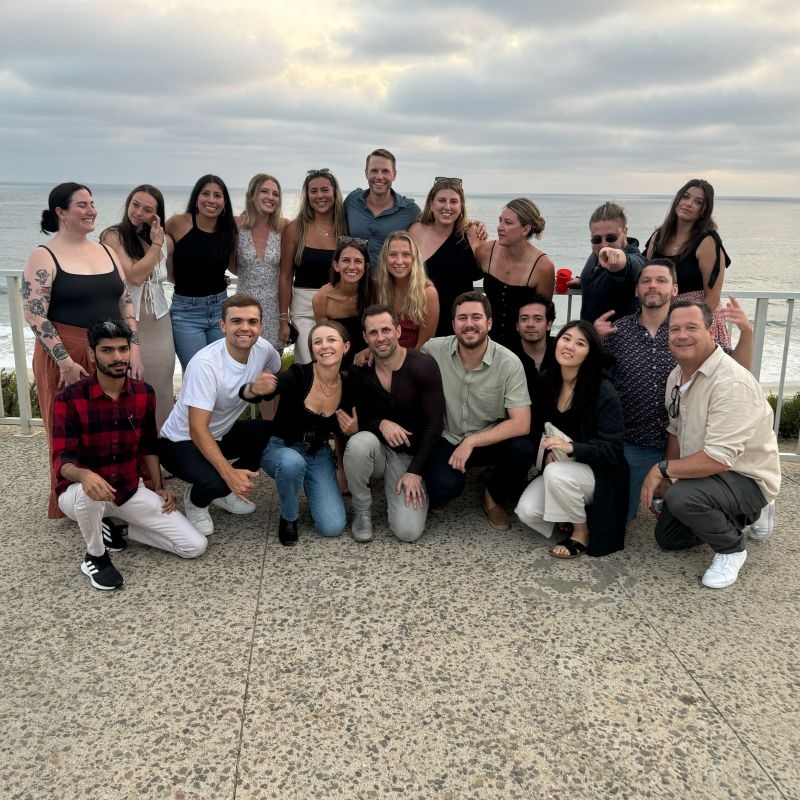
In the same post, she described spending more than six hours a day talking with studio owners. Finding and keeping people had come up in those conversations. She recognized the issue both from her time as an instructor and from her responsibilities as an employer. Listening to customers was feeding a question about her own company: how could employees feel appreciated and see a future there?
She has also praised investor Allison Pickens for being responsive, making introductions and staying supportive between a company’s more celebratory moments. That description gives a little texture to the funding story. Fishman values someone who will engage with the business and its founder when there is no announcement to share. The same preference runs through the customer calls, the team appointments and the investor relationship: spend enough time together to understand what is happening.
Software that can answer the parking question
By 2025, Fishman was describing practical uses for AI. Arketa had used it internally in engineering and marketing, and was developing customer-facing tools for routine studio questions. Does the place have showers? What is parking like? These are small questions with the power to delay a booking.
Inspired Capital’s explanation of its investment emphasized the opportunity to bring more of a studio’s operations into one platform. Booking and payments were the starting point. Websites, apps, marketing and customer engagement expanded the job. The investor saw specialized software as a way for small businesses to gain access to new AI functionality.
Fishman’s interests also extend to what a studio can sell. In her predictions for the Pilates industry heading into 2026, she encouraged operators to consider equipment-based private sessions alongside classes. Her reasoning was commercial: access to equipment a customer does not have at home can support higher prices. It is the sort of observation that belongs in a conversation about the business behind a schedule.
These ambitions have a common scale. The technology may be complicated, but the immediate questions are recognizable: can a customer book, can an owner collect payment, can the business make better use of what it already has? Fishman keeps returning to those transactions. There is plenty of room for technical invention inside a question about parking.
Back on the other side of the desk
Powered’s September 2026 announcement brought that approach into a physical space on Bond Street in Lower Manhattan. Arketa planned strength and sculpt classes, with a co-working lounge to follow in the fall. Fishman described opening a studio as a longstanding goal and an opportunity to understand the operator’s experience again.
“What we learn here goes straight into the platform,” she said.
The promise makes the studio part of the company’s working method. A software team can ask owners questions and study booking behavior. Running a room adds the practical relationships between those tasks: the person arriving, the question being asked, the payment being taken. Fishman is giving the company another place to observe them together.
Her first education in the business happened while helping other people get into class. Years later, after an accelerator, funding rounds and thousands of customers, she is returning to a setting where the next lesson can arrive without an appointment. Someone walks up to the desk. The software has to help.