The first useful place to understand Players’ Lounge is a bar on a quiet weeknight. Bars already knew how to sell a little friendly competition: trivia, bingo, a reason to stay for another drink. The founders brought FIFA. A video game that had belonged to the dorm room acquired a bracket, an audience and a cash prize. The entertainment was familiar. The arrangement around it was the invention.
- Cash competition for adults who play games without making gaming their profession.
- Head-to-head matches and tournaments sit alongside personalized performance challenges.
- A July 2026 ProphetX partnership adds markets on real-world sports.
The bar was the prototype
Austin Woolridge and Zach Dixon had played soccer together at Wesleyan. They also enjoyed competitive gaming, and missed its social rhythm after college. Along with fellow co-founder Dan Delaney, they built Players’ Lounge around the recreational competitor. The company dates its beginnings to 2014; the online wagering platform followed in 2016. It entered Y Combinator’s Winter 2018 batch.
There is a useful distinction in that origin. A person can enjoy competitive FIFA while having no intention of joining an esports team. Nor must that person gather an audience on Twitch. Players’ Lounge sells access to a smaller occasion: this match, these opponents, this amount of money. It gives the player another reason to care about a game already being played.
For a founder studying the business, the bar nights offer a practical sequence. Put the activity where people already gather. Observe whether they return. Then build the machinery that lets the occasion travel. The lesson is an interpretation of the company’s history, not a claim that every lively pub tournament deserves venture funding.

A stranger, a score and a stake
The original online service takes a surprisingly physical route through the internet. Players arrange a challenge, add an opponent’s console gamertag, invite that person into the actual game, check the rules, play, and report the score. Players’ Lounge supplies the competition and payment layer. Madden, NBA 2K and EA Sports FC remain somebody else’s games.
This is where the company’s expertise becomes visible. Finding another player is only the beginning. Money makes the result consequential. The platform needs compatible opponents, agreed settings, reliable evidence and a way to decide what happened when two people tell different stories.
The FAQ recommends recording matches. In a disputed result, it asks for evidence within ten minutes. A missing screenshot or an invisible gamertag can matter. For a player, recording is part of participating properly. For the business, adjudication is part of the product, even if it is considerably less glamorous than the prize.
- 01 Agree rules
- 02 Play the game
- 03 Verify result
- 04 Settle prize
Registration is free; the wager is a separate matter. The historical peer-to-peer model took a 10% rake. That fee bought the surrounding service, rather than the game itself. PL+ adds a subscription with tournament benefits and advertised cashback. A player weighing the offering must compare the actual entry, payout and membership terms, not merely the handsome number beside a possible win.
The intended customer has a day job, lectures or other commitments. The appeal is a competitive occasion without the machinery of a professional career. Nearby businesses include cash-tournament platforms and mobile skill-game networks. Players’ Lounge’s particular starting point was familiar console and PC titles, with wagers arranged around them.
The opponent becomes a number
Head-to-head competition has an awkward dependency: somebody else must be ready for the right match. The company’s own help pages describe tournament delays when scores go unreported or a player fails to appear. That is a documented friction. It does not mean the original business failed.
In September 2022, Players’ Lounge launched a mobile player-versus-house product. Historical game-account data helped establish a personal performance challenge. Instead of arranging a money match with another customer, a player could stake on meeting a target in ordinary gameplay.
“This is just you playing against your own handicap”
Zach Dixon, November 2022
Dixon described that arrangement as more efficient. The change removes one coordination problem and introduces a measurement problem: predicting a player’s next performance well enough to set a challenge. The app’s instructions make the user’s part straightforward: link game accounts or Twitch, choose a personalized line, stake money and play. Its description includes kills, damage and wins.
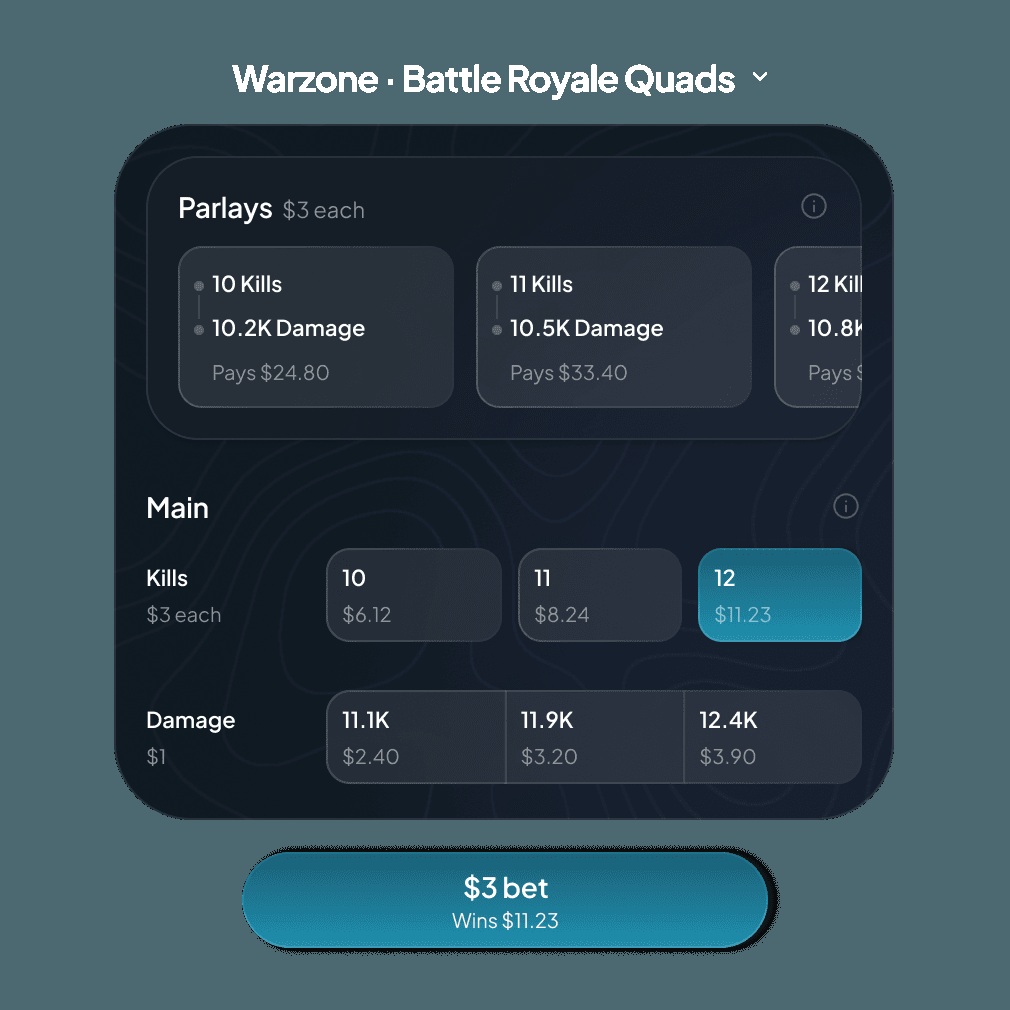
Investors paid for room to pursue that expansion. A $3 million seed round in 2019 included Drake. In July 2022, Griffin Gaming Partners led a $10.5 million Series A, with Comcast Ventures, Samsung Next and other participants. Celebrity names make an agreeable introduction. They do not establish that a customer will win.
The wallet travels beyond the controller
The next expansion crosses into real sports. On July 23, 2026, Players’ Lounge and ProphetX announced an integrated prediction-market service. Players’ Lounge supplies the customer experience; ProphetX supplies the exchange infrastructure. Users trade sports event contracts with other market participants.
Money wagered through the platform. Revenue and profit are different measures.
The current website also lists staking other players and quick arcade competitions. The widening menu suggests a business organizing several kinds of paid competition around a shared account. It also requires careful distinctions: backing another gamer, completing your own challenge and trading a sports contract involve different counterparties and conditions.
Those conditions decide whether the proposition works. Participants must be adults in eligible locations. Gameplay needs evidence; personalized challenges need useful data. Exchange orders need another trader. PL Predict’s launch FAQ says early cash-outs and customer-set limit prices are not yet available. None of these products turns ability into a dependable salary.
What another company can copy is the attention to everything surrounding the contest. Players’ Lounge began by arranging an evening people wanted to attend. Its subsequent work has been arranging the opponent, the target, the evidence and the settlement. The game may be familiar. Getting strangers to trust the result is the recurring assignment.