The useful thing about a closet is that it stores clothes. The troublesome thing is that it also stores memory. By the time a college formal arrives, every good dress may already have appeared in photographs, been admired, and become socially exhausted while remaining physically immaculate. At the University of Mississippi in 2015, Sara Kiparizoska and William Ault saw a marketplace hiding inside that contradiction. Their friends owned the supply. A calendar full of formals created demand. All that remained was the small matter of software.
Eli Allen became the builder. He had studied computer science at Ole Miss, worked in teaching, research and systems administration, and spent time on FedEx's data analytics team. Graduate school seemed like the orderly next step. Curtsy was less orderly: a peer-to-peer dress rental network aimed at young women, assembled by a team learning the business as they went. Allen left graduate study and chose the mess.
The first product borrowed a visual grammar its users already knew. Listings looked social. Owners could post photographs of themselves wearing a dress beside more polished images, giving prospective renters a better sense of how fabric behaved away from a studio. Allen said active users opened the app more than six times a week. On a campus, where the customer and the inventory might be a short walk apart, that frequency could turn a wardrobe into a network.
A company hiding in spare time
Early Curtsy had an advantage that no amount of growth hacking can manufacture cheaply: density. Ole Miss formal culture provided repeated occasions, while sorority networks carried recommendations from one trusted person to the next. About 3,000 users joined around the original campus. The marketplace did not need to conjure strangers from the internet and persuade them to trust one another across a continent. It began among people separated by a mile, a friend or a group chat.
Still, momentum had to compete with rent and coursework. Allen was in graduate school. Ault was taking odd jobs. They developed Curtsy after everything else, the familiar founder arrangement in which the most important project receives the least alert hours. Then the Rebel Student Venture Fund awarded the team a grant in 2015. Its grants ranged from hundreds to a few thousand dollars, modest sums in venture-capital arithmetic. In the arithmetic of two students, the money bought concentration. It also offered proof that an institution had inspected the idea and found it worth a wager.
“Receiving the grant gave us enough money so we could turn our full attention to the project; it also gave us legitimacy which allowed us to attract other angel investors.”Eli Allen
Allen and Ault began working full time. David Oates, a designer with startup experience, joined as chief executive. Clara Agnes Ault helped build the community around the product. The group moved to San Francisco and entered Y Combinator's Summer 2016 batch. The geography changed, but Curtsy's earliest lesson travelled well: software could make dormant possessions feel liquid if it removed enough awkwardness from the exchange.
The engineer with a pair of scissors
Oates has a fond description of Allen's operating style. Allen built the entirety of Curtsy's original iOS application, he recalled, with functionality comparable to products that had been around for years. His gift, Oates said, was that he loved cutting corners. The joke only works because the app worked. This was not carelessness elevated into doctrine. It was an ability to tell the load-bearing beam from the ornamental moulding.
Founders often discuss speed as if it were a personality trait, something between caffeine tolerance and impatience. Allen's version was more technical. An early feature should be complete enough to expose the next problem. Anything beyond that can become a tax on learning. The team joked about adding qualifiers to the minimum viable product until it became “minimum viable, functional, beautiful.” The phrase is ridiculous in exactly the way a useful internal phrase should be: everyone remembers the priority stack.
That instinct mattered because Curtsy did not remain the company it began as. Local dress rental worked on a campus, but national scale asked different questions. The company moved toward resale, expanded from occasion dresses into clothing, shoes and accessories, and built shipping into the transaction. A handoff across the quad could depend on proximity. A parcel crossing several states needed labels, support, payments, reliable listings and confidence on both sides.
One product, four enlarging circles
By late 2020, Curtsy reported a $25 million annualized gross merchandise volume and monthly growth around 30 percent, with several hundred thousand people buying and selling. The operation remained unusually lean: four co-founders, a handful of other people and contract workers. In January 2021, the company announced an $11 million Series A led by Index Ventures. Forbes placed the four co-founders on its 2021 30 Under 30 list for Retail & Ecommerce.
When the search box became honest
Scale replaced one kind of scarcity with another. The early app needed enough dresses nearby. The later app had millions of possible combinations of brand, size, style and condition. Inventory was no longer difficult to find because it was absent. It was difficult to find because language is clumsy. A shopper may type two words while carrying an entire outfit, occasion and price ceiling in her head.
Curtsy's existing text search missed that intent often enough that the team reduced its prominence. They favoured product feeds, intercepted popular queries with their own machine-learning models and manually improved the results. It was an engineer's frank admission that a standard feature had not earned its usual place in the interface. Allen put it plainly: the text-based system missed user intent, and Curtsy had compensated by deprioritizing search.
The team later adopted a product-discovery system built around behaviour and intent. They compared old and new results side by side, showed the work to investors and began directing people toward search again. A published case study reported a 10 percent improvement in search conversion. The number is tidy. The more revealing change is emotional: the team moved from hiding a feature to wanting customers to see it.
Reported lift in search conversion after Curtsy rebuilt discovery around shopper intent.
Coming home with a working answer
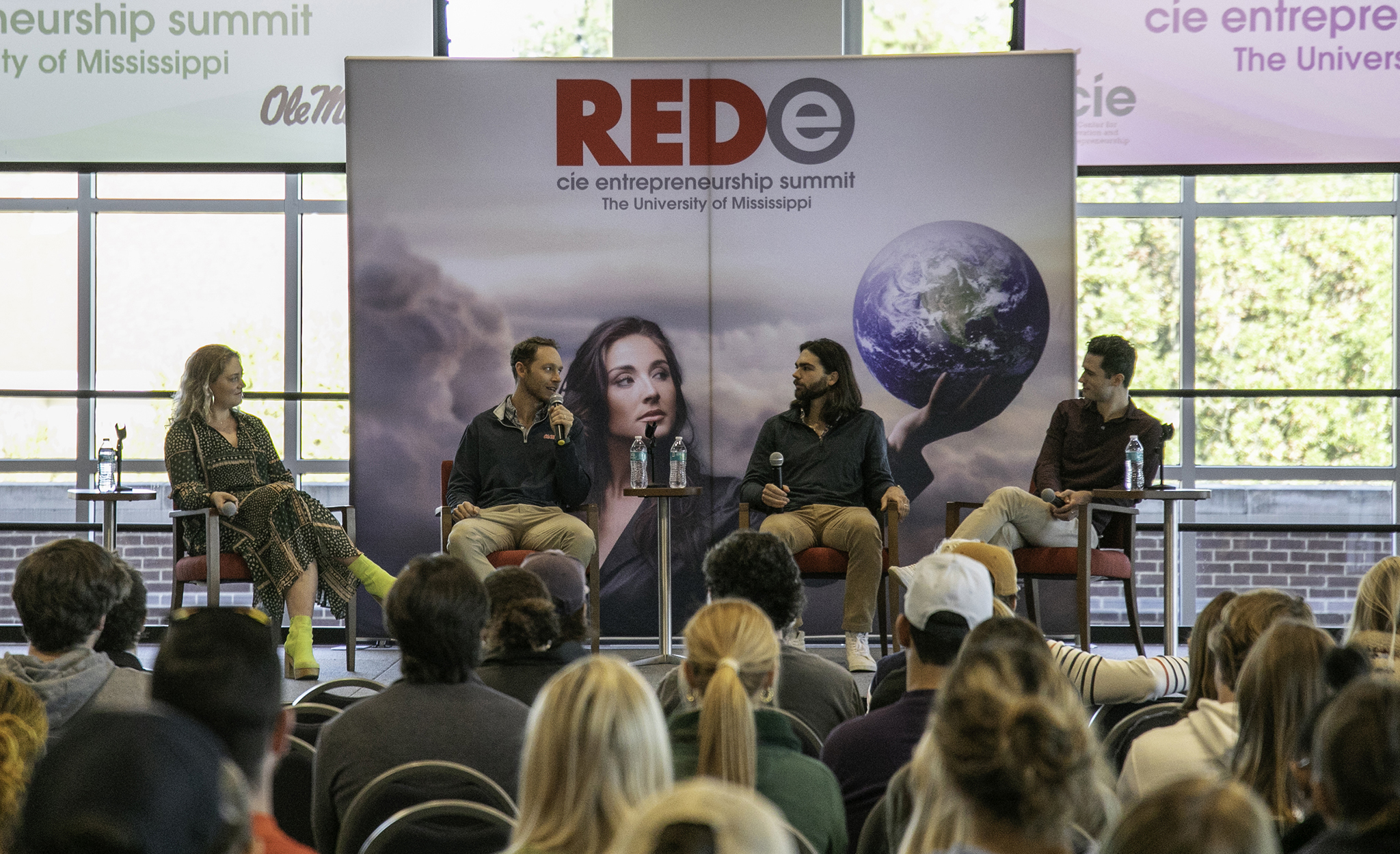
In 2023, Allen and the Curtsy co-founders returned to Oxford for the university's REDe Entrepreneurship Summit. More than 250 students attended. The founders talked about the mistakes and decisions behind the company, then helped judge a student business-model competition. It was a pleasing circuit: the beneficiaries of a campus grant returning to inspect the next set of improbable plans.
Allen sounded less interested in polishing a legend than in acknowledging an ecosystem. He remembered the Entrepreneur Club, office space at Insight Park, faculty members, local business owners and early investors. A startup is commonly narrated as an act of escape - from school, from a hometown, from a conventional career. Curtsy's story is more sociable. Allen did leave graduate school and Mississippi, but the company could leave because the local network first gave it somewhere to stand.
Curtsy now describes itself as an AI-assisted secondhand shopping app. It says more than two million people have used the marketplace and sellers have earned more than $45 million. The numbers are larger than the old campus network, yet the product still depends on the original human proposition: someone owns a good thing she no longer wears, and someone else would wear it if the path between them felt easy.
“My dream was always to create something that people love. Millions have bought or sold something on Curtsy, and I love that I get to work on something every day that's so important to so many people.”Eli Allen
Love is an extravagant requirement for software. It is also exacting. People do not love a marketplace in the abstract. They love that a listing took seconds, that a search understood the occasion, that a label appeared without a printer, that an unworn dress became rent money, or that a package contained precisely the bargain it promised. Affection accumulates at the level of details.
That is where Allen's corner-cutting philosophy reveals its limit. The shortcut is valuable only while it protects what users care about. A rough first release can be an instrument of attention. A rough permanent experience becomes neglect. After a decade, the original app has become infrastructure for a community much larger than its campus beginnings. Some corners have to be restored, reinforced or redesigned entirely.
The cleverness in Curtsy's journey lies less in having foreseen a national resale business than in revising the product without discarding the problem. Dresses became wardrobes. Rentals became sales. A nearby exchange became a shipping network. Feeds gave way, in part, to smarter search. Through each change, Allen's job remained recognizably the same: make the distance between an idle possession and its next owner feel shorter than it did yesterday.