Company · Cloud Infrastructure
The Startup That Turned Cloud Marketplace Paperwork Into a Product
Selling software through AWS, Azure, and Google Cloud is where the big B2B deals now happen - and also where the operational mess lives. Suger built the plumbing so vendors do not have to.
There is a version of enterprise software sales that never shows up in the keynote. A buyer at a large company wants to purchase a tool. Instead of cutting a fresh purchase order, they want to spend money they have already committed to Amazon, Microsoft, or Google - drawing down a cloud budget the finance team pre-approved months ago. For the software vendor, that is great news and a logistical headache at once. The deal is bigger and it closes faster, but it now has to route through a cloud provider's marketplace, with its own contracts, metering rules, payout schedules, and reconciliation. Suger, a San Francisco company founded in 2022, exists to make that routing invisible.
Suger (spelled S-U-G-E-R) describes itself, without much ceremony, as "Salesforce for cloud marketplaces." The comparison is more precise than it sounds. Just as CRM software took the scattered artifacts of a sales process and put them in one system of record, Suger takes the scattered artifacts of marketplace selling - the listing, the private offer, the co-sell registration, the usage meter, the invoice, the revenue entry - and unifies them behind a single API-driven platform. The company works with more than 300 independent software vendors and, by its own count, has processed north of $6 billion in transactions across six marketplaces.
01 / The ProblemWhy marketplace selling breaks
Getting a product onto AWS Marketplace or the Azure marketplace is not a single task. It is a stack of them, each with its own console, terminology, and failure mode. A vendor first has to create and maintain the listing itself. Then comes the private offer - the negotiated, custom-priced version of a deal that almost every real enterprise transaction becomes. Then metering, so usage-based pricing bills correctly. Then co-sell, where the vendor's reps coordinate with the cloud provider's reps on shared opportunities. Then billing, payouts, and revenue recognition, each of which the finance team needs reconciled to the penny.
Historically, companies solved this two ways, both bad. They either built and maintained brittle in-house integrations to each marketplace - engineering time spent on plumbing instead of product - or they ran the whole thing by hand in spreadsheets and Slack threads, which does not survive scale. Multiply that by three or four clouds, each with different APIs, and the operational cost compounds quickly.
That number is Suger's core pitch, and it is a specific one. The company reports that vendors who move from DIY setups or narrower tools to Suger see roughly three times the marketplace deal volume and 140% higher contract values. The claim is directional rather than audited, but the logic behind it is easy to follow: when the operational friction of transacting drops, more deals actually route through the channel, and the deals that do tend to be larger.
02 / The ProductOne platform, the whole workflow
Suger's platform is organized around the lifecycle of a marketplace deal rather than around any single feature. Listings and product management sit at the front. Private offers and resale offers handle the negotiated middle. Co-sell automation coordinates with cloud provider sales teams. Billing and usage metering, with automated revenue recognition, handle the money. Partner relationship management covers channel and referral relationships. And two-way CRM sync pushes all of it back into Salesforce or HubSpot, so the marketplace pipeline lives where the rest of the sales team already works.
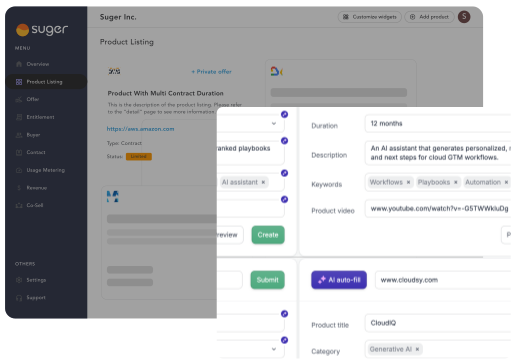
The design choice that matters here is "API-first." Suger is built so that engineering teams can wire marketplace operations into their own systems, while revenue and operations teams get a console they can run without filing a ticket. That dual audience - engineers and rev-ops - is part of why the product spread inside companies rather than sitting with one department.
Six marketplaces, one integration surface.
03 / The MarketA channel getting big fast
The reason any of this is worth building is timing. Cloud marketplaces have become the fastest-growing channel for B2B software sales, and total annual transactions through them are projected to pass $100 billion by 2028. The appeal for enterprises is concrete: larger deal sizes, faster sales cycles, and minimal risk of late payment, because the money moves through the cloud provider's billing relationship. As more procurement shifts toward committed cloud spend, the vendors who can transact smoothly through that channel have a structural advantage.
This is also where Suger's competitive position gets interesting. The largest player in the space, Tackle.io, has raised more than $148 million and built much of its business around the listing process. Suger's counter-argument is that listing is the easy part. The value - and the pain - lives in everything after the product goes live: the private offers, the metering, the co-sell coordination, the revenue recognition. By owning that longer tail of the workflow, Suger is betting on the part of the problem that gets harder, not easier, as a vendor scales.
The customer list reads like a directory of modern software: Snowflake, Intel, Notion, 1Password, Airtable, Vanta, Fivetran, Glean, dbt Labs, and Contentsquare are among the names Suger has cited. That mix matters. These are not companies dabbling in the channel - many of them are marketplace-native, generating serious revenue through cloud procurement, which is precisely the segment that feels the operational pain most acutely. Winning the vendors who transact the most is a reasonable proxy for having built the thing that actually works at volume.
04 / The FoundersBuilt by people who felt the pain
Suger was co-founded by Jon Yoo, the CEO, and Chengjun Yuan, the CTO. Yoo came from Salesforce; Yuan came from Confluent - both companies that themselves sell heavily through cloud marketplaces, which is a useful detail. The founders were not outsiders guessing at a problem. They had watched, from the inside, how much manual effort went into a channel that finance and sales both wanted to grow.
The company went through Y Combinator's Winter 2023 batch and raised a $3.7 million seed round with participation from Craft Ventures, Y Combinator, and Pioneer Fund. Through 2024 it did the thing early-stage investors want to see: it more than quadrupled revenue while growing past 200 customers. That traction set up the next raise.

05 / The MoneyThe $15M Series A
In February 2025, Suger announced a $15 million Series A led by Threshold Ventures, with participation from returning investors Craft Ventures, Intel Capital, and Y Combinator, plus new backers including Celero Ventures and GSBackers. The round brought total funding to roughly $18.7 million. The stated plan was more R&D investment toward what the company calls a unified ecosystem of cloud-forward procurement - in plainer terms, going deeper on the workflow it already owns rather than sprawling into unrelated products.
What a reader can actually take from this
- Boring, high-value workflows are a category. Marketplace ops was tedious enough that everyone avoided productizing it - which is exactly why it was open.
- Own the part that gets harder at scale. Suger ceded "listing" as commodity and planted its flag on private offers, metering, and revenue recognition.
- Build for two buyers at once. API-first for engineers, a console for rev-ops - the product spreads across a company instead of stalling in one team.
- Anchor pricing to a number the customer feels. "3x your marketplace volume" is a sharper wedge than a feature list.
06 / The CaveatsWhere the bet could wobble
None of this is risk-free, and it is worth being honest about the conditions under which the model strains. Suger sits between software vendors and a handful of very large cloud providers, and those providers control the marketplaces, the APIs, and the economics. If AWS, Azure, or Google decide to build more of this tooling natively, the middle layer gets squeezed. The category is also getting crowded - Tackle, Labra, WorkSpan, Clazar, and in-house teams all want the same workflow. And the headline metrics, while plausible, are self-reported averages, not independently audited figures. A vendor with low marketplace maturity will see very different results than a company that already had committed cloud buyers waiting.
Still, the shape of the opportunity is clear. As long as enterprises keep steering purchases through committed cloud spend, someone has to run the pipes between the software vendor and the marketplace. Suger's wager is that being the neutral, multi-cloud layer - rather than a tool tied to any single provider - is the durable place to stand. For now, with 300-plus customers and billions in transactions moving through, the position is holding.