Jon Yoo has a favorite way to describe his company, and it is not dressed for a pitch deck. Suger, he says, is the plumber of cloud go-to-market. The pipes run between software sellers, hyperscalers, customer budgets, contracts, usage meters, finance systems and sales teams. When they work, a buyer gets the clean sensation of clicking purchase. When they do not, an expensive deal sits in a portal while adults exchange screenshots.
There is mischief in the metaphor, but also a precise view of where businesses hide. The cloud marketplace may look like an app store. Behind the shop window, an independent software vendor has to list a product, configure a private offer, connect its CRM, register a co-sell opportunity, report usage, issue the right bill and recognize the revenue. Repeat across AWS, Microsoft Azure, Google Cloud and other platforms. Add resellers and consulting partners. The pipes multiply.
Yoo has built his career by moving closer to that machinery. Before Suger, there was leveraged-finance investment banking at Wells Fargo, strategy and operations at Salesforce, and business operations at Workstream. Finance taught polish and discipline, but it also left him wary of working backward from a desired answer. Salesforce showed him what happens when new revenue channels meet large-company systems. Workstream brought him closer to the speed and compromises of a growth company. By late 2022, the accumulated irritation had a name.
The first product was a lesson, not a market
Yoo says he wanted to be an entrepreneur from his mid-teens. His early technology venture explored whether display chips could be printed on a pliable surface. Think a screen on a ski jacket. The technology held fascination; the customer demand did not. He would later tell an interviewer that the idea had started with technology and worked backward toward a problem. Suger began with the opposite instinct.
The pain was especially vivid to co-founder and CTO Chengjun Yuan, who had worked on marketplace products at Confluent after time at Google and Facebook. In Yoo's telling, Confluent had meaningful revenue moving through hyperscaler marketplaces and a substantial group of engineers and operators keeping the channel alive. Most software companies did not have that payroll. Nor did their engineers dream of maintaining marketplace integrations instead of working on the product customers actually bought.
The founding insight was almost offensively practical: make the recurring integration work reusable. Suger would handle listings, private offers, contracts, co-selling, metering and billing so a software company could enter the channel without assembling its own miniature bureaucracy.
A sensible problem does not guarantee a sensible first product. Suger entered Y Combinator's Winter 2023 batch and pivoted in the middle of it. Yoo later recalled a five-week stretch without signing a customer. The company had raised seed capital; a co-founder departed; the easy narrative disappeared. In a 2025 podcast conversation, he described the business then finding its grip, growing from $500,000 to $2 million in annual recurring revenue within six months while employing five people.
A janitor with a better job title
The plumber line has an origin story. Growing up, Yoo took whatever jobs he could find. He once applied for the grandly titled role of Museum Grounds Administrator. He pictured fossils and perhaps the occasional VIP tour. The duties were cleaning bathrooms, wiping exhibit mirrors and raking leaves. A bait-and-switch, certainly, but a useful one. It was a science museum, and he watched visitors become animated by the exhibits. He started learning the science. Eventually he could explain it.
The anecdote contains his founder persona in miniature: puncture the title, attend to the work, acquire the knowledge, then teach it. Yoo freely admits that he had not worked in partnerships before Suger. He learned from practitioners, codified their methods into software and kept learning in public. Plumbing is not an apology for the category. It is a claim that infrastructure deserves someone who enjoys looking beneath the floorboards.
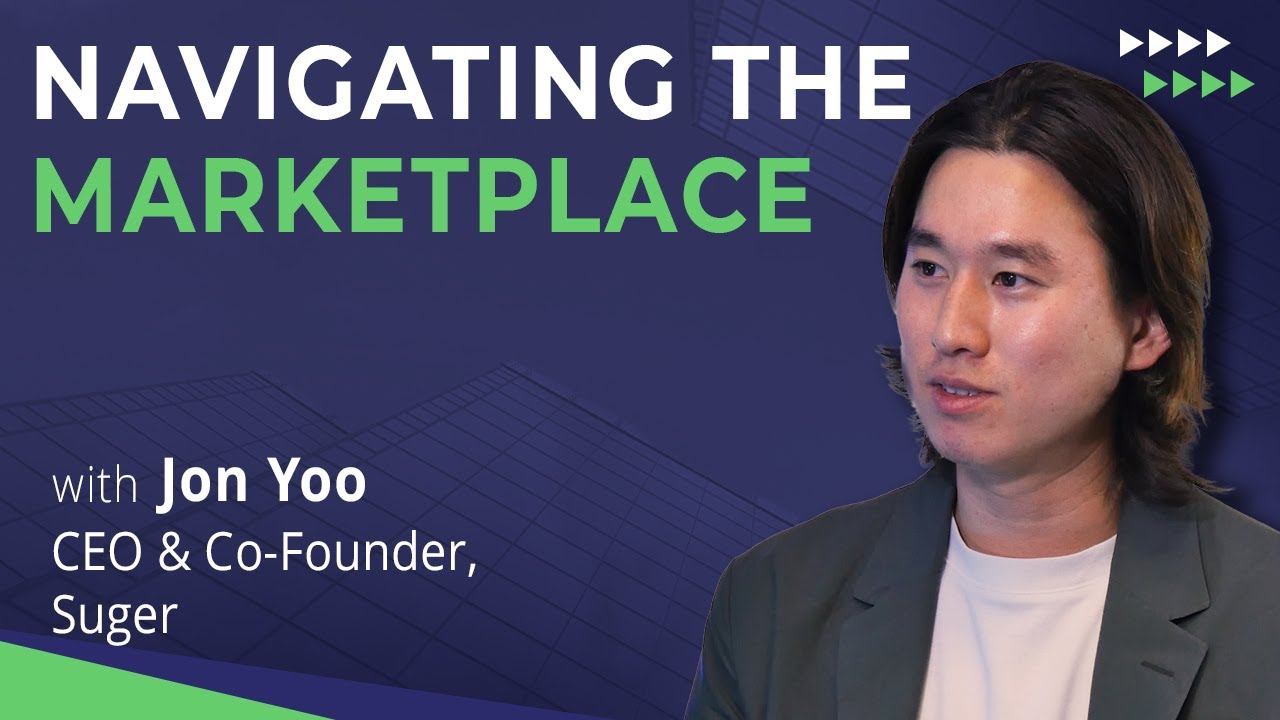
By February 2025, Suger said it had more than quadrupled revenue during the previous year and served over 200 customers. Its announced $15 million Series A was led by Threshold Ventures, with participation from Celero Ventures, GSBackers, Matt McIlwain and returning backers including Craft Ventures, Intel Capital, Y Combinator and Pioneer Fund. Later that year, Yoo reported more than 250 companies on the platform and over $6 billion in total cloud marketplace contract value processed.
The numbers matter because they show the pipes carrying real weight. More revealing is where Yoo wants them to go. He has described Suger's mission as bringing a consumer-grade experience to B2B sales. In enterprise software, that means hiding complexity without pretending it vanished. The contract still exists. So do entitlements, cloud commitments, approvals and invoices. The customer should not have to become an archaeologist to find them.
The product follows the repeated complaint
In early 2023, during customer discovery, Yoo heard from experienced AWS people that buyers lacked serious marketplace tooling. One conversation with Barry Russell sent him home energized enough to write a long, messy feature list that night. Suger was growing and capacity was scarce, so the idea went onto the back burner. It stayed there until the company returned to procurement and FinOps leaders. After more than 100 conversations, Yoo said the complaint had barely changed.
Suger launched a Buyer Service Platform for AWS Marketplace near the end of 2025. The product brought discovery, cloud-commitment tracking, offers, entitlements, invoices, payments and approval workflows into one view. Yoo added a small act of founder theatre with operational consequences: Suger would accept marketplace purchasing for its own procurement. Eating one's own dog food is a cliché. Making the finance team live inside it gives the phrase teeth.
Then the complaint widened again. Customers who used Suger for marketplaces wanted help with co-selling. Once that worked, they pointed to similar confusion across resellers, distributors, systems integrators and technology partners. Different labels, same post-handshake labor: coordinate the opportunity, attribute influence, calculate payouts, track money and keep the parties from losing the thread.
In June 2026, Yoo introduced Suger PRM. He was careful to say the company had not originally planned to build partner relationship management software. The product emerged by following adjacent work, not by decorating a market map. Suger had started with cloud plumbing and discovered a larger building.
Bad news first, meetings short
Yoo's most personal piece of company infrastructure may be a document. In July 2026, he published a public guide titled “What it's like working with me.” It is funny in places and exact throughout. Give him editing access to documents. Prefer a short screen recording for product feedback. Put context on calendar invitations. Default to visible group channels. Avoid a long Slack thread when a skim-friendly document will do.
The central unit of work is one accountable owner. For an approved project, Yoo expects the lift, timeline and requirements. If timing slips, communicate early. He says he will push for faster, which he defines as cutting scope without surrendering quality. Plans matter less than hypotheses, a clock, a measure and a stated good outcome. Decisions turn on magnitude and reversibility. Low-stakes choices that can be undone belong with the person doing the work.
His debate rules borrow the language of argument: claim, warrant, evidence, impact. Primary evidence beats corporate folklore. He invites challenges from junior and senior colleagues alike, and says he may change a decision when new data arrives. Meetings should generally run 15 to 30 minutes and end in a decision or a task. Anyone who forwards a crowded email with only “thoughts??” should not expect telepathy.
It is a demanding culture in his own description: direct, output-focused, impatient with ambiguity and comfortable with disagreement. Yoo also volunteers the contradictions. He says he is far from perfect, asks for direct feedback and warns that short replies indicate time pressure rather than displeasure. The candor is not softness, but it does make the sharp edges visible before someone bumps into them.
What the pipes are carrying next
Cloud marketplaces are changing alongside the software moving through them. AI products often use consumption pricing, which makes usage reporting and billing more intricate. Some deploy in the vendor's cloud; others run in the customer's environment because the data cannot travel. Updates, licenses and expirations need ongoing care. A marketplace integration is not a ribbon-cutting. It is a service that keeps waking up in the morning.
Yoo's bet is that more B2B transactions will adopt the speed and clarity consumers already expect, while the operational layer becomes more automated and more connected. Suger now stretches from sellers to buyers, from marketplaces to partner programs, and from workflow automation toward agents that operate across those systems. The ambition is broad. Its logic remains stubbornly local: find the handoff where work gets trapped.
There is a clean irony here. Yoo once left finance partly disenchanted with machinery that could work backward toward a desired answer. He is now building machinery of his own. The difference is where it begins. A stalled deal. An engineer maintaining an integration nobody wants to own. A procurement leader hunting through portals. A partnerships team held together by spreadsheets and optimism. No glamorous title can improve a clogged pipe. Someone still has to open the cabinet.