The final score settles who won. It does considerably less for the winner’s bank balance. In a 2022 interview, Community Gaming chief executive Chris Gonsalves described esports payouts that could take days or weeks, with fees and administrative friction attached. The spectacle was fast; the settlement was leisurely. Community Gaming chose to work on the second half of that sentence. Its proposition was pleasingly unromantic: put the prize money into a smart contract, finish the competition, and release the rewards.
- Tournament tools and automated crypto payouts.
- Publisher support for amateur competition.
- Forkast predictions; CG+ passes and rewards.
The wallet at the end of the bracket
Community Gaming supplies the machinery around competitive play: registration, team rosters, brackets, match reporting and prize distribution. Players find events; organizers configure them; game developers gain somewhere to gather a competitive community. The company sits between a game and its tournament audience. It does not need to make the game itself.
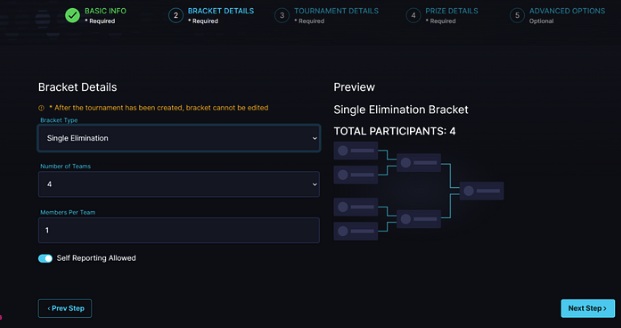
The organizer’s guide makes the mechanism concrete. Choose a format, define the payout distribution and decide whether entry is free or paid. In blockchain tournaments, the prize pool is funded onchain. Results determine where the money goes. Traditional tournaments are also supported, but those use manual payments through services such as Stripe or PayPal. “Instant” belongs to a particular workflow, rather than every event wearing the company’s badge.
That distinction matters to anyone trying it. Organizers still need participants, sensible rules and a trustworthy result. Software can distribute the pot; it cannot establish who deserved to win when two players disagree. The administrative work shrinks, but the referee does not vanish.
A blockchain with stage fright
For all the crypto vocabulary surrounding the business, its early appeal depended on ordinary games. Gonsalves named Call of Duty: Mobile, Hearthstone and League of Legends when explaining the platform in 2022. His phrase was admirably direct: “Web2 games are our bread and butter.” The quote captures the product’s useful ambition: make the payment technology less conspicuous than the competition.
A 2021 Polygon partnership offered cheaper tournament settlement. The knowledge center recommends Polygon for low fees and says a payout transaction usually takes under 30 seconds. That is a company estimate, not a stopwatch applied to every tournament. A separate reward guide describes a claim button and says Community Gaming subsidizes the claiming transaction.
Alternatives such as start.gg and Challonge also organize competitive communities. Drawing a bracket is hardly a secret art. Community Gaming’s distinguishing emphasis is connecting the bracket to funded prizes and wallet payments. For an organizer who spends Sunday evening chasing payment details, that emphasis may be more persuasive than another elegant tournament tree.
- 01Fund the potOnchain escrow
- 02Verify the scoreConfirmed results
- 03Release rewardsWinner wallets
Two different five percents
The economics require careful reading. Community Gaming’s user agreement entitles it to up to 5% of participant entry or other service fees. Its FAQ separately lets an organizer allocate 0-5% of a prize pool as an organizer fee. Those percentages describe different recipients and different bases. Neither establishes a universal price for every event.
The CG+ product adds another route: passes for exclusive tournaments, quests and token rewards. It advertises “no-loss” events in which every participant receives CGX. Receiving a token does not establish that its value covers a pass purchase. Readers should judge the entry terms and reward denomination together. A guaranteed allocation and a guaranteed financial return are very different promises.
Participant entry / service fees
Prize-pool allocation
The amateur needs a door, too
The business becomes more interesting when publishers enter the picture. In 2021, Community Gaming and Riot Games NA Esports announced a VALORANT Elite Showdown with 64 teams and a $25,000 prize pool, mixing established organizations with ranked amateurs. A tournament can be a doorway into a competitive scene, as well as a destination.
In October 2024, Moonton’s partnership brought a more practical bundle to Mobile Legends: Bang Bang organizers in Latin America: potential grants, prizes, in-game items and help accessing Tournament Mode. That mode could unlock all skins for participants. Even the wardrobe, it seems, has an organizing committee.
These arrangements explain why developers and publishers belong among the company’s customers and partners. An organizer gets tools and assistance; a publisher gets structured reasons for players to return.
“Web2 games are our bread and butter.”Gonsalves · Decrypt · 2022
Capital arrived. So did the bill.
Community Gaming announced a $2.3 million seed round led by CoinFund in July 2021, followed by a $16 million Series A led by SoftBank’s SB Opportunity Fund in April 2022. The larger round backed expansion in Latin America and Southeast Asia. Animoca, Binance Labs, BITKRAFT and Griffin Gaming Partners joined the investor list. These are financing amounts, not revenue or the cost of building the software.
Then the market imposed a less flattering measure. In April 2023, the company confirmed 17 layoffs to Decrypt, just over 17% of its workforce. Gonsalves attributed the decision to the esports downturn. Registrations could increase while the business still needed to cut expenses. Participation is evidence of interest; it does not, by itself, pay salaries.
From playing the match to predicting it
By December 2024, Ronin reported more than 1,000 Community Gaming tournaments in its ecosystem and over 60,000 total participants across two years. The next idea broadened who could take part. Community Gaming’s whitepaper argued that recurring esports events and streamer culture could support a dedicated prediction market. A fan’s knowledge could become the activity, even without entering a match.
Forkast and the CGX ecosystem token launched in February 2025 on Ronin. The introduction was untidy. Blockworks reported that heavy demand took the website down, interrupting token claims while the price fell sharply. Traders alleged insider selling; Gonsalves denied it and pointed to team and investor lockups. The episode demonstrated a familiar dependency: an onchain product still needs its website to stay upright.
Copy the plumbing, earn the applause
For someone building a community product, the transferable idea is specific: locate the annoying obligation after the exciting activity, and automate it. Fund the prize before play begins. Publish the distribution. Make the final result trigger a clear payment step. Those choices can improve a tournament without requiring its players to become blockchain enthusiasts.
They work best where organizers can resolve disputes, players can receive the chosen currency, and enough people want to compete. They offer less help to a community with no reliable results or no usable payout route. Community Gaming’s most convincing promise remains modest: the evening should end with less administration. A good tournament produces a winner. A well-run one also closes the tab.