The placekicker waits. Around him, football is collision and motion, twenty-one other men doing noisy work. His own assignment is a small republic of silence: mark, steps, breath, swing. If the ball clears the uprights, everyone runs away to the next thing. If it does not, the empty space between those posts can feel as wide as a continent.
Doug Brien lived in that republic for 12 NFL seasons. He made 207 field goals, converted 294 extra points, played 154 regular-season games, and collected a Super Bowl ring as a rookie with the San Francisco 49ers. He also learned the central cruelty of kicking: preparation can improve the odds, but it cannot remove consequence. When the attempt begins, there is nowhere to pass responsibility.
That sounds like a sporting education. It turned out to be an entrepreneurial one. Brien would leave football, enter the wreckage of the American housing crash, and help turn scattered foreclosures into a company holding roughly 17,000 homes. He would build another company to manage rental property with software, merge it into Roofstock, and eventually take the chief executive's chair. The settings changed. The work kept its familiar outline: study an unruly field, choose a line, commit, and live publicly with where the ball lands.
Drafted 85th overall in 1994 · career long: 56 yards · 915 total points
I. The lonely specialist
A job measured in clean contact
Brien arrived at the University of California, Berkeley as a walk-on and earned a scholarship. The 49ers selected him in the third round of the 1994 draft, a conspicuous investment in a position usually noticed only when something has gone wrong. His professional itinerary eventually included San Francisco, New Orleans, Indianapolis, Tampa Bay, Minnesota, the New York Jets, and Chicago. A kicker becomes fluent in impermanence: a different locker, a different holder, the same narrow target.
He was buying houses during NFL off-seasons before property became his full-time occupation. That detail matters. His second career was not conjured at a retirement dinner; it grew beside the first, an option patiently made real. Brien later told a group of current and former Miami Dolphins players that, near the end of his playing career, he wanted to do what he chose, rather than what necessity chose for him. He asked them a compact question: “What's your next game?”
What's your next game?Doug Brien, speaking to football players about life after the NFL
His answer was waiting in the Bay Area, although it did not look inviting. The 2008 financial crisis had emptied houses, crushed prices, and injured whole neighborhoods. In places such as Antioch and Vallejo, homes could sell for a fraction of their value only two years earlier. Investors understood apartment buildings. Thousands of detached houses, spread across cities and carrying individual roofs, furnaces, tenants, and lawns, looked like an administrative migraine.
II. A market nobody wanted
The unnerving absence of company
Brien and Colin Wiel, an engineer with an artificial-intelligence background, saw the same chaos and wondered whether technology could make it legible. They began Waypoint Homes in 2009, using their own money to buy distressed houses, renovate them, and hold them as rentals. The thesis was simple enough to explain over coffee and difficult enough to consume every waking hour: home prices would recover, families still needed places to live, and better data could make scattered properties operate like a portfolio.
At first, the lack of competition frightened them. Experienced people knew the market. Experienced people were staying away. So the founders kept returning to one question: “What are we missing?” Due diligence, in this version, was less a search for reassuring evidence than an organized effort to prove themselves foolish before the market did it for them.
They were not too grand to be foolish on occasion. In one mix-up, their team spent $25,000 renovating the wrong house. They bought another property between a gas station and an adult store. “That was a fail,” they later wrote with admirable economy. The early Waypoint story contains naked drug dealers fleeing a house, a violent crime witnessed near an inspection, and a federal investigation prompted by an auction buyer who was arrested for bid rigging. Brien and Wiel were not charged, but waited about two and a half years for that uncertainty to end.
These are not charming startup ornaments. They show what “scaling” meant when the product had plumbing and the fieldwork happened in neighborhoods carrying the damage of foreclosure. Every neat spreadsheet row corresponded to a physical address and, eventually, a resident. Errors were expensive. A software bug could acquire a lawn.
III. Seventeen thousand repetitions
Turning houses into an operating system
Waypoint grew by converting intuition into repeatable choices. Field teams used iPads to record what they saw. Custom tools helped estimate repairs, likely rent, purchase price, and return. The founders asked what it would take to acquire 25 houses a month, then 200, then 400. Scale was not a slogan; it was the uncomfortable distance between one reliable process and several hundred simultaneous versions of it.
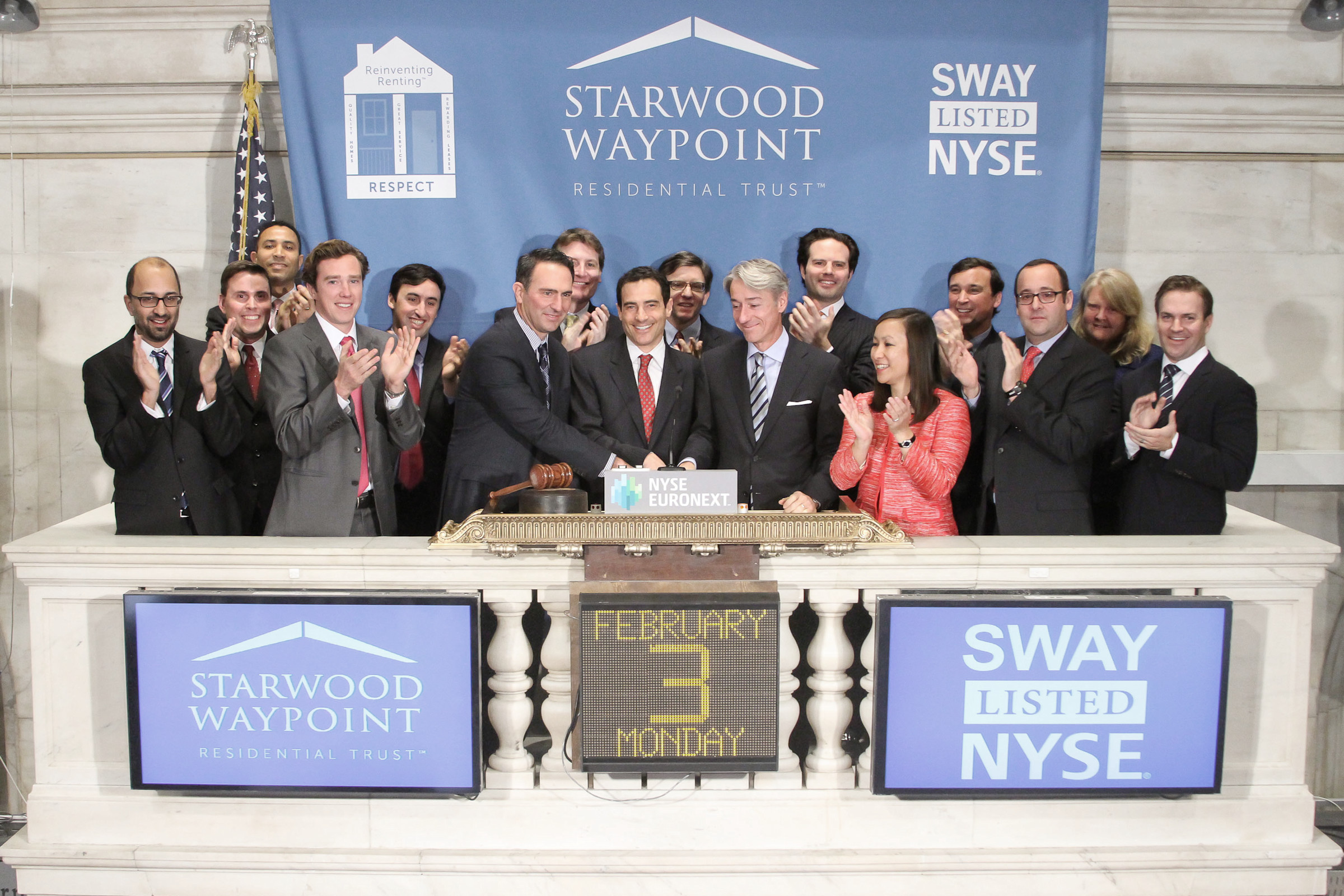
By the end of that run, Waypoint had roughly 17,000 homes, more than 500 employees, and about $3.5 billion in assets under management. It merged with Starwood and reached the New York Stock Exchange in 2014 as Starwood Waypoint Residential Trust, trading under SWAY. Brien and Gary Beasley served as co-CEOs. A business born among foreclosure auctions now had a ticker symbol.
One long trajectory
Success also exposed the limits of the model. Brien and Wiel spent enormous energy raising capital to buy houses. They had turned scattered rentals into an institutional asset class, but their larger ambition remained out of reach. Brien has described the distant target as one million homes. Seventeen thousand was substantial and still, against that number, merely a beginning.
After leaving the public company, the pair started again. Mynd, founded in 2016, would be asset-light. Instead of owning every house, it would use a shared technology platform and local operating teams to help other people find, finance, lease, manage, and sell rental properties remotely. The old Waypoint machinery became a service. The hard-won knowledge moved from balance sheet to software.
IV. The reunion
Two halves of the same house
Roofstock and Mynd developed as neighboring answers to the same stubborn problem. Roofstock built tools and a marketplace for buying and selling rental investments. Mynd focused on what happened after closing: leasing, maintenance, accounting, and management. Brien and Beasley, once partners at Waypoint, remained attached to a shared belief that data could give investors more confidence in single-family rentals.
In May 2024, the companies merged. Mynd's property-management operation kept its brand; Brien became Roofstock's president, overseeing operations, growth, and technology. The deal placed the transaction and the long middle of ownership inside one platform. In 2025, Beasley moved to executive chairman and Brien became president and CEO.
There is a pleasing loop to the reunion, but sentiment does not run twenty thousand homes. The practical question is the one Brien now discusses with institutional owners: which work deserves to remain inside an investment firm, and which work is better entrusted to an operator with greater scale? Control feels valuable. So do time and capital. The arithmetic changes as portfolios grow.
Don't be afraid to think big.Doug Brien on the lesson of building Waypoint
Brien's public language favors scale: exponential growth, remote investing, integrated systems, a housing ecosystem reinvented for investors and residents. Yet the revealing parts of his career are stubbornly small. The exact address before a renovation. The condition report entered from the field. The accounting system that speaks to the management system. The plant foot beside the ball.
His story also contains a necessary tension. A house can be an investment unit and somebody's home at the same time. Waypoint's founders argued that private capital could return vacant buildings to useful life; their companies have also operated inside the continuing debate over institutional ownership and housing access. Brien's chosen answer has been operational: make rentals better managed, make the data clearer, and make the services available to individuals as well as institutions. The claim is testable one resident experience and one investor statement at a time.
V. After the kick
Recovery as a management practice
A placekicker's life offers a convenient myth of perfect nerve. The actual craft is less cinematic. It is repetition, adjustment, and the ability to return after an outcome that cannot be edited. Brien's business career has the same texture. Waypoint made costly mistakes and kept improving its system. Its founders endured an investigation and kept operating. Mynd raised money through uncertain markets. A merger rearranged roles, brands, and teams. The job was always to take the next useful action without pretending the last result had not happened.
This may explain why Brien's most durable idea is not really about boldness. He and Wiel titled their book The Big Long, a counterpoint to the famous short bet against housing. Going long is not simply optimism with a longer calendar. It means accepting maintenance. Houses age, residents call, markets turn, software breaks, capital becomes expensive. The wager survives only if the operating habits do.
At Roofstock, Brien now leads a company spanning acquisitions, management, asset oversight, and dispositions. His current field is much wider than two uprights. Still, the geometry is recognizable. Thousands of decisions must line up: price, repair, lease, service, hold, sell. The executive cannot take every kick. He has to build a system in which other people can see the mark and trust the motion.
The crowd tends to remember the dramatic attempt. Brien's career suggests a quieter unit of achievement: the return to position. A missed kick, a wrong house, a stalled raise, a difficult integration. Reset the mark. Check the conditions. Begin again. The long game, after all, is only a great many next games placed carefully beside one another.