Most people meet title risk as an interruption. A document appears. A claim, lien or ownership wrinkle sends a transaction sideways. The buyer has packed boxes; the lender has a timetable; the closing date has acquired the emotional force of a national holiday. Then the hidden machinery of property ownership clears its throat. Liz Lilly's work begins much earlier, before the throat-clearing, in the less cinematic business of helping an industry understand what it can know sooner.
As chief marketing officer of Austin-based Flueid, Lilly is responsible for explaining technology built around Verification of Title, or VOT. The proposition is plain once somebody has done the explaining: information about a property's title condition and its insurable risks can be brought toward the beginning of a real-estate workflow. Lenders, title companies and servicers can then choose the right path with more context. The difficulty is that every noun in the previous two sentences carries its own regulations, systems, habits and professional tribe.
This is where Lilly's career becomes more interesting than the title on her business card. She did not arrive through mortgage operations or software engineering. She arrived through public relations, the profession of standing between a complicated institution and everyone trying to understand it. The good practitioners do not merely make noise. They locate the sentence on which several rooms can agree.
The apprenticeship in other people's complexity
Lilly studied mass communication with a public-relations focus at Louisiana State University, added a minor in business administration, and graduated summa cum laude. The pairing is almost too tidy for the career that followed: learn how institutions speak, then learn why they make decisions. Her early work moved among consulting, social media analysis, public affairs and university promotions. In 2015, while still near the beginning of the ladder, she won a Ketchum Mindfire Challenge for developing a campaign concept.
A year later, she and two co-authors published a piece in O'Dwyer's with the charmingly upward-looking title “Social Media Tips for Senior Management.” It asked what junior staff wished leadership understood about social media. The subject now reads like an early sketch of Lilly's durable concern: how information travels between levels of an organization, and what gets lost on the stairs.
She worked at Crosswind Media & Public Relations before joining Edelman in 2017. At the global agency, Lilly advanced from account executive to senior account supervisor. Her assignments included strategy and program management for FedEx, St. David's Foundation and electric-truck company Hyliion, plus deputy global client-relationship work spanning six Bridgestone Americas business units. Executive positioning, reputation, crisis response and corporate transformation became her working materials.
“The work we've done together has challenged me in the best of ways, and it's some of the most rewarding work of my career.”Liz Lilly, on her Flueid team
Agency life teaches a particular form of alertness. A communicator must hear the executive's ambition, the operator's constraint, the reporter's skepticism and the audience's limited patience, often before lunch. Lilly's later job at Flueid would require all four.
A product that prefers to be invisible
Flueid announced Lilly as its director of communications and public relations in March 2021. Her remit was to build and protect the company's position through media relations, content strategy and thought leadership. The firm itself had been founded in 2017 by Peter Bowman and Peter Richter, following a much longer lineage of work in title technology. Its software aimed to bring data and title decisions into the systems already used across lending, closing and servicing.
The marketing problem was not a shortage of substance. It was an abundance of it. Title insurance is essential, technical and rarely a dinner-table obsession. Flueid's flagship decisioning platform began with refinance and expanded into home equity, loss mitigation, loan modification and purchase. Each use case introduced a new audience with its own urgent question. A servicer considering a distressed loan does not enter the conversation like a purchase lender trying to protect a closing date.
Lilly helped turn that expanding engine into a coherent company story. By 2023, she had established Flueid's marketing and communications function and built its first formal plan around a multi-product roadmap. The work elevated Flueid Decision from a refinance-only narrative toward one spanning the transaction lifecycle. The method was not to give every market the same speech. She tailored the message to each vertical while keeping it tied to a common “north star.”
That phrase can become corporate wallpaper in less careful hands. Here it names a practical discipline. If the story changes completely for every buyer, the company becomes a cupboard of unrelated promises. If it never changes, buyers cannot see themselves in it. Lilly's work occupied the narrow, useful strip between consistency and specificity.
The award that gave the game away
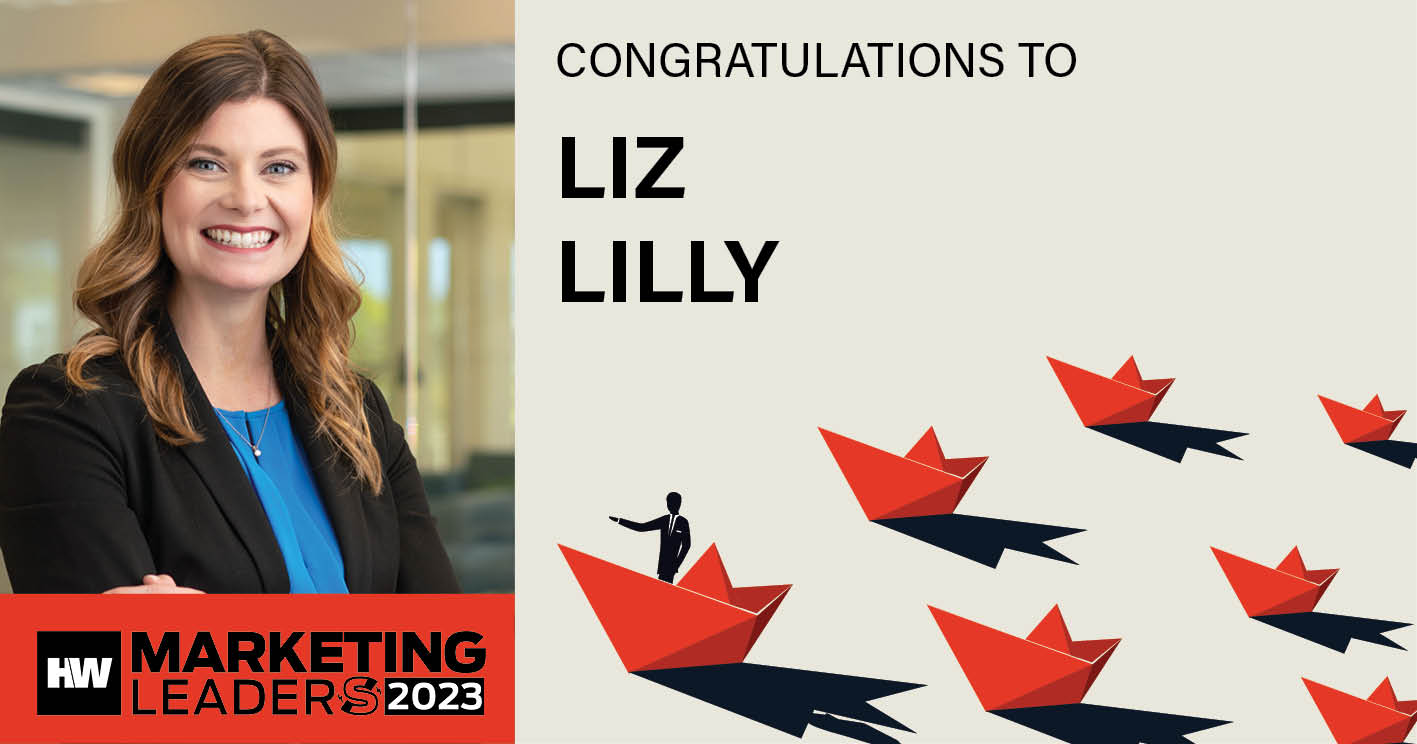
HousingWire named Lilly a 2023 Marketing Leader. The recognition cited her role as a counselor across the C-suite, product and sales, as well as her work reshaping Flueid's story. Awards copy often arrives wearing ceremonial clothing. Lilly's own response was more revealing. She wrote that the Flueid team had done a “really special [and sneaky] thing,” credited communications and creative colleagues Andrea Mencía Sandoval and John Shin, and finished with three economical words: “a team win.”
The instinct to distribute credit is pleasant; it is also operationally accurate. Marketing a technical platform is a relay race in which the baton is meaning. Product must describe what the software does. Sales must know whom it helps. Executives must say why the company exists. Customers must recognize their problem without feeling that someone has borrowed it for a slogan. The marketer runs between them, trying not to drop the noun.
The noun, in this case, is often “decision.” Software companies adore the word because it promises momentum. In title, a decision must carry the weight of evidence, underwriting standards and the specific facts attached to a property. Lilly's communications work therefore has a useful constraint: velocity cannot outrun certainty. She has to describe an earlier answer without implying a careless one. This is why her background in reputation work matters. Reputation is what accumulates when the elegant sentence and the lived result keep recognizing each other. Every product launch, conference explanation and sales asset makes a small deposit or withdrawal. The audience may never see the ledger, but it always feels the balance.
Lilly's promotion to chief marketing officer, publicly noted by Flueid in December 2024, put that relay at the executive table. The timing mattered. Flueid had completed the purchase piece of its product diversification and raised growth financing to scale VOT technology across the market. Growth creates more surfaces on which a story can crack. A CMO who came up through reputation and transformation work knows to inspect the seams.
Teaching the category, not merely selling inside it
Lilly's current public work extends beyond corporate promotion into industry education. The American Land Title Association describes her as leading Flueid's advocacy and education alongside CEO Peter Bowman. Her conference sessions ask how title-decisioning platforms uncover insurable risk and how they can accelerate the title-insurance process. This is category work: the patient business of giving people a framework before asking them to choose a vendor.
It also returns Lilly to the question beneath that early article for senior managers. What does one group understand that another does not yet see? At LSU, the gap ran between junior social-media practitioners and leadership. At Edelman, it ran across executives, employees, clients and the public. At Flueid, it runs through a property transaction. The scale and terminology changed. The habit of translation held.
A technical company's story succeeds when the people building, buying and using the product can still recognize the same truth in it.The operating principle behind Lilly's work
There is a temptation in technology marketing to make complexity vanish. That can produce a handsome landing page and a bewildered sales call. Lilly's record suggests a more durable ambition: arrange the complexity so the audience can move through it. The title professional should still hear rigor. The lender should hear timing. The servicer should hear options. The consumer, often present only as the person waiting, should feel fewer late surprises.
Flueid's corporate promise is to make the rigid real-estate process more fluid. The wordplay in the company name combines “fluidity” and “fuel,” but Lilly's part of the work is closer to plumbing. Good plumbing is praised chiefly when absent. It makes different systems connect, keeps pressure from becoming catastrophe and lets the important thing flow where it needs to go.
That may be the quiet wit of her career. The public-relations graduate became a CMO by learning how to make invisible infrastructure intelligible. She works on risks most people would prefer never to meet, in a process everyone wants to feel simple, among experts who know simplicity is expensive. Her answer has been neither a louder megaphone nor a brighter coat of paint. It is the well-built sentence, passed carefully from room to room, arriving before the problem does.