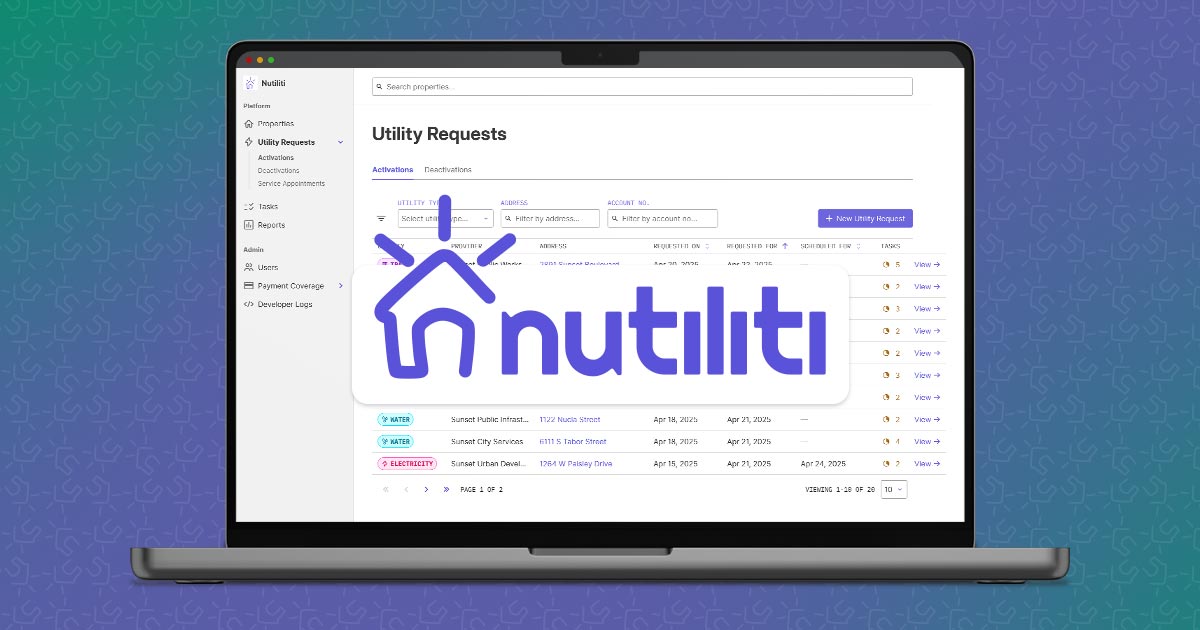
The company that would very much like to never make you think about a water bill again.
Here is a business idea that will never trend on the internet: turn utilities on and off for landlords. Pay the electric bill during a vacancy. Bill the tenant back for the water they used. Reconcile all of it against the accounting system so the numbers agree at the end of the month. It is not a pitch that gets a standing ovation at a demo day. It is, however, a real thing that hundreds of thousands of rental units require, every single month, forever. Nutiliti's entire premise is that the boring stuff is where the money quietly hides, and that somebody should build a proper machine to handle it.
The machine is part software and part staff. Nutiliti - the name is "utility" wearing a slightly different hat - sells property managers and owners a platform, a REST API, and, crucially, a dedicated human being who understands their specific portfolio. You could describe the whole thing as a bet that utility management is annoying enough to outsource but exception-prone enough that you cannot fully automate it away. Both halves of that bet turn out to matter, which is the interesting part.
Each link in the utility chain is trivial on its own. Turn a service on. Pay a bill. Charge a tenant. Reconcile the books. The problem is that you do not do them once - you do them across every unit, in every state, with a different provider for each, on their schedule and not yours. Nutiliti took the whole chain.
Electricity, gas, water, and internet turned on or off on your behalf - including service appointments and, when a provider insists, someone showing up in person.
Bill retrieval and payment while a unit sits empty, with proactive monitoring to catch leaks and stray charges before they compound.
Accurate tenant chargebacks, direct billing and collections, transparent history - and yes, they answer the resident's phone call about it.
Documented endpoints, webhooks, and custom routes that sync utility data in real time into the property management system you already use.
One human who actually knows your portfolio, with same-day - often same-hour - answers by phone, email, or chat.
Nutiliti's most persuasive slide is not a slide - it is a subtraction. In one customer case study, work that consumed more than 80 hours a month came down to roughly two. That is not a rounding error you dress up in a deck. It is the difference between hiring a person to babysit utility accounts and not.
The origin story has a nice bit of contrast to it. Before Nutiliti, Nick Whalley traded electronic equities at Goldman Sachs and holds an engineering degree from Dartmouth. He then walked off the trading floor and into a company about turning off the gas at a vacant duplex. If you squint, it is the same job: find the inefficiency everyone else has stopped noticing, and stand in the middle of it. He co-founded Nutiliti in Austin in August 2020 and now serves as CEO.
Former Goldman Sachs electronic-equities trader; Dartmouth engineering. Has a hand in everything at the company.
Architect of the operational model that lets a small team run utilities for many portfolios at once. Originally from Houston.
Leads product development and the platform - the API and dashboard that make the human side scalable.
In December 2023, Nutiliti closed a seed round of $6,323,538 - a precise number that suggests the funding did real work rather than round to a headline. The backers are a mix of the kind of funds that like unglamorous, defensible workflows: Palm Drive Capital, CEAS Investments, Crosstimbers Capital Group, de Anda Capital, and Escondido Ventures among them. Total funding to date sits around $7 million. It is, by venture standards, a modest raise. It is also exactly the right size for a company whose value proposition is "we will make you stop thinking about this."
Nutiliti sells to single-family rental, multifamily, build-to-rent, and commercial operators across the United States - anyone with enough units that utilities stop being a chore and start being a job. The company integrates with property management platforms including Buildium's marketplace, and runs payments through Stripe, which is to say it lives inside the software stack landlords already have rather than asking them to adopt a new religion.
The competitive field is not empty. Conservice is the giant of utility management; Livable automates RUBS and cost recovery; smaller players and expense-management firms circle the same accounts. Nutiliti's differentiator is the deliberate refusal to be pure software. Its wager is that landlords do not actually want a self-serve portal for the worst part of their month - they want to hand it to someone who picks up the phone the same day. Whether "software plus a human" beats "software alone" at scale is the open question, and the answer is worth watching.
Single-family, multifamily, build-to-rent, and commercial portfolios nationwide.
Conservice, Livable, and utility expense managers like UMC Solutions.
Automation for volume, a named account manager for the exceptions software cannot handle.
"Nutiliti" is "utility" with the vowels rearranged just enough to be trademarkable and slightly fun to say.
When a utility provider requires a physical activation, Nutiliti sends a human to the property. Software does not flip every breaker.
Founded in Austin in August 2020, later headquartered in Houston - a Texas company for a Texas-sized rental market.
The CEO left electronic equities at Goldman Sachs to arbitrage a different inefficiency: your utility paperwork.
Note: This profile compiles publicly available information. Figures such as the 80-to-2 hours claim and funding totals are as reported by the company and third-party databases, and are approximate.