Before PodPlay Technologies had a software business, its founders had a room problem. A neighborhood table-tennis club needed to be small enough to fit near its customers and affordable enough to survive there. A conventional front desk complicated both ambitions. The table could earn money late at night; the person beside the door would still need paying. The question became wonderfully literal: could the club let people in by itself?
- Built inside PingPod, sold to other venues from 2023.
- Branded bookings, scoreboards, replays and optional autonomous access.
- Public monthly fees: $30-$350 per court, depending on tier.
- September 2026 company figures: 290+ clubs, 1.9 million players.
01 A small room, an expensive assumption
PingPod opened its first Lower East Side location in February 2020. Its idea was to put table tennis close to where people lived, in visible, street-level spaces. The team could not buy the autonomous system it wanted, so it built one. Early development proved that a single venue could operate without regular staff on site. The next task was making that arrangement repeatable.
Other operators began asking to license the technology. PodPlay launched its external offering in 2023. Here was useful evidence of demand: people who had seen the operating model wanted the machinery behind it. Pickleball supplied an expanding customer base, and a reason to concentrate. A new club could adopt the system before its habits, spreadsheets and subscriptions hardened into institutional furniture.
The co-founders bring complementary experience. CEO Max Kogler had worked in finance and youth sports operations; CRO Ben Borton came from investment management and fintech. CTO Ilya Rivkin’s mobile background included Nike+ Running and Equinox. The proposition combined an operator’s cost problem with a consumer app designer’s attention to the person holding the phone.
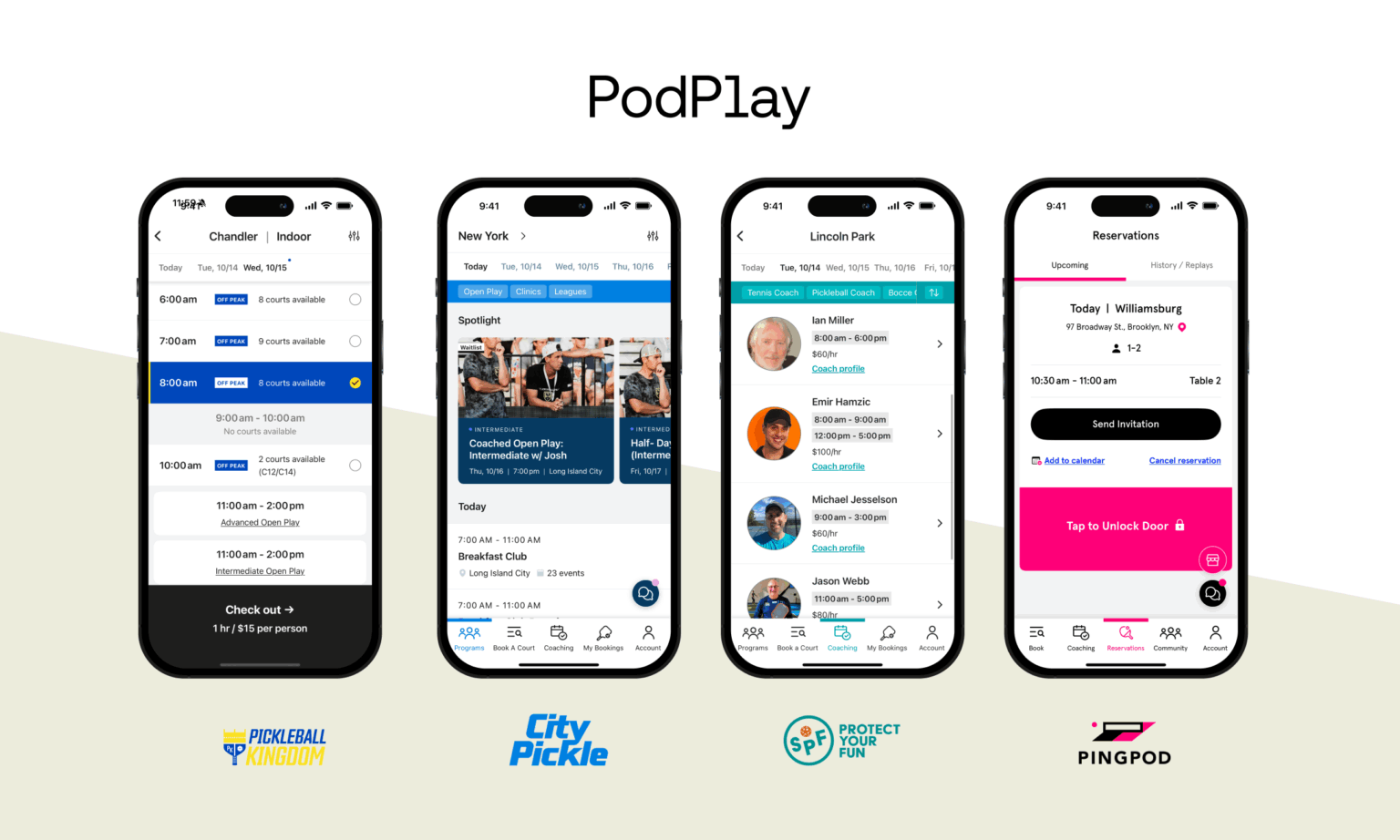
02 A reservation is only the beginning
PodPlay sells venue owners software for reservations, memberships, events, coaching, payments and reporting. Players encounter a white-label experience: their club’s identity on the web or, depending on tier, in its iOS and Android apps. Operators can advertise open play, sell a membership and connect customers with coaches through the same system.
The higher tiers extend that booking into the building. Cameras and monitors provide replays; digital scoreboards track the game. Autonomous access and remote monitoring can extend opening hours without requiring a person at reception throughout. The distinction is the connection between these tasks. A booking has consequences for a door, a court and a player’s video history.
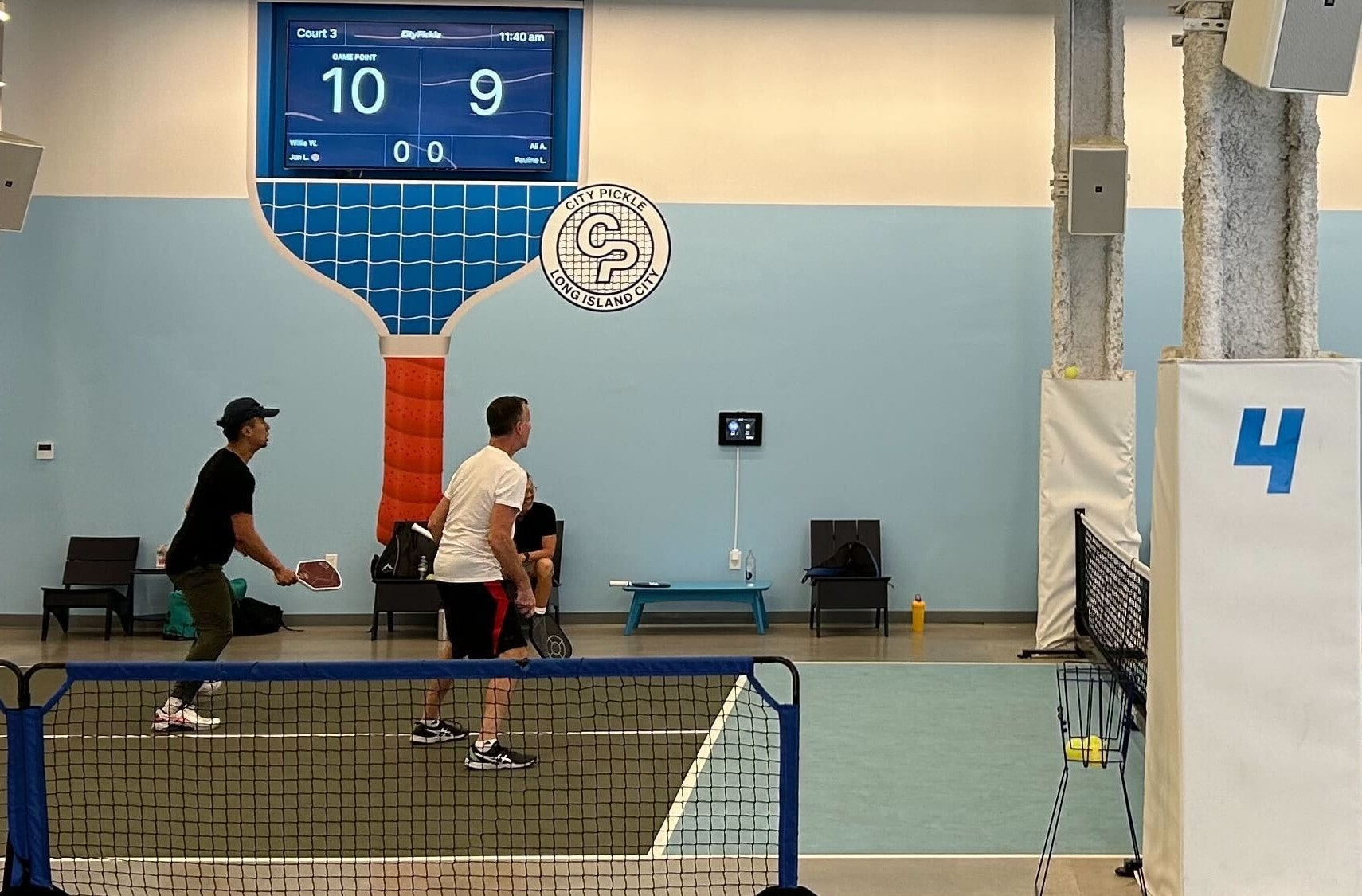
Customers include CityPickle, SPF, Performance Pickleball and Pickleball Kingdom. A December 2024 exclusive agreement addressed Kingdom’s franchise network, which then had nearly 400 awarded franchises. Awarded franchises are future opportunity, rather than a count of installed clubs. PodPlay also serves table tennis, padel, pool and golf simulators.
CourtReserve and Playtomic compete for club-management budgets. CourtReserve offers access and video integrations too. PodPlay’s case rests on its connected hardware, branded player experience and operating knowledge from PingPod. An owner should compare the complete working arrangement, including implementation and support, rather than award the contract to the longest feature list.
03 The arithmetic deserves its own scoreboard
PodPlay’s public FAQ lists $30-$350 per court per month. For eight courts, that implies $240-$2,800 monthly across the published range. This is subscription arithmetic, not a complete installation quote. The FAQ describes a twelve-month initial term and ninety-day cancellation notice; hardware-enabled installations require advance scheduling.
Then consider the savings. In a December 2024 analysis, PodPlay said labor, including cleaning, ran at 11% of PingPod network revenue, 66% below its industry benchmark. Adding PodPlay fees brought technology plus labor to 18%, a 44% reduction against the benchmark’s labor alone. Including the replacement cost makes the comparison more useful.
Those numbers describe a particular operating model. They do not establish that every pickleball venue will reproduce it. Empty courts still earn nothing, and somebody must clean the building. In May 2026, Borton said roughly a quarter of partners operated fully autonomously. Staffed and hybrid clubs belong in this story too.
04 Every amateur is a potential broadcaster
The replay button does a clever second job. A player saves a good rally; the resulting clip carries the club’s watermark. Shared pride becomes an introduction to the venue. PodPlay and The Dink launched ClipTHAT in April 2025 to feature amateur highlights. Cameras supply the footage, while distribution partners supply another route to an audience.
At Premier Pickleball in Utah, local creators receive free memberships and filming access. PodPlay’s September 2026 case study describes replay footage appearing in more than fifty posts with over three million views. Owner Molly Hansen acknowledges that attributing memberships directly to creator content is difficult. Reach is useful; it is not a membership receipt.
Analysis adds another use for the cameras. PodPlay integrated PB Vision in January 2026, removing recording and upload chores from AI match review. Processing is usage-based, and clubs control their markup. Its August account describes coaches and operators building lessons and events around match data. The practical innovation is making footage available without asking recreational players to become video technicians.
05 The court cannot manufacture company

An $8 million Series A led by Frontier Growth was announced in October 2025, following PodPlay’s separation from PingPod. Engineering, sales and customer success were slated for expansion. Growth introduces choices: Borton has described customer-service pressure, abundant feature requests and the need to decline opportunities that distract from the core product.
“Our platform lets owners focus on community and experience while technology handles the rest.”Max Kogler / October 2025
The lesson an operator can copy is concrete. Test the booking journey as a player. Count usable court hours and the full cost of serving them. Make highlights easy to retrieve, give local creators room to work, and measure whether attention leads to visits. Automation earns its place when it removes chores that obstruct play. Programming, coaching and hospitality still give people a reason to return.