The first thing Tripleseat fixed was not software. It was dinner. In 2008, Jonathan Morse watched a private event go badly and heard a revealing explanation: restaurant event managers did not use dedicated tools because the available software was too expensive or too complicated. His follow-up research suggested roughly 85 percent of restaurants and unique venues still ran events with paper and pen. Here was a sizable revenue stream managed with the technical elegance of a coat-check ticket.
Morse knew the job from the inside. He had worked from busboy and line cook to restaurant floor manager and hotel sales executive. He was not a programmer, so he searched online for one and met Kevin Zink, who became his co-founder and technical counterpart. The pairing was almost comically literal: one person knew every awkward handoff in an event; the other could turn those handoffs into a product.
The result was Tripleseat, a cloud platform for selling and running private events at restaurants, hotels and other venues. A lead enters through a form, marketplace listing, email or phone call. The sales team qualifies it, checks a calendar, sends a proposal, collects a signature and deposit, builds the event details, hands instructions to operations, and later measures what sold. Instead of scattering the truth across an inbox, spreadsheet, contract folder and someone's memory, the event gets one record.
The event trail Tripleseat wants to own
Capture
Qualify
Book
Plan
Pay
Learn
The wedgeThe restaurant binder was the competitor
Tripleseat sits in an unusually specific corner of the software market. It is part CRM, part calendar, part document generator, part payment system and part operations log. Generic sales software understands contacts and deals. Hospitality software needs to understand guest counts, menus, food-and-beverage minimums, banquet event orders, deposits, room turns, floor plans and the difference between a tentative hold and a definite booking.
That vocabulary is the differentiation. A restaurant sales manager can create branded proposals, contracts and BEOs without rebuilding the same facts in several documents. A hotel team can coordinate room blocks and multi-day events. A winery can sell a tasting ticket. A group with ten locations can route the lead to the right property and compare pipeline performance across all of them.
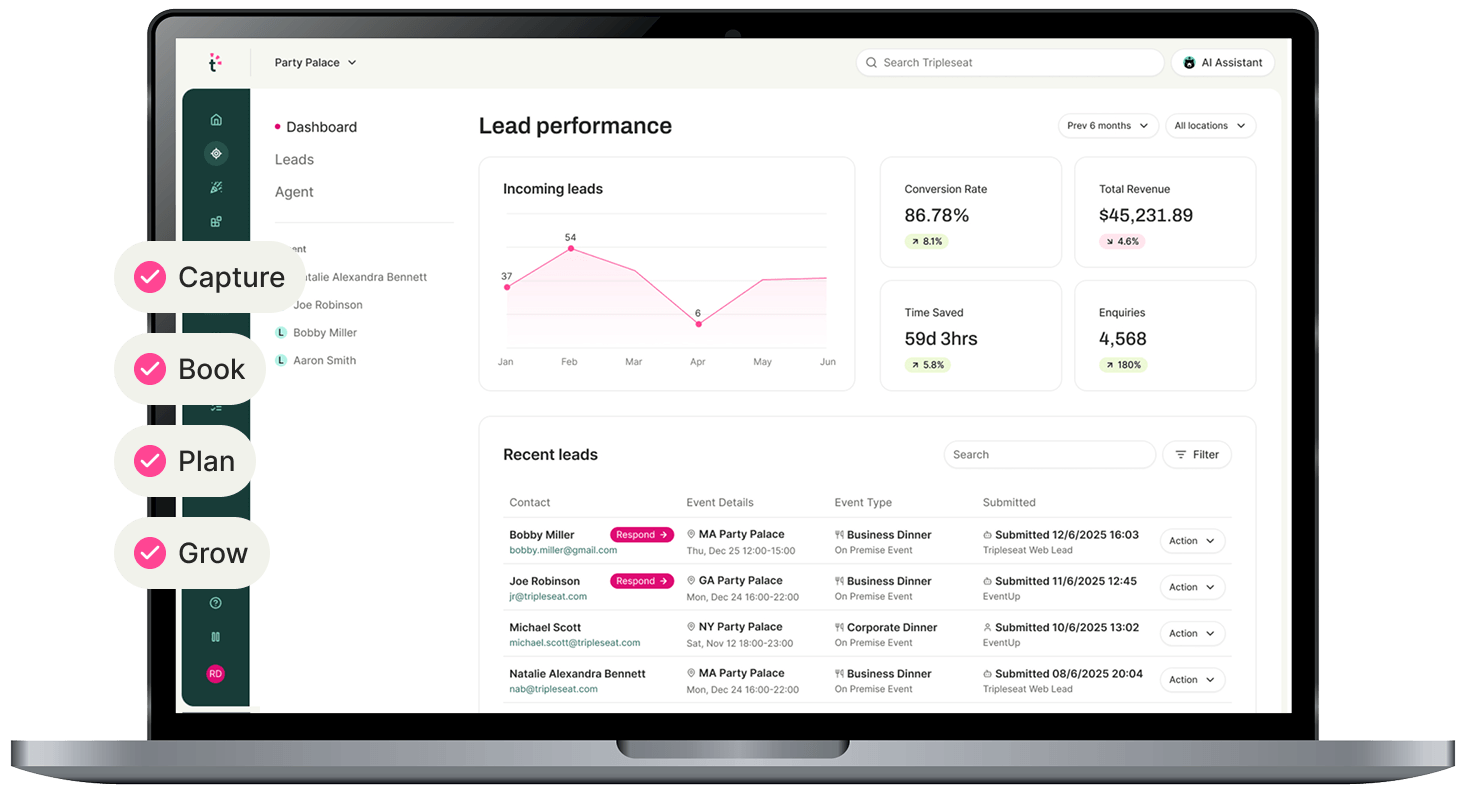
The company now packages the core platform with several adjacent products. Direct Book lets guests request or confirm events, large-party reservations and catering online while the venue controls availability, minimums and deposits. Tickets adds branded registration and ticket sales. Floor Plans, built from Tripleseat's 2024 acquisition of Merri, connects 2D diagrams and 3D walkthroughs to the event record. EventUp, inherited through the Gather combination, supplies venue discovery and lead generation. Hotels gets property-management integrations and room-block workflows. Insights and Tripleseat Intelligence push toward reporting and AI-assisted decisions.
The expansionOwn the workflow, then orbit the transaction
Tripleseat followed a recognizable vertical SaaS sequence. First, digitize the daily work. Next, become the system where revenue is quoted and tracked. Then add payment processing, distribution, analytics and specialized extensions. Each addition is close enough to the original job that the buyer does not need a new mental model.
The capital history mirrors that sequence. Tripleseat bootstrapped until 2017, when Level Equity invested $7 million; Level added $2 million in 2018. Vista Equity Partners acquired the company in 2020 and combined it with Gather, another event-management business. General Atlantic made an undisclosed strategic growth investment in 2023, with Vista, Level and Enlightened Hospitality Investments remaining minority investors. The stated plan was to expand products, payments, market reach and acquisitions.
The graph below is not Tripleseat's own revenue. It is the value of events its restaurant and unique-venue customers managed through the platform in 2022 and 2023, as reported by the company. That distinction matters. Booking volume demonstrates how close the software sits to customer transactions, but it does not reveal Tripleseat's take rate, subscription revenue or profit.
The 2022 value is derived from the company's stated 21% year-over-year increase. It is not audited company revenue.
The customerA banquet manager does not need another blank canvas
Tripleseat sells to hospitality operators who run repeatable but detail-heavy events: restaurants, caterers, hotels, wineries, breweries, golf courses, wedding venues, nightclubs and entertainment concepts. The company says more than 20,000 venues use its products, from independents to groups such as Tao, Starr, Hawksmoor and Thomas Keller Restaurant Group.

The customer problem is less “how do I plan an event?” than “how do I keep twenty changing details from contradicting one another?” A signed guest count can differ from the chef's sheet. A deposit can live in the payment processor without a clean event reference. A new sales rep can reply without seeing last year's booking history. Multi-location groups add routing and reporting problems. Tripleseat makes those mismatches visible before guests do.
Its partnerships extend that promise into the rest of the hospitality stack. Connections with reservation systems such as SevenRooms, property platforms such as Mews and Cloudbeds, payments providers, accounting tools, staffing software and pre-order services reduce re-entry. The 2026 Cloudbeds integration, for example, links group sales with room blocks, allotments and pickup data. It is a useful illustration of where Tripleseat fits: between the first inquiry and the property's operational systems.
The competitive map changes with the buyer's biggest headache. Perfect Venue and Event Temple pursue venue sales and event operations. Cvent and Momentus cover wider enterprise meeting programs. SevenRooms and OpenTable approach restaurants through reservations and guest relationships. Eventbrite begins with ticketing. Diagramming products begin with the room. Tripleseat's pitch is that a hospitality team should not have to assemble those pieces around every private booking. Its advantage is breadth within a defined operating context, not breadth across every kind of event.
That distinction also explains the company's culture marketing. Tripleseat repeatedly describes itself as built by hospitality people for hospitality people. This is more than a warm slogan when implementation depends on knowing why a chef needs the BEO, why sales guards the client conversation and why finance cares about the deposit schedule. Software can centralize the record, but adoption comes from fitting the rituals already present in the building. The product has to feel less like a mandate from IT and more like a cleaner pre-shift meeting.
The economicsWhat it costs, and what failure looks like
Tripleseat does not publish a menu of dollar prices. It quotes based on volume, locations, add-ons and use case. The business model is subscription software with additional economics from embedded payments and products such as Direct Book, Floor Plans, Marketplace, Insights and Tickets. Buyers therefore have to compare a custom bill with the cost of missed inquiries, slow replies, duplicated labor and event errors.
The first failure in the origin story was operational: a private event went poorly. The founder's mind changed when research suggested the problem was structural and widespread, not one careless team. Years later, the more practical failure mode is buying software and expecting it to generate demand by itself. Tripleseat can capture, route and convert inquiries; it cannot make an unmarketed venue famous. It also cannot repair a team that refuses to maintain event records or agree on a workflow.
Conditions that favor it
- Events happen often enough to repeat the pain.
- Several people sell or execute each booking.
- Deposits, documents and menus must stay aligned.
- Multiple locations need shared reporting.
Conditions that weaken it
- A venue books only a handful of simple events.
- One person can hold the entire process.
- The team will not adopt a common record.
- The goal is demand creation without marketing.
The copyable bitDo not start broad. Start embarrassingly specific.
The part worth stealing is not “build SaaS for restaurants.” It is the method. Find an expensive workflow still held together by familiar, slightly embarrassing tools. Hire or partner for lived domain knowledge. Encode the nouns and exceptions that generic software ignores. Win one frequent job before attaching financial products or a marketplace.
Tripleseat also demonstrates why a narrow product can become broad without becoming vague. Leads made CRM logical. Contracts made signatures logical. Deposits made payments logical. Venue search made a marketplace logical. Event records made analytics logical. Floor plans made visual collaboration logical. Each expansion touches the same booking instead of chasing an unrelated buyer.
There are limits to copying the playbook. It works when the niche has meaningful transaction value, repeated coordination, recognizable vocabulary and enough fragmented customers to support a product company. It works less well when events are rare, the workflow changes completely from customer to customer, integrations are impossible, or an incumbent already owns both the operational record and the payment. Vertical SaaS is attractive because it gets close to the work; it is difficult for exactly the same reason.
In 2025, founder Jonathan Morse retired and Michelle Fischer became chief executive. By 2026 the company had added new finance, product and revenue leaders and announced the Cloudbeds partnership. The founder-led chapter may be over, but the original insight remains visible in every product: hospitality earns its money in moments that look effortless to a guest and feel anything but effortless backstage.
There are badges around that progress, too. Tripleseat made the Boston Business Journal's Fast 50 list five years in a row through 2023, won a 2025 APPEALIE customer-success award and said it placed first in ten G2 Summer 2026 reports. Awards are not a product strategy, but they mark a company that kept selling after the category became crowded. The more persuasive achievement is quieter: a tool born from a failed dinner now sits inside the daily operating language of thousands of venues.