Alex Jekowsky wanted to buy a laundromat. This is a perfectly reasonable ambition for someone who has already sold a software company. The machines are tangible. The customers keep returning. Clean socks enjoy a dependable market. After years spent persuading universities to adopt campus-commerce technology, a business with a door, a counter, and visible customers had its attractions.
Then came the awkward question: how would he actually run it? Jekowsky was accustomed to building payment systems. He began looking at the tools available to laundry operators and found a problem he understood. A prospective investment gradually became a product investigation. He could buy stores, or he could help owners manage the stores they already had.
Today, the New York-based co-founder and CEO of Cents is pursuing the second idea. The company brings together laundry software, machine-payment hardware, and payment processing. But his story begins well before the washers. It begins with another familiar physical object that seemed to have escaped the internet: a college bulletin board.
A campus pinned to the wall
At Chapman University, Jekowsky noticed boards crowded with flyers, advertisements, and notices. Students had things to sell, events to promote, and transactions to arrange. Much of that activity still depended on paper or on marketplaces built for everyone rather than for a particular campus.
He began Ulyngo, initially thinking of it as a college version of Craigslist. The idea changed as he learned who would pay and what they needed. A student app became a marketplace platform sold to universities, supporting the commerce threaded through student life. A club collecting dues and a student selling a textbook could belong to the same digital neighborhood.
There is a useful distinction here between spotting an irritation and finding a business. The irritation is easy to describe. The business requires an institution to adopt something, a payment to work, and users to return. Ulyngo made Jekowsky work through those less picturesque details. By the end of his sophomore year, he left college to concentrate on it.
Leaving school supplied time. It did not automatically supply money. A few years later, Hebrew Free Loan provided a $50,000 interest-free business loan. He remembered the relief of being able to pay his team, along with the responsibility to repay the money so somebody else could use it. The loan is a small but telling part of the story: entrepreneurship also runs on people who agree to trust a young founder before an exit makes that trust look obvious.
The coffee-shop office
The tidy version of a startup story jumps from founding to acquisition. Jekowsky’s account includes the furniture in between, or rather its absence. He gave up Ulyngo’s office to save money and spent more than nine hours a day working from Beacon, a San Francisco coffee shop. Coffee was already among his stated enthusiasms. It acquired a second job as office infrastructure.
Ulyngo’s product was advancing, but university sales cycles moved slowly. Jekowsky sought campus-technology partners that could introduce it to more schools. Modo Labs emerged from that search. The relationship began with partnership conversations and, two years later, became an acquisition announced on April 23, 2019.
Modo’s plans show the substance of what he had built. Its campus apps could gain commerce functions: selling a bicycle, registering for a run, paying membership dues, or buying and selling textbooks. These are ordinary activities, but getting them into a trusted institutional system was the work.
Jekowsky sold his first company at 23. He and Ulyngo colleague Ethan Durham appeared on Forbes’ 2020 30 Under 30 Education list. The recognition followed a business assembled around campus transactions, with its share of slow sales and improvised workspace. A photograph of an award would leave out the coffee bill.
The counter was the classroom
After the sale, Jekowsky joined the acquiring company. His brother-in-law Gilli Cherrin had also sold a business and moved into a corporate role. Both missed the creativity and personal connections of building something themselves. In late 2019, Jekowsky attended a Coin Laundry Association event in the Bay Area, meeting Brian Wallace and dozens of business owners.
His interest in buying stores grew. So did his interest in the people running them. To learn the work, he talked to operators, traveled, and worked store counters. A large New York laundry owner let the team spend time inside stores and interview employees and customers. The counter offered an unusually direct education: software ideas could be tested against the people expected to use them.
“That’s how you build SMB tech, by thinking like an owner and an operator,” he said.
An owner’s business has its own habits, customers, and constraints. Jekowsky found that selling the product required understanding those differences and explaining why Cents existed. A rehearsed presentation could cover features. It could not substitute for curiosity about the business on the other side of the counter. That lesson gives the early fieldwork its weight: he was learning how to listen as well as what to build.
A screen has to do something
Cents entered laundry with a broad ambition: connect software, hardware, and payments in one offering. A point-of-sale system can record a transaction at the counter. Machine hardware brings the self-service part of the store into that picture. Delivery tools extend the business beyond its front door. Each component handles a different piece of an operator’s working day.
The company launched commercially in 2021. By August 2024, it announced a $40 million Series B led by Camber Creek, with existing investors Bessemer Venture Partners and Tiger Global participating. Alongside that financing came the acquisition of Laundroworks, a hardware-based payment-system business serving laundromats and shared laundry rooms.
The physical equipment matters to the plot. Laundry software has to meet laundry machines. Owners need tools that work where the money is actually collected. Connecting that equipment to the wider business requires a different kind of effort from adding another screen to an app.
Jekowsky’s explanation of the acquisition was practical. Cents Connect was growing, but scaling hardware required capital, resources, and experience. Laundroworks supplied engineering knowledge and distribution that would have taken time to develop. Buying a company was a way to accelerate the work already underway. The laundry industry had become his business; the hardware industry came with it.
A simplified view of the Cents offering. The owner has to live with all three.
Engineers without the confetti
What attracted him to Laundroworks was also cultural. He described engineers who cared about products and customers without much interest in startup glamour. Their priorities were durable equipment, support, and accessible pricing. Those qualities can seem rather plain beside a funding announcement. They are more interesting when a customer needs the payment system to work.
This is where Jekowsky’s two businesses rhyme. A university marketplace and a laundry platform both enter environments with existing routines. The founder’s cleverness is only useful if the product fits the people and institutions around it. In laundry, that means taking the equipment and the operator’s expectations seriously.
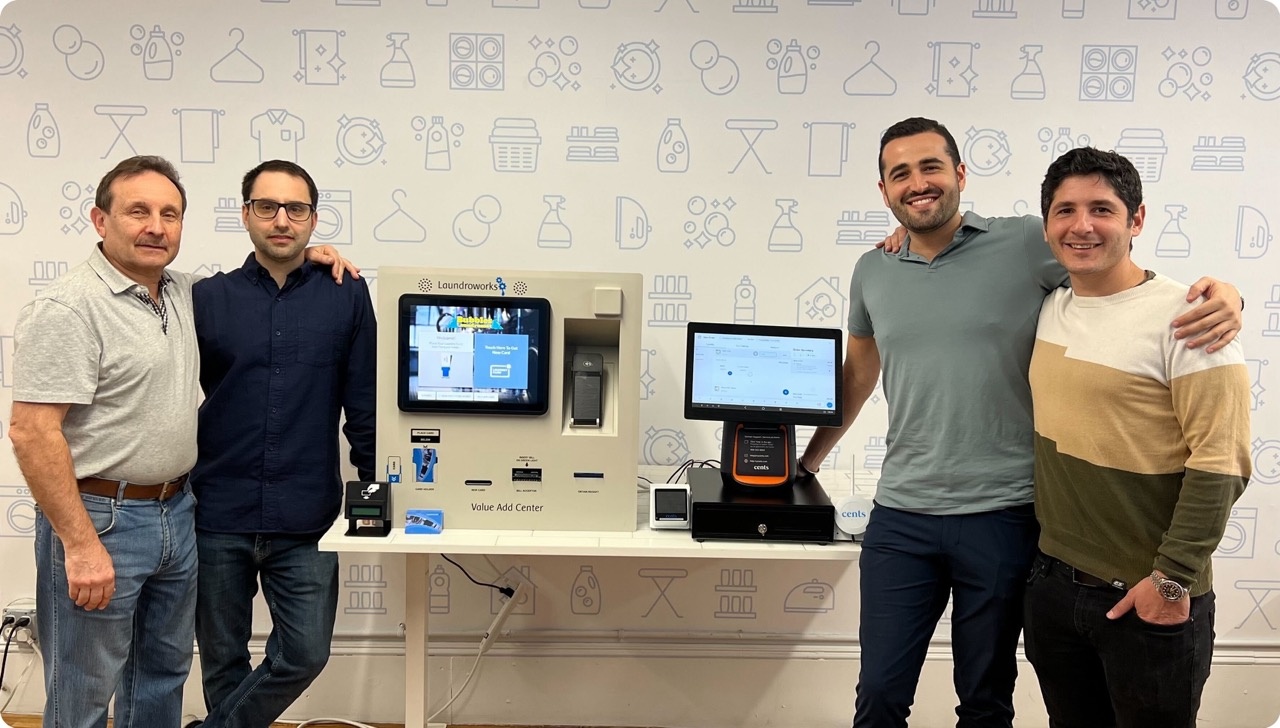
A photograph from the Cents-Laundroworks announcement places Jekowsky and Cherrin beside the payment equipment and the Laundroworks team. It is an apt group portrait: the people share the frame with the machinery. In this business, a box that accepts a payment deserves some room in the picture.
Learning to leave a question open
Jekowsky has an earlier anecdote about being too ready with an answer. On an investor call, he responded quickly to every question. He thought that demonstrated preparation. The prospective investor heard someone who might resist coaching. Jekowsky said the encounter changed how he approached subsequent pitches and meetings.
The lesson is easy to repeat and harder to practice. A founder is supposed to know the business. Yet answering everything immediately can close the very conversation that would improve it. His move into an unfamiliar industry gave that tension practical consequences. Working a counter made room for someone else’s expertise.
There are other dimensions to the person doing the listening. Raised in Tiburon, California, he has described music, baseball, travel, coffee, and craft beer among his interests. At Chapman, his LinkedIn record includes DJ work and a Saturday-evening radio show. The campus-commerce founder had another way of bringing people together before payments became the main business.
His subsequent commitments keep a connection to younger entrepreneurs. Chapman lists him on its Argyros business school’s Board of Counselors. His personal site also describes mentoring at Techstars and working with first-time founders. The student who left college to build a company now has reasons to return to the conversation about how other people start.
The number after the announcement
On March 26, 2026, Cents announced a $140 million Series C led by Sumeru Equity Partners, with further investment from Camber Creek. The company reported more than 4,500 laundromat locations and $1 billion in annual payments processed. Those figures describe the scale reached by an idea that began with Jekowsky considering a few stores.
Funding makes an easy headline. The allocation of attention afterward is more revealing. Cents outlined investment in customer support, payment hardware, its product range, and AI-powered tools. Jekowsky’s ambition includes serving more garment-care businesses, from route operators and dry cleaners to tailors and cobblers.
In June 2026, he reported $60 million in 2025 revenue and emphasized customer retention. Those are different measures of progress: one records the volume of business, the other whether customers keep choosing the product. His interest in both fits a company whose relationship with an owner continues long after a sale.
The original investment idea is still visible inside that relationship. Jekowsky had wanted a business he could understand and operate. His questions led him into other owners’ stores, then into the tools those stores use. He exchanged the prospect of owning a few laundromats for the ongoing responsibility of helping many of them run. The machines keep turning. He has given himself plenty to do while they do.