The most important piece of software in a barbershop may be the one nobody notices while the clippers are running. It remembers who booked, who walked in, which service was sold, how much the customer tipped, what the barber is owed, whether the owner takes commission or chair rent, and where the money should land. SQUIRE built a company around that invisible tangle. The result looks simple from the customer side - find a barber, choose a time, pay - because the complexity has been pushed behind the screen.
That was not the original plan. When Songe LaRon, a corporate lawyer, and Dave Salvant, a finance professional, started SQUIRE in 2015, they imagined a consumer marketplace: OpenTable for haircuts. The pitch caught the mobile-service mood of the period. Their app would help people discover barbers, reserve appointments, and pay without the usual phone calls and waiting. They went shop to shop, signed up barbers, and even paid a graffiti artist a few hundred dollars to write “Download Squire” around Manhattan.
The problem was less cinematic. Shops used SQUIRE for the customers it brought them, then returned to their old calendars for everybody else. Two systems meant two versions of the day and fresh opportunities for double-booking. The marketplace could not become essential while the shop’s actual operations lived elsewhere.
The field studyThey bought the problem
In 2016, an owner of a struggling barbershop in Manhattan’s Chelsea Market wanted out. LaRon and Salvant spent $20,000 - one-third of the roughly $60,000 they had available - to take over the lease for six months. They could not cut hair without licenses, so they did nearly everything else. They ran the front desk, ordered supplies, talked to customers, and swept the floor. Salvant later called the shop a “test kitchen.” It was product research with rent due.
The shop exposed what a generic booking calendar misses. A barber may set an individual schedule and price. One worker may rent a chair while another receives a percentage of services. A checkout can combine a haircut, beard trim, pomade, tip, discount, and commission split. Walk-ins may never touch the appointment book. No-shows leave perishable inventory: an empty hour that cannot be sold tomorrow. At closing, the owner still has to reconcile cash, cards, products, and people.
“That gave us a test kitchen to develop the software.”Dave Salvant, co-founder and president
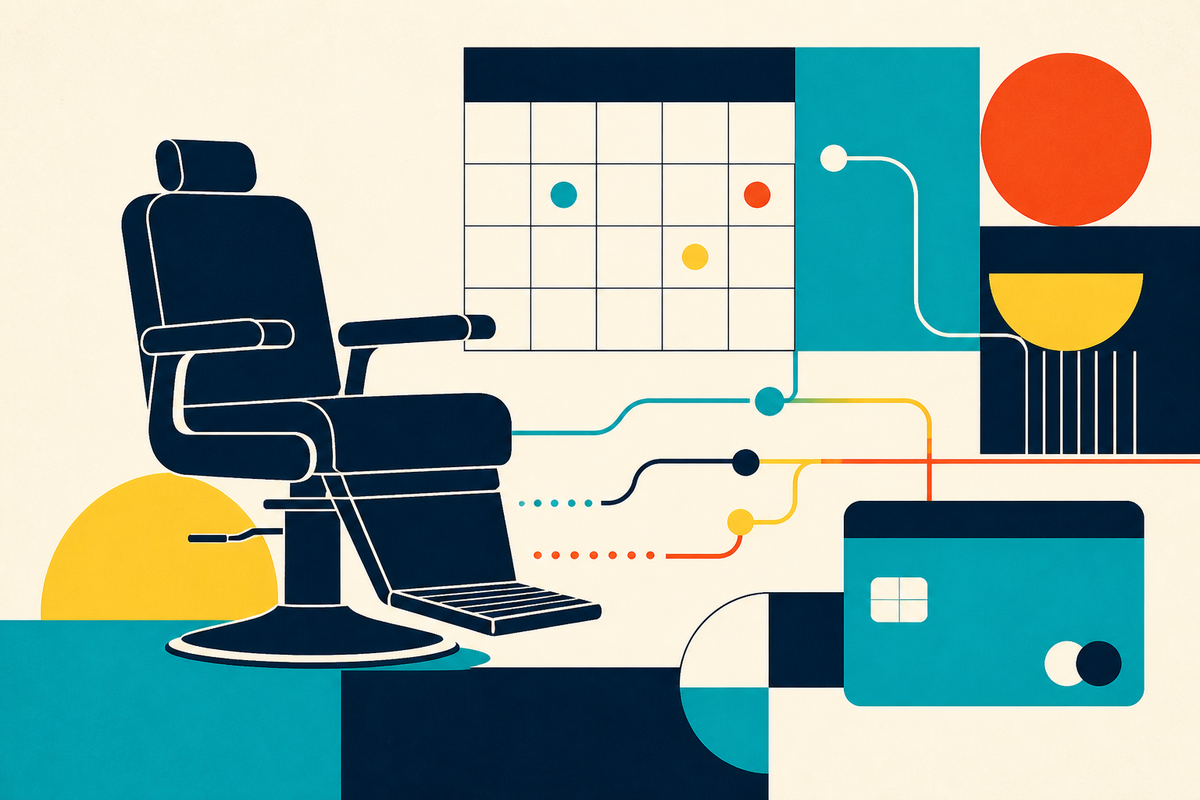
SQUIRE rebuilt itself around those mechanics. The customer app remained, but the center of gravity moved behind the counter. Scheduling joined point of sale. Payments fed reporting. Tips and service revenue could flow into payouts. Booth rent could be collected in the same system. Customer histories could power reminders, promotions, and rebooking. The valuable product was no longer a digital appointment. It was the connection between everything that happened before and after one.
The productOne ticket, several businesses
Today SQUIRE sells four main subscription levels. Independent barbers can start at $30 a month. A full single-location shop is advertised at $50. Executive, at $150 per shop, adds multi-location support, unlimited email and SMS marketing, review tools, commission and rent collection, and optional AI. Titan, at $250 per shop, adds branded apps, loyalty, gift cards, inventory, purchase orders, and client chat. Payment processing and paid add-ons create additional revenue. It is classic vertical SaaS with a fintech layer: recurring software fees plus economics tied to money moving through the product.
The two-sided design matters. A consumer can discover a shop, check reviews, reserve, reschedule, prepay, and tip. A barber can see a live calendar, accept a walk-in, tap a phone to collect payment, and track clients. An owner can inspect retention, service mix, product sales, barber performance, commissions, and rent across locations. Established shops can put their own name and icon on the booking experience rather than sending loyal clients into a marketplace full of alternatives.
When each step shares data, the owner does not have to rebuild the transaction at the end of the week.
Stripe supplies much of the payment infrastructure, including card readers, Connect money movement, fraud tools, and Tap to Pay. SQUIRE says its mobile teams integrated phone-based contactless payments in two weeks. That small detail suits the room: checkout can happen beside the chair instead of at a fixed retail counter. The system also keeps the tip, service, and eventual payout attached to the same record.
SQUIRE has worked with Gusto on embedded payroll capabilities and runs on Amazon Web Services. Google and Instagram booking routes turn search and social profiles into appointments. More recently, Google Ads conversion tracking links campaign spending to completed bookings. These partnerships extend the platform without changing its premise: the shop should see one business, not a pile of integrations.
The wedgeSpecificity is the feature
Competitors surround SQUIRE from several directions. Booksy, Boulevard, Vagaro, Fresha, StyleSeat, theCut, and Mindbody’s Booker sell booking or management tools to beauty and wellness businesses. Square can combine appointments with a familiar payment terminal. The cheapest incumbent is still a group chat, a paper calendar, peer-to-peer payments, and a spreadsheet whose author has quietly left the shop.
The patchwork
Booking here. Card reader there. Tips in cash. Rent by transfer. Inventory on a sheet. Reporting after hours.
The SQUIRE bet
One client record connects the calendar, ticket, tip, payout, products, marketing, loyalty, and owner report.
SQUIRE’s distinction is not that every individual feature is unavailable elsewhere. It is that the features share a barbershop-specific model of the world. Generic retail software assumes a cashier and fixed products. Generic salon software may assume employees and centrally controlled pricing. A barbershop can mix renters, contractors, employees, commissions, individual prices, independent brands, walk-ins, and a shop-wide reputation under one roof. Encoding those exceptions is less glamorous than consumer discovery, but it is harder to replace.
The company’s customer stories make the value tangible. Il Mulino, a six-location grooming and self-care brand in western New York, uses growth reports and leaderboards to compare barbers, services, products, and locations. Persons of Interest, a Brooklyn group, said SQUIRE removed hours of end-of-day spreadsheet reconciliation. Glassbox Barbershop in Toronto used analytics to identify productive barbers and merchandise that actually moved. What owners buy is not merely automation. It is legibility.
The next layerAI enters a very human room
SQUIRE’s next expansion is an intelligence layer trained around the work already passing through its system. Smart Rebooking is live. Announced capabilities include an AI phone answerer that can handle missed calls and put appointments directly on the calendar, marketing assistance inside Engage, review responses, performance explanations, smarter search, deposits, and faster automatic payouts. Operator, a paid add-on, is being positioned as a 24-hour front desk, marketing manager, and business coach.
There is a credible advantage in the platform’s operational context. A general chatbot can draft a promotion. SQUIRE can, in principle, know which clients have not returned, which chairs are empty, which services carry the best ticket, and which message can produce an appointment in the same calendar. The useful unit is not generated text; it is a completed business action.
The tension is equally clear. Barbershops are relationship businesses and, in many communities, informal civic rooms. Their value is conversation, trust, memory, and the person holding the clippers. SQUIRE’s own language now stresses that technology should protect the human work by handling everything around it. That is a sensible boundary. An AI receptionist can answer a missed call. It cannot become the reason a customer returns to the same chair for ten years.
“Being an entrepreneur and being an artist is similar. You are creating something that doesn’t exist and bringing it into the world.”Songe LaRon, co-founder and CEO
The marketA narrow door into a broad business
Investors once questioned whether barbershops could support a large technology company. SQUIRE answered with product breadth and payment volume. It raised an $8 million Series A in 2019, a $34 million Series B in 2020, then $45 million in equity and $15 million in debt later that year at a $250 million valuation. A $60 million Series D led by Tiger Global valued it at $750 million in July 2021. Silicon Valley Bank added a $35 million debt facility in November 2024. The last public priced valuation remains the 2021 figure, not a current appraisal.
The capital reflects a larger vertical-software thesis. A focused platform can begin with one painful workflow, become the system of record, then add payments, lending, payroll logic, marketing, commerce, and automation. Construction has Procore. Home services has ServiceTitan. Restaurants have Toast. SQUIRE’s place is the barbering and men’s-grooming corner of that map, where a global population of small operators has many of the same needs as a large enterprise but little administrative staff.
Its challenge is to keep the product specific without making it heavy, and to keep shops loyal when switching costs include clients, reviews, payment histories, and daily habit. Public app reviews show both sides of scale: enthusiastic customers praise easy rescheduling and cashless checkout, while critical shop owners describe support delays and scheduling frustrations. Infrastructure becomes more consequential as it becomes more complete.
Still, SQUIRE’s founding correction remains its clearest advantage. The founders stopped mistaking the visible customer moment for the whole business. They learned that the haircut is the craft; the company opportunity is the unruly sequence around it. Ten years on, the product keeps adding layers, but the job is recognizable: let the barber pay attention to the person in the chair, and make the rest of the shop add up.