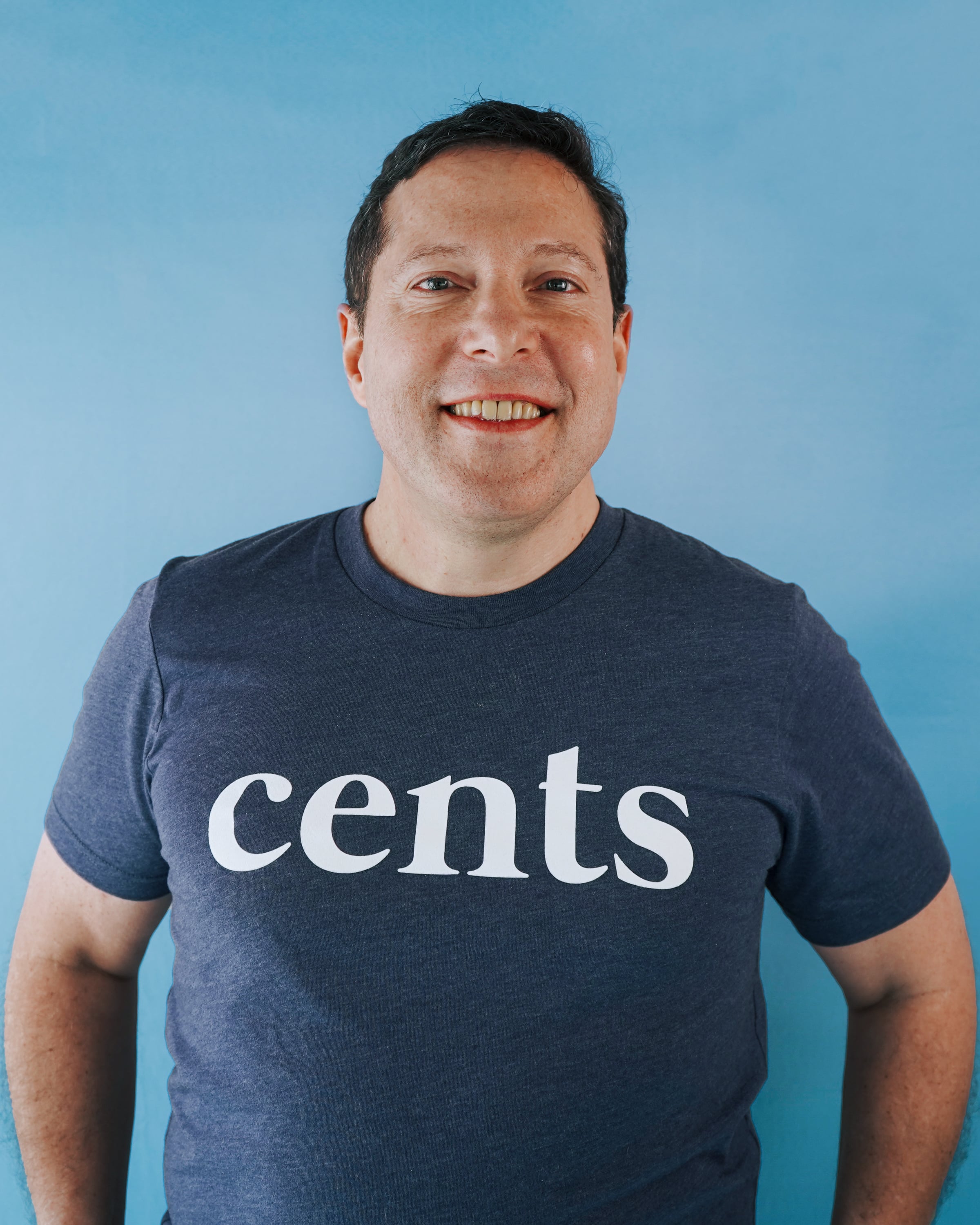
Today he is making laundromats add up
Walk into a Cents-powered laundromat and you will not see Lawrence Herman, but you will feel his fingerprints on the math. He is the Chief Financial Officer and AI Strategy Leader at Cents, the company building a single operating system for laundromats and dry cleaners: software, hardware, and payments stitched into one platform that an owner can run from a phone.
It is an unglamorous category, and that is exactly the point. The laundromat is one of the last cash-heavy, spreadsheet-light corners of American small business. Cents has raised roughly $185 million to change that, including a $140 million Series C, and Herman is the person who keeps that capital pointed at the right machines. He joined in September 2024, bringing a title most finance chiefs do not carry: not just CFO, but AI Strategy Leader. At a company turning quarters and detergent into data, those two jobs turn out to be the same job.
No one wants to suffer the same fate as Blockbuster.
Herman has spent a career proving the same point in different industries. He has been the numbers person at companies you have used and one you definitely have. The throughline is not a sector. It is money in all its shapes, and the discipline of making it behave.
A tour of every kind of money
The career started at Goldman Sachs, with an early internship in Tokyo. From there came American Express, where Herman landed in the Travelers Cheque and Prepaid business. It sounds like a museum exhibit now, but in the early payments world it was the front door, and it is where his fascination with how value moves began.
He climbed through emerging payments at Mastercard, logging more than a decade combined across the two card networks in finance leadership and strategic planning. Then he followed the money where it was going next. At Dataminr, the real-time AI information platform, he served as director of FP&A and helped secure a $400 million Series E at a $1.4 billion valuation. At Paxful, a global crypto marketplace and peer-to-peer remittance platform, he ran finance as SVP and drove 60% annual revenue growth in his first year. At Accrete, an AI machine-learning company, he was CFO.
In 2022 he became CFO of Dwolla, the account-to-account payments platform, arriving with a line that doubles as a thesis: "As a long-time believer in the A2A payments space, I am thrilled to join Dwolla during this exciting time." Banks, cards, crypto, AI, and now laundry. Few finance executives can claim a stamp in every passport page of money. Herman can.
The deeper resume reads like a directory of institutions: Citigroup, Morgan Stanley, EY, and earlier still, stretches touching the finance functions at companies as varied as Viacom, Prudential, and Canon. Most people build a career inside one of those worlds. Herman treated them as chapters. The pattern is migration, always toward the next place value was changing form, from paper cheques to plastic to ledgers to tokens to whatever a laundromat owner taps next.
When the answer was the silence
As a young intern in Tokyo, Herman did what an ambitious analyst does: he asked a division leader, directly, about the challenges facing the department. The reply was four words. "Thank you for your question." Then nothing. No follow-up, no list of problems, no opening.
It could have read as a brush-off. Herman read it as a syllabus. The exchange taught him to respect the cultural nuance of indirect communication, and that not every question requires a direct answer. It is the kind of lesson that quietly reshapes a career: the best finance leaders are often the ones who listen for what is not said, who build consensus instead of demanding it. He has carried it from a Tokyo office to every boardroom since.
Focus on the things you can change, and don't waste energy on things you can't.
Three points, three asks, no surprises
Ask people who have sat across the table and a pattern emerges. Herman walks into meetings prepared in a specific, almost mechanical way: three discussion points and three needs, every time. It is preparation as a personality trait, and it is the opposite of the CFO who governs by gut.
He values open communication and transparency, and he treats listening as the load-bearing skill of finance leadership. The composure is the part colleagues mention most. Crypto winters, funding droughts, AI hype cycles: Herman has been CFO through several boom-and-bust whiplashes and kept the same even temperature through all of them. His own framing is almost weatherproof.
A quiet crusade for financial literacy
For all the billion-dollar rounds, the thing Herman seems to wish for most is humbler and harder: that everyone understood money the way he does. He is an evangelist for financial literacy, and he would like to see it taught early, so it is "ingrained in everyone from a young age."
There is a neat symmetry there. Someone whose job is to make capital legible to boards spends his spare conviction wanting to make it legible to children. He is also a founding member of The F Suite, a community for finance leaders, and has served as an advisor, which is to say he has chosen to teach the discipline as much as practice it.
The unsexy frontier with the best numbers
After crypto marketplaces and real-time AI platforms, the laundromat might look like a step down in glamour. It is anything but a step down in opportunity. The category is enormous, fragmented, and stubbornly analog, the kind of business that runs on quarters, handshakes, and gut feel. Cents, led by co-founder and CEO Alex Jekowsky, is wiring it for the modern era: point-of-sale, machine monitoring, pickup-and-delivery logistics, marketing tools, and digital payments, all in one system.
That is the exact intersection Herman has spent a career standing in, where payments meet software meet operations. His dual mandate as CFO and AI Strategy Leader is the tell. He is not just reporting on the business; he is helping decide where machine intelligence makes the spin cycle smarter and the unit economics tighter. For a finance chief who has watched companies thrive and stall across five industries, the appeal is obvious: a real market, real cash flow, and a clean shot at building the operating system before anyone else owns the category.
Challenging times will follow boom times, just as darkness comes after the sun each day.
It is a fitting philosophy for the work ahead. Laundromats do not care about hype cycles. They care about whether the machines run, the books balance, and the lights stay on. Lawrence Herman has spent a career keeping the lights on through every kind of weather. The detergent is just the latest commodity he intends to turn into data.