The repair has been reported. The resident has called again. Somewhere between the contact centre, the contractor and the landlord’s spreadsheet, a straightforward job has acquired a second life as an administrative mystery. Who accepted it? When are they coming? Does anyone have the latest update? This is the territory Plentific has chosen to occupy: the expensive, exasperating distance between knowing something is broken and getting it fixed.
The company sells software for organising that journey, alongside a marketplace of contractors who can do the work. A housing provider can assign jobs to its own operatives, its existing suppliers or additional tradespeople, then track progress and connect the invoice to the original request. The ambition is broad. The test is pleasingly concrete: does somebody turn up, do the right job and leave a record everyone can use?
Five hundred jobs. One Tuesday evening.
Platform Housing Group provides a useful opening scene. Emerging from the pandemic with a backlog of roughly 14,000 jobs, it began using Plentific in December 2022. Its first batch of 500 jobs went onto the platform on a Tuesday evening. Within 24 hours, every job had received a quote. The first work was completed on site by Thursday, according to the customer account.
That is a story about available capacity as much as software. Platform Housing brought in around 30 new contractors, extending the supply it could call upon. Its published case study reports a 26% reduction in average repair completion time, equivalent to eight days, and a 17-day reduction in appointment waiting time. Those are results from a particular deployment, rather than a forecast for every buyer.
The preparation deserves equal billing. Insurance, governance, IT and finance stakeholders took part in discussions before launch. A batch that appeared quickly on screen rested on organisational work beforehand. For readers trying to copy the result, that detail matters: choose a defined queue of jobs, agree how suppliers will be admitted and paid, then measure how quickly work actually moves.
Different measures, one resident journey. Appointment waiting time and repair completion time are not interchangeable.
The customer changed before the company grew
Co-founders Cem Savas and Emre Kazan brought backgrounds in property and finance to the business. Savas serves as chief executive; Kazan is chief technology officer. The legal company was incorporated in October 2012. Early press coverage often dates its founding to 2013, a reminder that incorporation and a business’s public beginning do not always land on the same calendar page.
The consequential change came later. Investor Gregory Dewerpe recalls meeting the founders in December 2018 as Plentific moved from a consumer business towards enterprise customers. His account describes subsequent pilot validation that supported combining enterprise software with a managed marketplace. The first approach was revised; the documentary evidence points to a change in customer and commercial model, rather than one spectacular product malfunction.
The logic is easy to follow. A household may need a tradesperson occasionally. A housing organisation has an ongoing stream of repairs, established suppliers and recurring coordination problems. Serving that buyer creates a reason for software to remain in use after one job ends. It also demands more: permissions, purchasing rules, integrations and records that survive staff changes.
A/O PropTech, now noa, led a $32 million Series B in 2019 with Target Global. In August 2021, Plentific raised a $100 million Series C co-led by Highland Europe and Brookfield Technology Partners, with Mubadala, RXR Digital Ventures and existing investors participating. Expansion and product development were central to the announced plans. Capital bought room to build; customer adoption still had to justify the spending.
A marketplace with a job to finish
Plentific’s position sits between several familiar software categories. Housing-management systems hold tenancy and property records. Field-service tools schedule operatives. Contractor marketplaces help buyers find someone available. Plentific brings those activities into a connected operating process, with particular depth in housing repairs, inspections, compliance and the work needed between tenancies.
Its current website reports more than 1.7 million live properties, over 100 customers and more than 5,000 service providers. Named customers include Peabody, L&Q, Notting Hill Genesis and Caridon. Housing associations are prominent, although its sector offering also covers local authorities, private rental operators, student accommodation and later living. These are organisational buyers managing repeated work across portfolios.
Some alternatives also appear on the partner list. Plentific advertises connections with NEC Housing, MRI, Civica Cx, Totalmobile and Oneserve. That makes the buying decision more interesting than choosing one brand to replace another. An operator may retain its main housing system while adding Plentific for maintenance delivery. The practical question is which system owns each record and how updates travel between them.
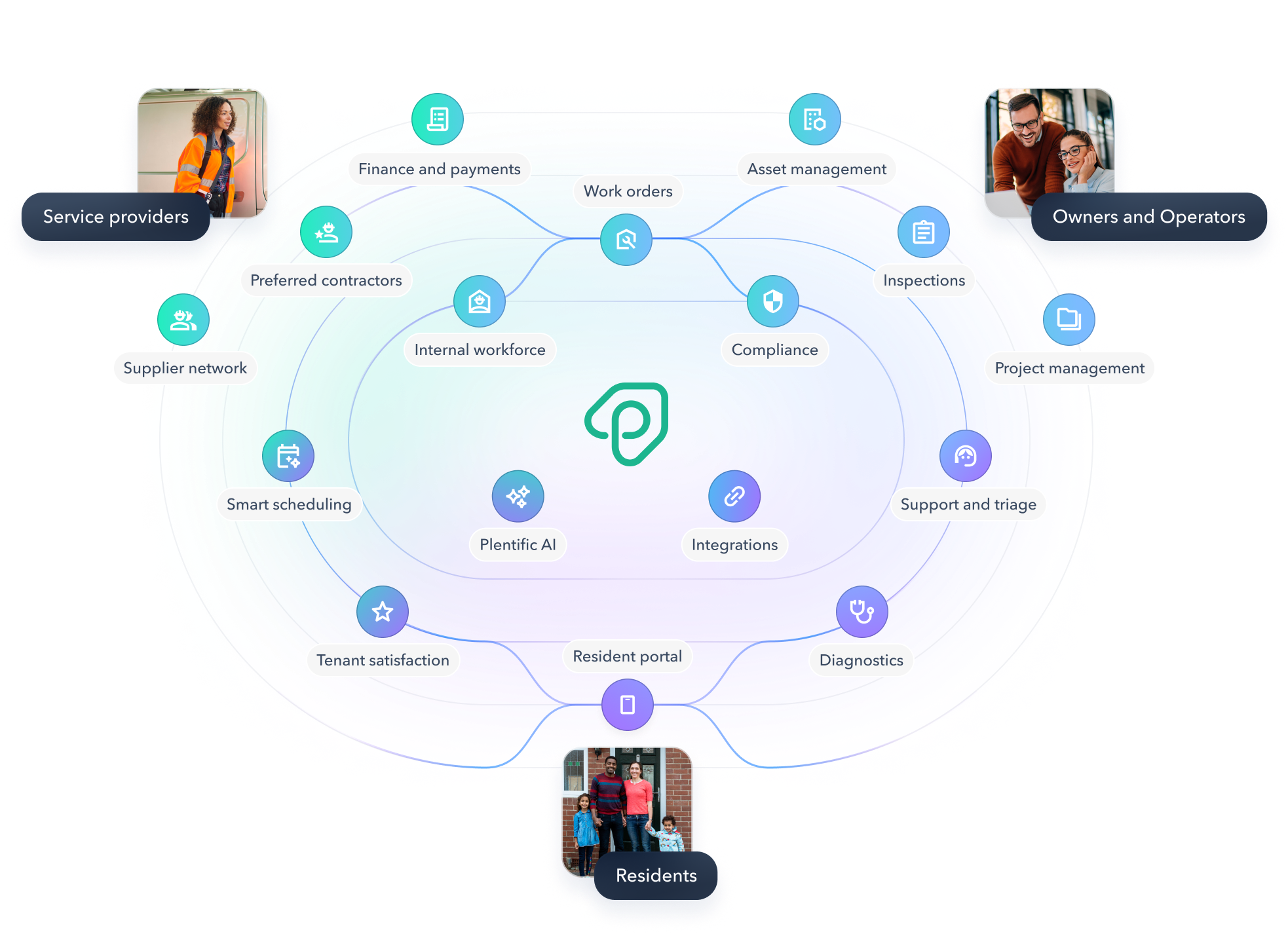
Field Service Management adds dynamic scheduling, mobile job records, offline capture and stock tracking. Payments links invoices to work orders and supports approval rules and financial-system integration. Managed services extend the offer beyond software access. Together, these products address the unglamorous steps that determine whether a visit can be scheduled, supplied, recorded and paid for without another round of chasing.
The price of keeping everyone connected
Plentific’s G-Cloud 14 price list makes the software economics unusually tangible. The core annual charge follows a committed volume of work orders. At 10,000 orders, the published rate is £15.50 each, producing a £155,000 annual fee before VAT. At 100,000, it is £9.30 each, or £930,000 annually. The schedule applies the same work-order price across marketplace suppliers, appointed contractors and internal teams.
Those figures buy platform access, not the underlying repair labour or materials. Implementation is separate: the published core-platform schedule ranges from £7,500 for up to 5,000 properties to £71,250 in its largest band. Optional modules carry additional charges. Where customers use Plentific’s payment processing for appointed contractors, the schedule lists a 2.5% fee on the final invoice value; off-platform settlement avoids that processing charge.
This is a budget decision about the whole operation. A buyer needs to compare software, setup and service costs with the value of fewer repeat visits, less administration and shorter vacancies. A lower price per work order at greater volume still produces a larger annual commitment. Counting subscriptions alone would miss both the potential savings and the expense of changing how people work.
Bars compare the per-order rate, not the total bill. Annual totals: £155,000 and £930,000 respectively. Published G-Cloud 14 rates; VAT, implementation and extras excluded.
The meeting that gave an afternoon back
L&Q’s account offers a quieter measure of value. Its voids and lettings teams had spent three hours in weekly alignment meetings. After introducing a shared voids-duration report, that became 30 minutes. The old process relied on spreadsheets, multiple mailboxes and information passed between people. The revised workflow made the status of work easier to inspect together.
L&Q also began opening a void project when an end-of-tenancy notice arrived, giving teams approximately two months to prepare for a property becoming vacant. Tasks, inspections and work orders could follow a defined sequence. The organisation used a mix of internal teams, appointed suppliers and marketplace contractors. The transferable idea is to start the next process at the earliest reliable signal, then make its stages visible.
Peabody tested the service across 24,000 London properties. The case study describes seven contact-centre staff mobilised in six days and 650 repairs delivered in one trial week. It reports 93% first-time fixes and 90% positive resident feedback, with 176 follow-up telephone interviews used to assess performance. The figures have a deployment context and a feedback exercise behind them; they should keep both attached.
“Plentific gives us flexibility during demand surges.”Lisa Turner, Peabody
In Plentific’s customer account
AI meets the badly written work order
Plentific’s published AI features are more specific than the sweeping promise of autonomous property management. They suggest improvements to work-order descriptions, refine messages, guide contractors preparing quotes and flag possible duplicate requests for review. A more informative description gives the next person a better starting point. Duplicate detection tackles the possibility that the same problem has entered the queue twice.
Resident-facing tools extend that logic upstream. Plentific acquired Active Housing in June 2023, adding specialist resident self-service and diagnostics expertise. Today, Active Portal, Active Diagnostics and Active Onboarding cover activities from reporting repairs to digital tenancy sign-up. Residents can use a web portal or native app, while integrations connect their requests to the landlord’s existing records.
More recent company material emphasises connected field service and an Open Framework sponsored by CDS, with Plentific as managing agent. The framework links contractor selection and procurement records to work delivery. Its promise is easier access to an organised supply chain. The operational benefit depends on usable supplier capacity and properly configured workflows after the procurement step is complete.
Someone still has to answer the door
The company’s expansion has also involved subtraction. Plentific bought inspection-software business TouchRight in January 2022; in May 2025, trade publication The Negotiator reported its sale to a business controlled by David and Miriam Roth. That makes it a past acquisition, rather than a subsidiary to casually carry forward in a current company description.
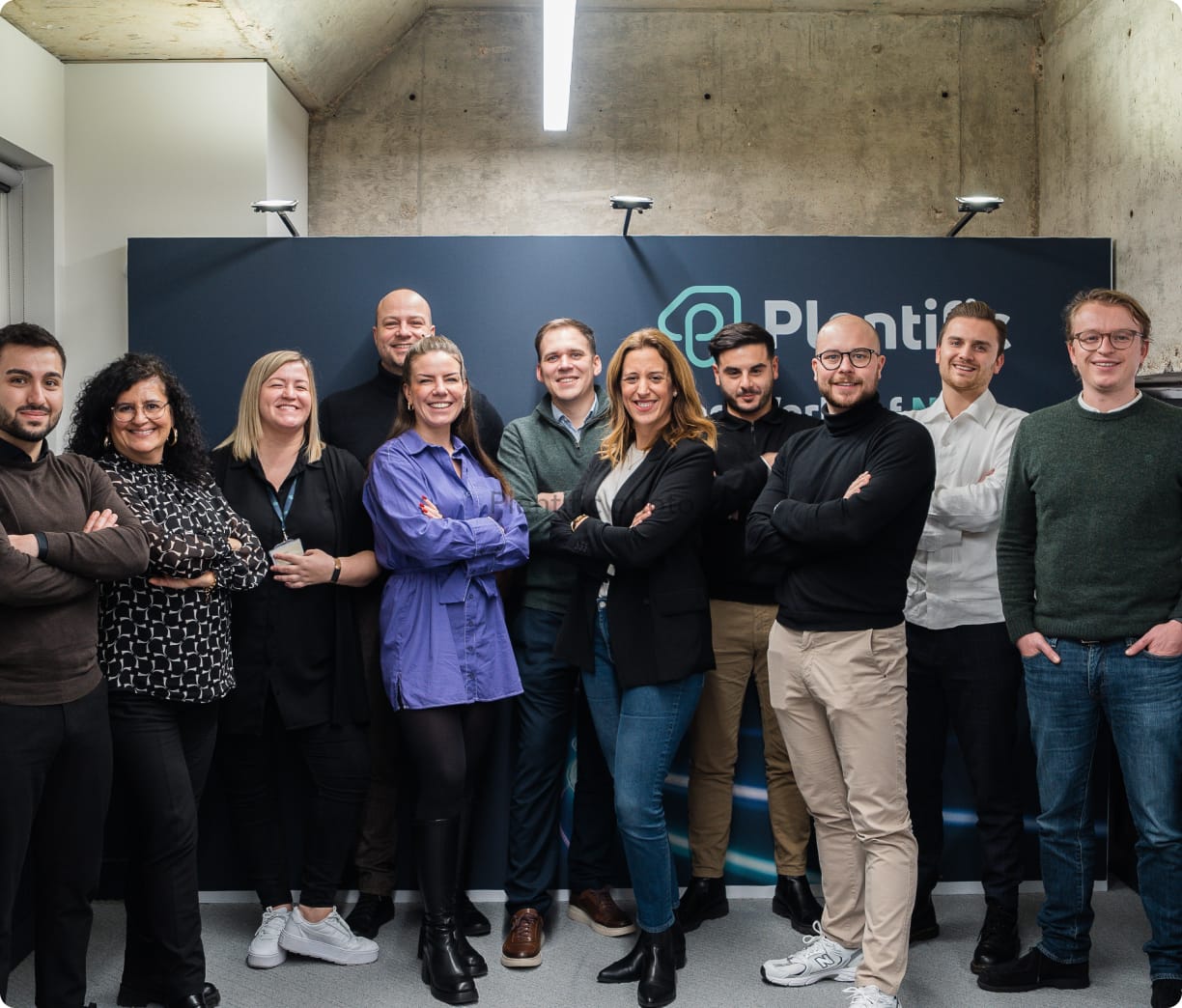
Plentific’s stated culture prizes teamwork, pragmatism and customer outcomes. Its work around the Women’s Trade Network, including collaboration with Peabody, also acknowledges that contractor supply depends on who gets opportunities to join the trades. The people doing the maintenance remain part of the product’s practical reach, even when they never work for the software company.
The conditions for success are demanding but understandable. Property records must be trustworthy. Staff and suppliers must update jobs. Residents need ways to get help when a digital channel is unsuitable. A marketplace cannot manufacture local trade capacity on demand, and an automated message cannot compensate for an appointment that nobody keeps.
For a prospective buyer, the sensible starting point is a bounded pilot with agreed definitions: time to appointment, completion time, first-time fixes, repeat calls and total cost per completed repair. Plentific’s strongest customer stories make the case through such observable changes. At the end of the chain, the resident has a much shorter scorecard. The problem was reported. Someone came. It is fixed.