At six in the morning, the difference between a franchise and a collection of shops is not the logo above the door. It is whether the person turning the key knows what happens next. Which temperature gets logged? Which course is overdue? Which inspection failed yesterday? Somewhere at headquarters there is a correct answer, beautifully preserved in a folder. This is a splendid comfort to headquarters and no help at all to the person with the key.
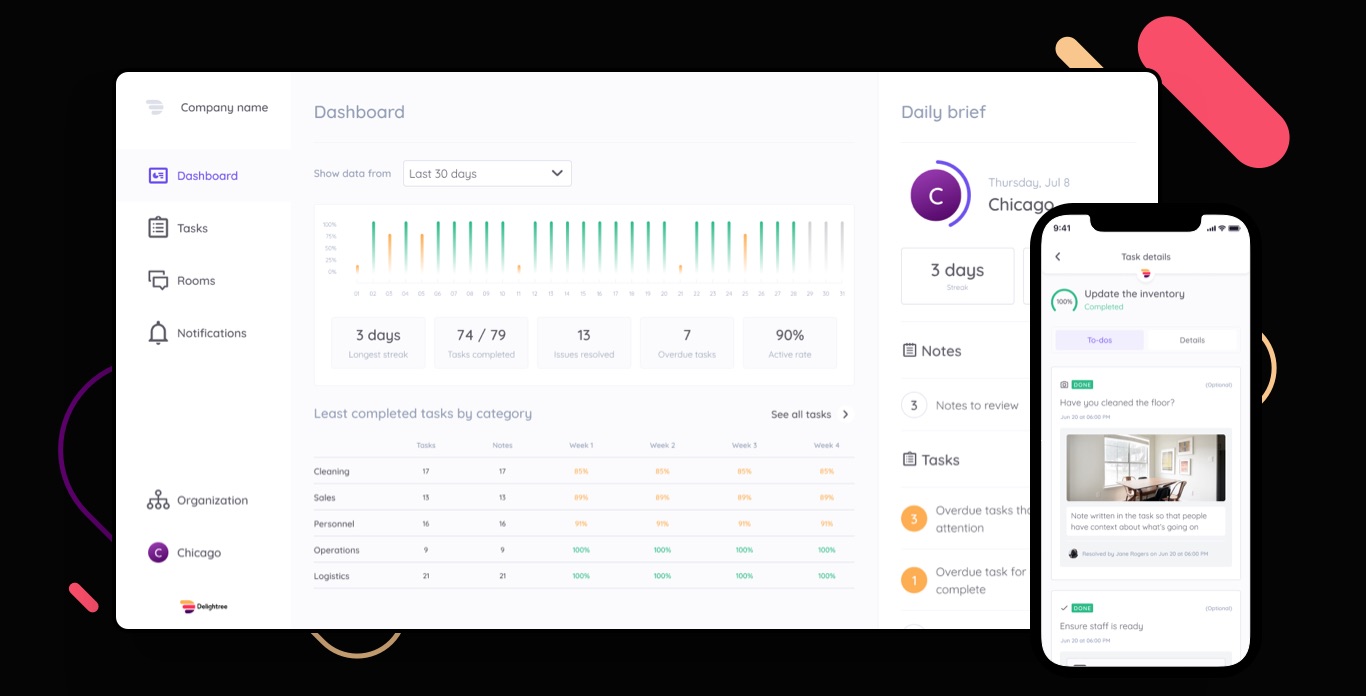
- Delightree puts launches, SOPs, training, tasks, audits, communications and reporting into one mobile-first system.
- More than 150 franchise brands use it; the company reports 136% net revenue retention.
- Pricing is quote-only, flat per location and includes unlimited HQ and corporate users.
- Its edge is connected execution. Its boundary is equally useful: it does not replace royalty accounting, franchise sales CRM, payroll or shift scheduling.
Delightree, founded in 2020 by Tushar Mishra and Madhulika Mukherjee, built its company around this small absurdity. Franchise software had become very good at keeping records and rather less good at causing anything to happen. A training course sat in one system, an opening plan in a spreadsheet, a safety audit in another app, a policy announcement in email, and the daily emergency in a group chat. Five tools for one job is how software companies count progress.
The first failureThe login that never happened
The first thing to break was adoption. The buyer was at HQ; the reluctant user was on the floor. Delightree’s most revealing doctrine is that franchise software is often “bought by HQ and endured by everyone else.” So it designed for the general manager opening at 6 a.m. - one app showing today’s tasks, required training, unread announcements and answers drawn from approved procedures.
This sounds less glamorous than artificial intelligence because it is more useful. If a franchisee will not open the software, the software does not exist. Delightree’s claimed 136% net retention matters here: existing customers are spending more over time. The platform is not merely getting through procurement; it is spreading through the operating stack.
What changedA filing cabinet learned to follow up
The platform now covers seven connected jobs: a knowledge base, training and onboarding, tasks and checklists, audits and site visits, location launches, communications, and dashboards. Each is ordinary by itself. The uncommon part is the handoff. An audit finding can become an assigned task. A task can trigger retraining. A policy update can demand acknowledgment. A new-location milestone can block the next phase. The work remains open until there is evidence that it closed.
Slick City supplies the cleanest account of the switch. As the indoor slide-and-air-court business grew beyond 32 awarded territories, its tasks, training, safety checks and opening work sprawled across five tools. The team met Delightree at the International Franchise Association convention and consolidated them. What changed its mind was not a dazzling new category. It was the accumulating tax of asking “where is that?” all day.
“Having everything in one spot is a game changer. Delightree pops up in our internal verbiage because it’s become part of how we operate.”Slick City leadership
The AI turnThree decisions, not 83 notifications
Once the work lives in one place, AI becomes less of a parlour trick. AI Search answers questions from the brand’s own SOPs and shows the source. Delphi lets a permitted user ask operational questions across the franchise hierarchy. Astra, now in early access, watches launches, training, audits, reviews and other operating signals. It detects a risk, suggests a cause, drafts the follow-up and waits.
That last verb is the point. Delightree’s formulation is “AI recommends. Humans decide.” Customer data respects existing roles and permissions; the company says customer-specific data is not used to train shared models. An operations leader should see three matters requiring judgment, not 83 notifications requiring patience. The machine does the chasing. A person approves the consequence.
“The most powerful thing AI can do for the American economy isn’t eliminate a job. It’s to create an owner.”Madhulika Mukherjee, co-founder
The moneyThe price of fewer passwords
Delightree does not publish a dollar price. It sells by quotation, charging a flat rate per location rather than per seat; HQ and corporate users are included. Network size is the main variable, with capabilities, roles, brands and rollout needs shaping the quote. Every customer gets hands-on onboarding and a named account manager. The absence of a public number is inconvenient. The pricing logic is not: charging for every frontline login would punish the adoption on which the product depends.
The company raised $25 million in August 2026 from Innovius, Accel, Timber Grove Ventures and Emergent. It plans to add engineering and product capacity and push further into agentic operations. Across its customer base, Delightree says locations open two to three months faster - at least 25% faster for a typical operator - while frontline teams recover as much as 30% of their time. Those are company-wide claims, not promises to every buyer, but they identify the economic prize: earlier revenue and less managerial chasing.
The useful imitationCopy the loop, not the software list
A reader can borrow Delightree’s method without buying Delightree. Begin with one standard that matters. Put it where the frontline already works. Turn it into training, then an assigned action, then a piece of evidence, then a corrective step. Give one person ownership. Do not call the process complete because a PDF was uploaded. Call it complete when the result is visible.
The method also requires restraint. A ten-location network with little compliance risk may run perfectly well on inexpensive point tools. A franchisor looking chiefly for candidate pipelines, royalty collection, payroll, time clocks or shift scheduling needs another system beside - or instead of - Delightree. And no connected platform can rescue poor operating standards; automation distributes nonsense more efficiently than a binder ever could.
Delightree fits networks whose expensive problem is execution across locations. It is a weaker fit when the central need is selling franchises, collecting royalties, running payroll or scheduling hourly labor.
The franchise business is an exercise in controlled repetition. The customer should get the same promise at location four and location four hundred, though the people, landlords and Tuesday mornings will all be different. Delightree’s wager is that the playbook must stop behaving like literature. It must become a sequence of visible events. The charming thing about a standard is that everyone agrees with it. The profitable thing is that someone follows it.