The useful way to understand BuildOps is to follow one repair call. A dispatcher needs to know which technician is free, nearby, certified, and carrying the right parts. The technician needs the equipment’s history before opening the panel. The office needs legible notes. Accounting needs labor, material, and tax data attached to the correct job. The owner needs to know whether the whole exercise made money. In too many commercial contracting firms, each answer lives in a different place - or in somebody’s head.
BuildOps sells the connective tissue. Founded in 2018 in Santa Monica by Alok Chanani, Steve Chew, and Neeraj Mittal, the company built cloud software for commercial specialty contractors: the mechanical, electrical, plumbing, refrigeration, and fire-safety firms that keep expensive buildings functioning. In March 2025, a $127 million Series C led by Meritech Capital Partners, with BOND and SE Ventures participating, valued it at $1 billion.
That valuation is the glamorous fact. The product is a parade of deliberately unglamorous verbs: schedule, dispatch, quote, track, inspect, order, bill, collect. BuildOps connects those actions across a browser application and mobile field app, then synchronizes the financial record with systems such as Sage Intacct, NetSuite, QuickBooks, and Viewpoint. Its newer Projects suite adds RFIs, submittals, change orders, drawings, budgets, procurement, and live job costing. OpsAI sits inside the workflow, matching technicians to calls, reading equipment nameplates from photographs, summarizing field notes, surfacing repair recommendations, and helping draft invoices.
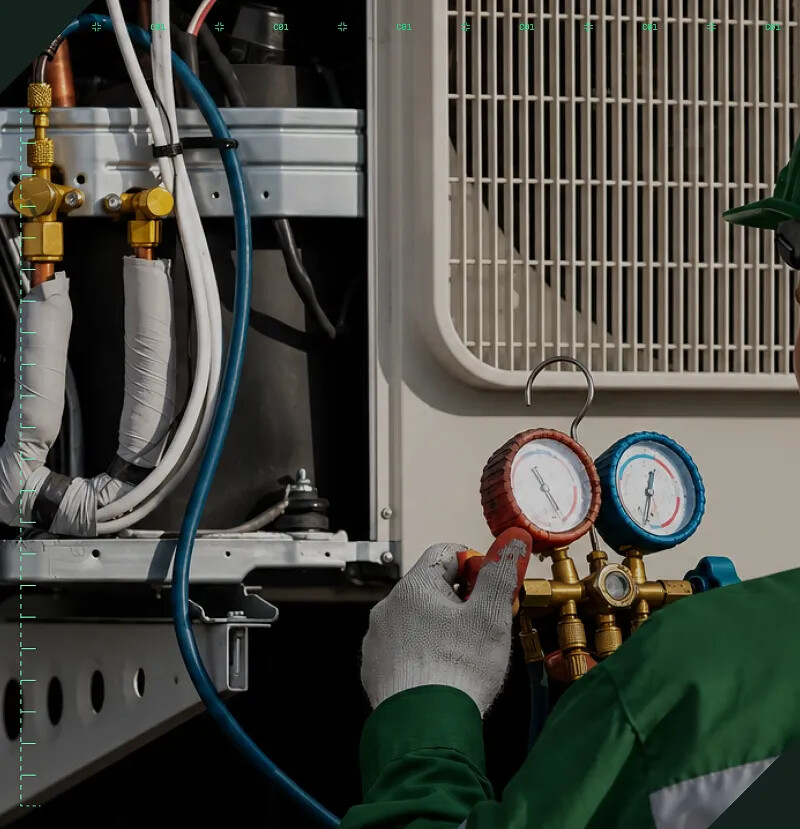
The million-dollar shop with a group-chat nervous system
Chanani, a former U.S. Army transportation-unit commander in Iraq who later ran a commercial real-estate business, saw contractors managing multimillion-dollar operations through spreadsheets and WhatsApp. Chew brought experience from Microsoft and other technology companies. Mittal had worked as a ServiceTitan developer. Together they spotted a neglected middle: residential field-service software did not naturally model a hospital’s dozens of assets or a multi-month electrical project, while general-contractor software watched the overall build rather than the specialty contractor carrying labor and material risk.
The whole strategy fits inside one sentence: what happens on the roof must show up in the ledger.
That sounds obvious until a technician’s handwritten note arrives two days late, a purchase order misses its cost code, or an approved quote waits for someone to retype it. The first thing to fail as a contractor grows is often not field execution. It is the handoff. A busy shop can add revenue and still lose control because billing lags, job costs are stale, dispatch depends on tribal knowledge, and service histories scatter across folders.
One record, five handoffs
BuildOps’ competitive claim is not merely that it has these modules. Plenty of rivals do. It is that the data stays attached while work changes shape. A piece of equipment installed during a project becomes an asset with a history. That history can drive preventive-maintenance visits, which create recommendations, quotes, scheduled work, invoices, and recurring revenue. The loop matters more than any individual screen.
The price is private. The cost is operational.
BuildOps does not post a standard dollar price. It builds a proposal around field and office seats, trades, service or project modules, and the integrations a back office requires. Subcontractors managed inside the product do not need their own licenses, and implementation and onboarding are included in plans. Buyers therefore cannot compare it with a cheap scheduling app by glancing at two monthly fees.
What does it really cost?
The invoice is only one line. The fuller budget includes roughly three months of implementation on average, data cleanup, ERP mapping, internal process decisions, training, and the temporary slowdown that accompanies any serious operating-system change. G2’s review data also estimates a nine-month average time to return on investment. Those are marketplace averages, not promises.
This is where the sales demo collides with the shop floor. Every old spreadsheet contains an exception somebody invented for a reason. Every dispatcher has a favorite shortcut. Every accounting integration embodies decisions about customers, inventory, taxes, and job codes. BuildOps’ implementation team can configure software, but it cannot make a customer agree with itself. The contractor must decide which habits are valuable and which are merely familiar.
The early failure point is usually adoption or integration. Verified reviewers praise centralization, usability, and support, while others describe a learning curve, update-related quirks, delayed mobile location data, limited customization, or accounting records that require correction after syncing. Those complaints do not erase the value proposition. They define its conditions. A connected system is only as trustworthy as its weakest handoff.
The numbers are good - and properly labeled
BuildOps’ 2026 customer benchmark surveyed 54 customers across HVAC, electrical, plumbing, and fire and life safety. Seventy-two percent reported revenue growth since implementation, 76 percent reported better margins, 75 percent reported faster invoicing, and 80 percent said their offices handled more volume without adding headcount. Customers reported replacing 2.6 tools on average. These are self-reported outcomes from BuildOps customers, not a randomized comparison with firms that did nothing.
Specific customer stories make the mechanism clearer. BuildOps says Layer One moved job costing from two weeks behind to daily. One customer cut average receivables from roughly 120 days to 30. Jolma Electric reported a 50 percent efficiency improvement after reducing administrative work. Rolls Mechanical reported 44 percent revenue growth in its first year on the platform - after an earlier software implementation attempt taught the company what it actually needed.
That last detail is worth lingering over. What changed the buyer’s mind was not a feature checklist. Failure produced a better specification. Rolls Mechanical learned to define its requirements before selecting the next system, then valued the connected path from the first customer call through job completion. Software buyers love to begin with vendors. The better place to begin is an autopsy of the current process.
AI that wears work boots
BuildOps is now describing itself as AI-native, but its better ideas avoid the chatbot-for-everything trap. Smart Dispatch recommends a technician using skills, location, and availability. A photo can capture data from a sun-bleached equipment plate. Smart Recap turns field notes into a customer-ready account. OpsAI can scan completed visits for repair opportunities and move a recommendation toward a quote. BuildOps reported that 4,500 AI-surfaced recommendations became quotes in the first 90 days and that quote time for those recommendations fell about 60 percent.
The appeal is not intelligence in the abstract. It is compression. A five-minute clerical step repeated across thousands of visits becomes cash-flow drag. The AI is useful when it removes that drag without inventing a part number, assigning an unqualified technician, or obscuring the person accountable for the decision. Commercial work has safety rules, union constraints, customer contracts, and equipment worth more than some houses. Automation needs guardrails and clean records.
What another operator can steal
BuildOps offers a playbook for founders and a buying checklist for contractors. The founder version begins with a customer boundary: serve the commercial specialty trade deeply enough to model the annoying exceptions. Observe the work before drawing the workflow. Connect to the accounting systems customers will not remove. Put AI inside an existing decision rather than beside it. Measure quote speed, travel, billing time, and margin instead of announcing that productivity feels modern.
The buyer version requires more skepticism. A residential-first shop that mainly needs inexpensive scheduling may be happier with Jobber, Housecall Pro, or another lighter product. An inspection-heavy fire business may prefer ServiceTrade’s emphasis on deficiency documentation and customer portals. A contractor unwilling to standardize data or train both office and field users will simply centralize confusion. And a company whose accounting stack cannot integrate reliably should resolve that question before signing, not during go-live.
BuildOps now sits in a crowded fight with ServiceTitan, ServiceTrade, Simpro, Procore, Salesforce Field Service, and older contractor ERPs. Its defense is specificity. The company has expanded from service into projects, payments, analytics, and AI without abandoning the specialty contractor as the main character. The December 2025 acquisition of Spover brought forecasting and data-operations talent into the platform, while new hubs in Raleigh and Toronto widened its operating footprint.
The company’s 2026 Inc. 5000 rank, No. 336, followed reported three-year revenue growth of 1,012 percent. Its Forge conference has grown beyond 600 attendees, a product-development loop disguised as an industry gathering. A Harvard Business School partnership is studying the skilled-labor gap. These moves make sense together: BuildOps cannot create more licensed electricians with software, but it can help the existing crew waste less of the day hunting information and waiting on paperwork.
There is a clean reason investors put a billion-dollar price on this business. Commercial contractors do vital, complicated work inside an economy that notices them mainly when something stops. BuildOps made the back office visible enough to become a market. Its fate will depend on a less cinematic achievement: whether the technician, dispatcher, project manager, and accountant all believe the same record by Friday afternoon.