Graham Audenart’s painting business had a peculiar problem. The work could be finished beautifully, yet the paperwork would disappear. Estimates went missing. Invoices went missing. The company lost them; customers lost them too. Between 2003 and 2010, Painters Enterprise ran on carbon copies, notebooks and loose sheets. A painter could leave a room looking better than he found it and still leave the office with another mess to clean up.
- Jobber connects the customer request to the final payment.
- Its customers do hands-on work: cleaning, landscaping, plumbing, painting and more.
- The useful idea to copy: repair the handoffs before adding more work.
The paperwork went missing first
Audenart tried software. What bothered him was the number of programs required: one for managing the business, another for invoicing, others for the remaining tasks. Every additional system introduced another place to look. “I wanted something all-encompassing,” he recalled in a 2020 customer story published by Jobber.
Sam Pillar and Forrest Zeisler, two software developers who met at an Edmonton coffee shop, built around that problem. Jobber launched in 2011. The founders talked to people in other trades and heard similar frustrations. A landscaper and a painter use different tools on site, but both need to know who ordered the work, when it happens and whether anyone has paid.

That gave the company a repeatable starting point. Build for a real business, then investigate whether its frustrations travel. By 2020, Audenart was running three service businesses using Jobber. He described looking up an old client’s job, recovering the products used and preparing another price. The software had become a memory that survived the missing sheet.
One job, five connected steps
Jobber is cloud software for home and commercial service companies. Its expertise sits in a particular sequence: a request becomes a quote, the quote becomes scheduled work, the completed work becomes an invoice, and the invoice becomes a payment. Customer records connect the sequence. Crews can check schedules and job details through the mobile app.
- 01Request
- 02Quote
- 03Job
- 04Invoice
- 05Payment
Consider an illustrative gutter-cleaning job. The homeowner sends a request. The owner prepares a quote. Approval moves the work into the schedule, with an assigned crew and job details. When the visit is complete, the business invoices the customer and collects payment. Recurring services follow the same logic across repeated visits. The attraction is continuity: each stage carries information into the next.
Housecall Pro, Workiz, FieldPulse and ServiceTitan offer alternatives in field service software. Jobber’s case rests on its connected workflow across more than 50 industries, rather than a single trade. For an owner piecing together spreadsheets, a calendar and an invoice generator, that coherence can matter more than a lengthy feature comparison.
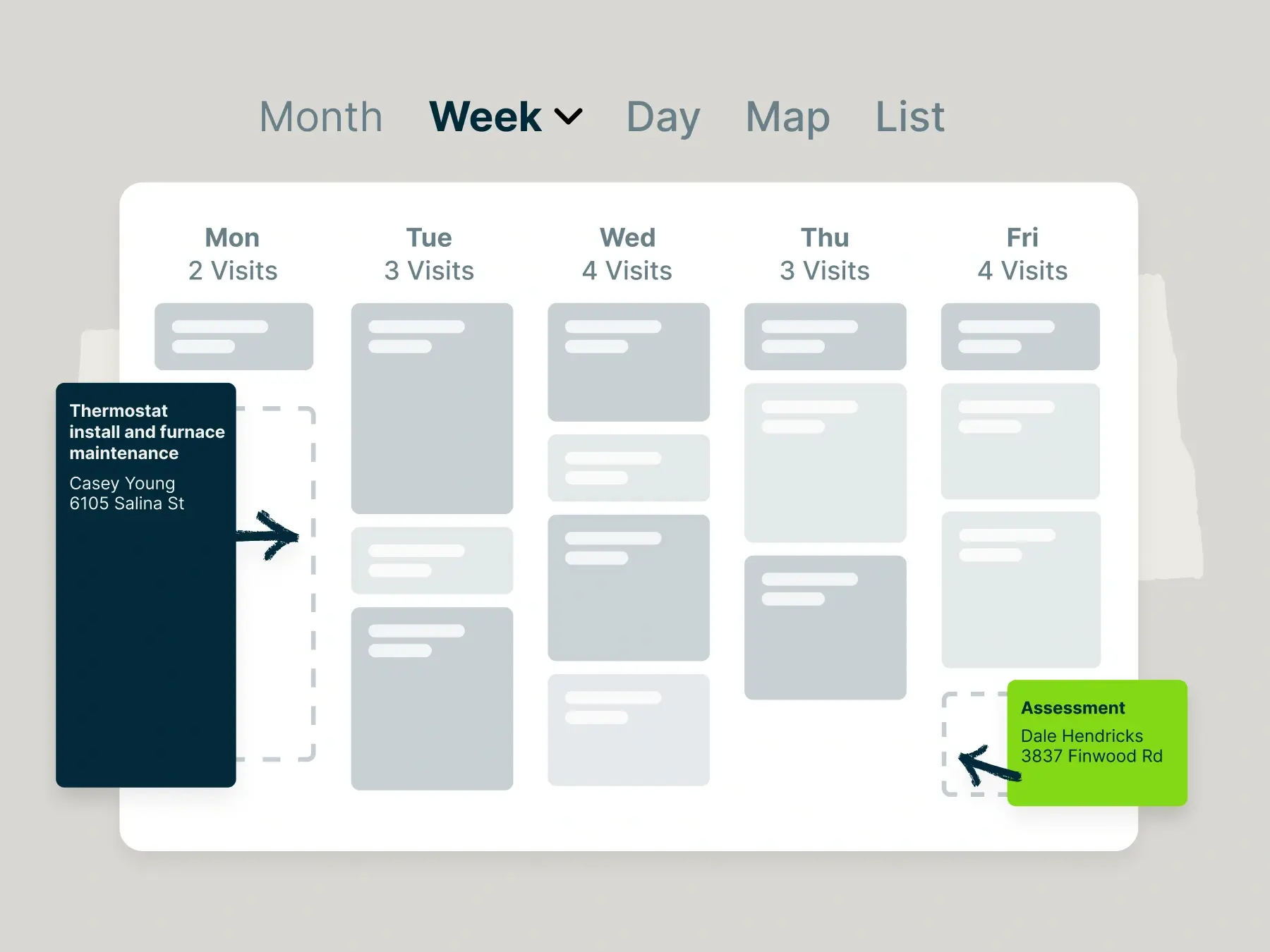
Jobber also reaches beyond the visit itself. Marketing tools help businesses collect reviews, ask for referrals and contact previous customers. Accounting integrations connect operations to the books: its Xero partnership was announced in July 2024, and QuickBooks Online synchronization is included in eligible subscriptions. Wisetack adds consumer financing for eligible U.S. businesses.
“Before Jobber, I was organizing everything by paper”
Graham Audenart · Painters Enterprise
The price of getting your evening back
Jobber earns money through subscriptions, paid add-ons and payment processing. As checked in October 2026, its one-user Core plan lists US$29 a month billed annually, or US$49 without a commitment. A five-user Connect plan lists US$149 a month billed annually, or US$199 without a commitment. Features such as automated follow-ups and QuickBooks Online synchronization sit above the entry tier.
Core, one user, billed annually
$348 for the yearUSD · listed pricing checked October 10, 2026 · before taxes, add-ons and transaction feesThe entry price therefore means US$348 for the year. Processing costs sit alongside it: the pricing page lists online credit-card processing at 2.9% plus 30 cents per transaction. Methods and countries have their own terms. The sensible calculation includes the subscription, the right number of users, the functions needed and the cost of collecting money.
There is also an organizational price. Someone must enter the client information, keep the schedule current and teach the crew where to record work. My practical reading: test one complete job during the trial. Watch where information still gets retyped. A business that leaves half its workflow in text messages will leave some of the benefit there too.
A bigger bet on ordinary businesses
The investors bought into this everyday machinery. Summit Partners led a US$60 million growth round in January 2021. General Atlantic led a US$100 million Series D in February 2023, with money intended for research, sales, marketing and customer acquisition. At that second announcement, Jobber reported its revenue had tripled since the earlier round.
More than 400,000 service professionals using Jobber daily.
By May 2026, Jobber reported more than 100,000 customer businesses. Its customers had delivered over US$100 billion in services. That last figure describes work performed by customers, not money earned by Jobber. Keeping those numbers separate matters: the software company grows by helping other companies run their own operations.
Its remit extends beyond software. Jobber publishes economic reports drawn from platform activity, offers business education and runs grants for service entrepreneurs. The 2026 grants program offers US$250,000 across nine recipients. Its careers material emphasizes humility, support and accountability. These efforts place Jobber alongside owners who need management knowledge as well as a working calendar.
The phone can answer itself
Jobber’s newer AI products follow the original administrative problem. Copilot launched in October 2024 with business guidance and data analysis. Receptionist became generally available in August 2025, answering calls and texts and booking work. Current help documentation also describes voice tools for creating quotes, sending invoices and checking schedules hands-free.
The appeal is easy to picture: someone working at a customer’s property can miss an incoming call. Receptionist can handle routine contact while the owner finishes the job. Owners control what it can do. Availability depends on the plan; the July 2026 guide lists a US$29 monthly add-on with 30 conversations on select plans, and unlimited usage included in Plus.
Useful automation still needs accurate business rules and human judgment. My takeaway from Jobber’s story is to organize the work first, then automate the repeated parts. Audenart began by wanting his estimates and invoices to stop disappearing. Fifteen years after launch, Jobber is still selling a better way to keep track of the day.