Imagine a lawyer finishing a six-minute call. The advice was sound. The client was relieved. Then another email arrived, a hearing moved, and the six minutes slipped away. By evening, the work still existed. Its record did not. For a firm that bills by time, memory has just become a rather expensive member of staff.
This is the territory CARET inhabits: the space between doing the work and keeping the business straight. The company sells practice management software, payments and cloud services to legal and accounting firms. Its flagship cloud platform, CARET Legal, brings matters, documents, calendars, billing and accounting together. The proposition is practical enough to sound dull until you have tried collecting money for work nobody remembered to record.
- One matter, many moving parts: CARET Legal connects case work with billing, accounting and client communication.
- A business with history: the portfolio reaches back to AbacusLaw in 1983; Zola Suite supplied a newer cloud foundation.
- A deliberate narrowing: CARET sold enterprise HotDocs in 2024 while keeping a practice management integration.
- The current bet: its 2026 release targets forgotten time, shifting priorities, court dates and recurring retainers.
The first problem was keeping track
CARET’s lineage begins with Abacus Data Systems and its founder, Judd Kessler. The company’s first product, AbacusLaw, arrived in 1983. The problem was the paper-and-pencil administration of a law practice: cases, appointments, contacts and the persistent need to know what should happen next. A lawyer’s expertise might win a matter. A neglected calendar could still spoil the week.
Over time, the business enlarged its scope. In its account of its first 35 years, Abacus described a shift under CEO Alessandra Lezama, who joined in 2013, toward the wider IT needs of professional firms. Software was one part of the office. The machines, access and hosting behind it were another. That history helps explain why CARET’s portfolio still contains both practice software and Abacus Private Cloud, a managed virtual workspace for business applications.
Then came a decisive cloud move. In March 2021, funds affiliated with Thomas H. Lee Partners acquired a majority stake in AbacusNext from PSG. That July, AbacusNext and Zola Suite announced their combination. Zola, launched in 2015, brought a native SaaS application with case management, timekeeping, billing and integrated accounting. The older business brought resources, payments and document automation. The arrangement joined different generations of legal technology under one roof.
Organize the practice
Add a cloud foundation
Narrow the focus
Surface overlooked work
A name that needed more room
Accumulating products creates a curious problem. Customers need to know what they are buying, while the parent company needs to explain what connects the purchases. AbacusNext had reached that point by 2023. Its own brand introduction was refreshingly plain: Our identity was confusing.
AbacusNext, Zola Suite and the other names were competing for attention within the same family.
After months of conversations with employees, partners and customers, the company adopted CARET. Zola Suite became CARET Legal. The name referred to the proofreading mark that indicates an insertion. It was an unusually literary answer to a software problem: make room. The company also published four team-defined values, including succeeding together and embracing progress, and describes its people as a global team able to engage from anywhere.
The more revealing decision came in June 2024. CARET sold its enterprise HotDocs document automation business to Mitratech. HotDocs served large law firms and financial institutions; CARET said the sale would let it concentrate investment on midsize law firms and AI capabilities. It retained what it described as the exclusive legal practice management integration with HotDocs. Ownership of the entire product was no longer necessary to keep a useful connection.
The interesting move was keeping the connection while selling the business.The HotDocs decision, June 2024
Follow the matter, then follow the money
To understand CARET Legal, follow a client through the office. An inquiry becomes a contact and a matter. Documents and emails need a home. Tasks and dates need owners. Work needs a time entry, an invoice and eventually a payment. Accounting needs to distinguish the firm’s money from funds held in trust. CARET’s pitch is that these steps can share a system rather than depend on repeated transcription.
The portfolio offers several routes. AbacusLaw and Amicus Attorney serve established practice management needs. OfficeTools addresses tax and accounting practices. Abacus Private Cloud hosts business applications in a managed workspace. CARET Legal is the cloud platform at the center of the newer legal story, with CARET Pay providing integrated payment processing.
The strongest explanation is a small customer example. CARET’s account of Virginia Beach firm Parks Zeigler describes lost data and documents before the transition, followed by fewer manual processes. In a separate integration announcement, Dunham Law in Kentucky used CARET Legal to access NetDocuments files, create workspaces and search its document system. Founder Brian Dunham said the connection saves time and allows Dunham Law to deliver client services efficiently and professionally
.
Those are vendor-published accounts, rather than controlled studies. Their value is in identifying the trouble: misplaced information and awkward transitions. The useful question for another firm is whether its own trouble looks similar.
- Client inquiry
- Active matter
- Recorded work
- Invoice & payment
Illustrative workflow, not a measured performance result.
Integration leaves the door open
CARET operates in a crowded legal practice management market, alongside alternatives such as Clio and MyCase. Its particular case rests on legal accounting inside the workflow, configurable processes, and a portfolio spanning desktop software, hosted applications and SaaS. These are reasons to investigate it, not a guarantee that it fits every practice better.
Its partnerships are also instructive. A January 2025 Lawmatics integration connects intake to case management. NetDocuments handles specialist document needs. The Domo partnership announced in September 2024 brings embedded analytics to such questions as aging receivables, staffing and future revenue. A firm can want a central operational record and still want specialist tools around it. CARET appears comfortable selling both ideas at once.
The corporate website reports more than 10,000 firms served across legal and accounting. The current legal site separately says more than 6,500 firms trust CARET. These are different company claims with different scopes, not numbers to add together. The audience includes attorneys, managing partners, office managers, bookkeepers and IT administrators: the people who encounter the same matter from decidedly different angles.
The price of a better memory
CARET Legal’s published subscription prices are $79, $99 and $119 per user per month, billed annually. Enterprise supplies core practice features. Enterprise Plus adds automated workflows, more permissions and document capabilities, with standard analytics. Enterprise Insights adds configurable analytics reports and dashboards. One-time implementation fees sit alongside the subscription.
What would the seats cost?
Annual seat cost only. Excludes implementation, payment processing, add-ons and tax. Published pricing checked October 1, 2026.
For ten users, the annual seat bill starts at $9,480. The higher plans bring it to $11,880 or $14,280. That arithmetic explains the business model: recurring software revenue, with payments and cloud services extending the relationship. It also explains why the purchase deserves a working demonstration. A bundle is economical when people use its connections. Unused features are merely rent.
The August 2026 terms also make the order consequential: annual orders generally require written notice at least 60 days before expiry to avoid renewal, and fees may increase annually. Buyers should check the actual term, migration scope and implementation price before signing. Familiar work deserves as much scrutiny as unfamiliar software.
The next entry still needs a human
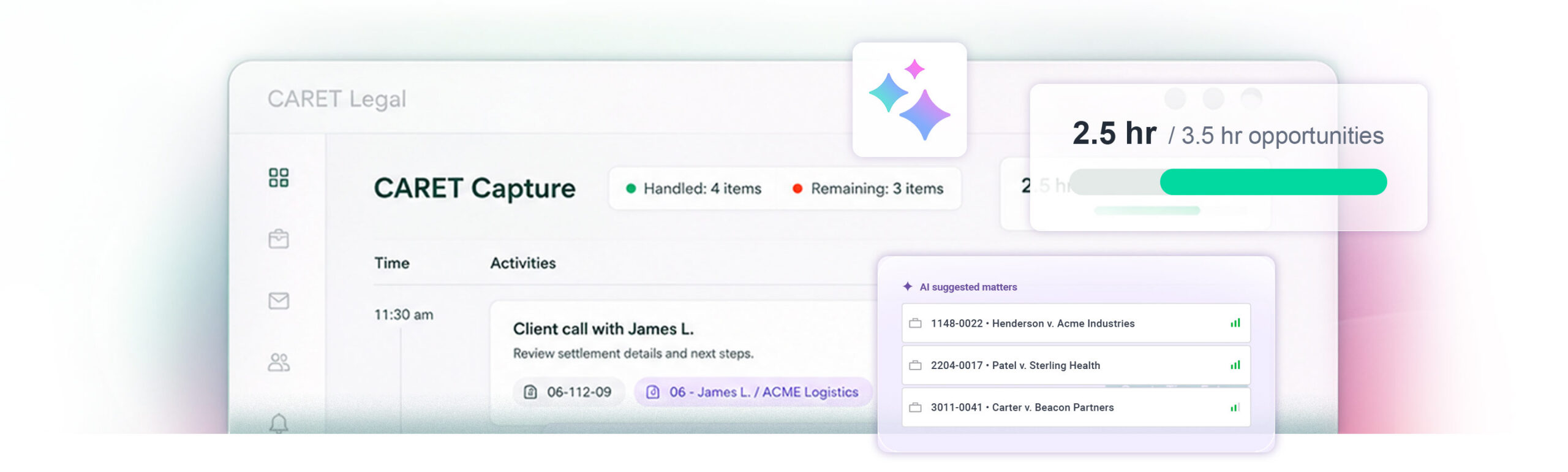
Jay Kuhlman became CARET’s CEO in June 2025. Its summer 2026 release makes the company’s current priorities concrete. CARET Capture identifies potentially billable activity for review. Command gathers deadlines, tasks, billing issues and matter activity into a dashboard. Court Rules calculates related deadlines from a trigger date. New dashboards address performance and forecasting; recurring card or ACH payments handle scheduled retainers.
The modest detail in Capture matters: the attorney reviews the activity and turns it into a time entry. Useful automation gives a person something to inspect. It does not relieve that person of knowing whether the work belongs on a client’s bill.
What can another firm copy? Start by mapping one matter from inquiry to collection. Count where someone retypes information, searches for a document or reconstructs a day. Demonstrate those exact transitions with real working examples before choosing a platform. This is an editorial buying principle, not a promise of a particular return.
Its limits are equally ordinary. Inconsistent records make analytics less useful. Staff who bypass the agreed process leave gaps in the central view. A practice that needs unusual workflows or wants to keep its existing specialist tools should test those requirements explicitly. CARET’s appeal depends on the office adopting the connections it is paying for. Even a better memory needs something worth remembering.
Take a closer look
CARET website · Explore CARET Legal · Plans · 2026 product release
YouTube demos & tutorials · Lawmatics integration webinar · Parks Zeigler customer video
LinkedIn · X · Facebook · Company news · Product blog