The product began where many good vertical-software companies begin: with an expert muttering, surely there is a better way. Caleb Frankel was working emergency shifts as a veterinarian when the available tools kept getting between the clinical team and the animal in front of it. Paper treatment sheets could be misplaced. Clunky programs demanded duplicate entry. Charges documented in one place failed to arrive on the invoice. A handoff at shift change could depend on a marker board, memory, or luck.
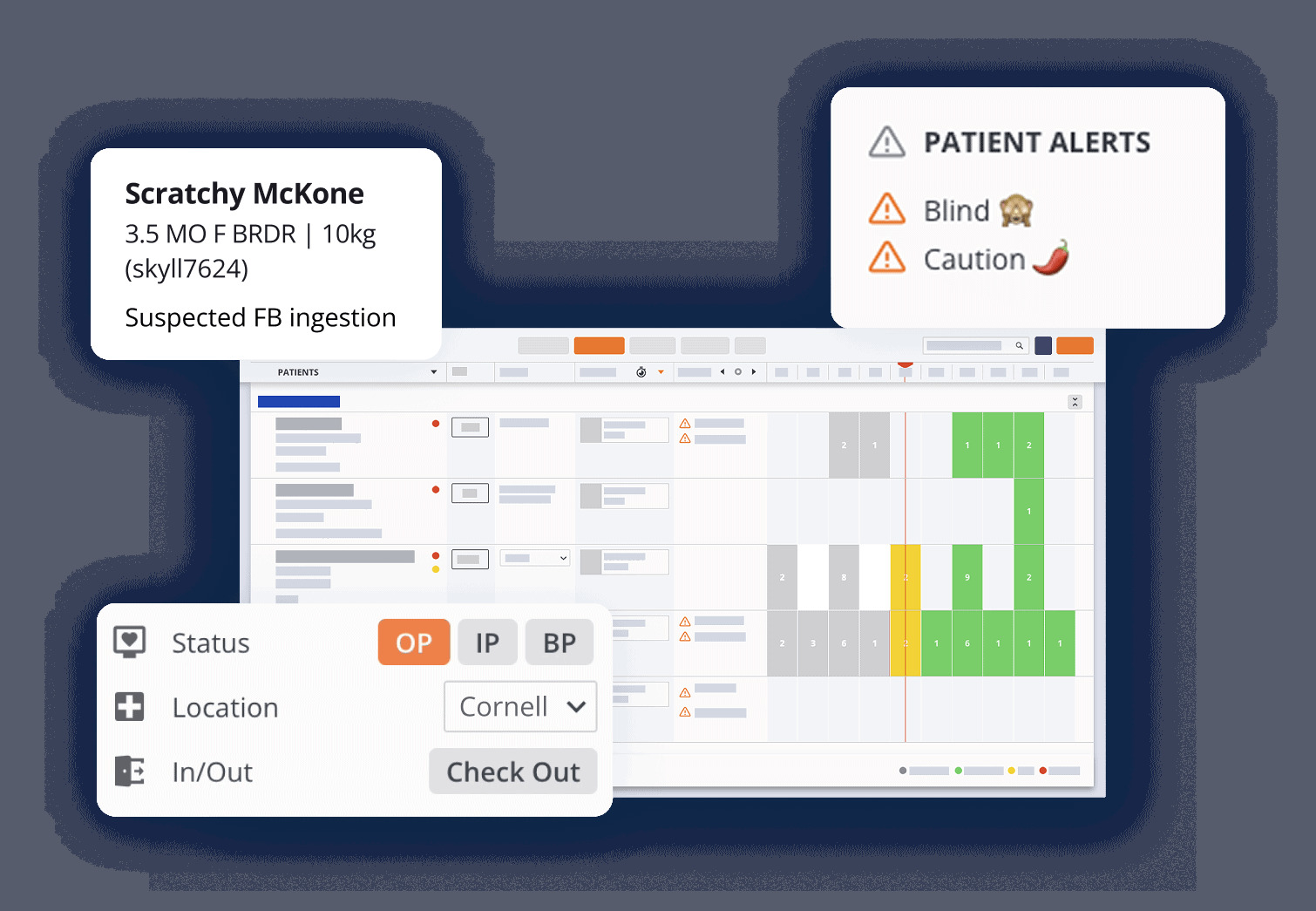
Frankel founded Instinct Science in 2017 to fix that specific mess. The first product, now called Instinct Treatment Plan, digitized the nerve center of inpatient care: treatment sheets, whiteboards, orders, task timing, safety alerts, and billing capture. Crucially, a hospital did not have to throw out its existing practice-management system on day one. Instinct could sit alongside it. That made the first purchase less like open-heart surgery and more like replacing one unreliable instrument.
The narrow entrance eventually opened onto a large room. Instinct built a full cloud practice-management and electronic medical record platform. It added scheduling, medical records, payments, inventory, client messaging, analytics, and around-the-clock support. Then it bought VetMedux in 2024, bringing the Plumb's veterinary drug reference and Clinician's Brief into the family. In 2026 it acquired ScribbleVet, an AI scribe. The company now describes a connected suite used by more than 360,000 veterinary professionals worldwide.
First: stop the paper from winning
Instinct's founding insight was not that veterinary hospitals needed more software. They already had plenty. The insight was that care and administration had been split into separate chores. A technician administered a medication, marked it on a sheet, and later someone translated that event into a charge. Every translation was a chance to miss revenue or information. Instinct made the clinical action and the billing action part of the same workflow.
That is the unromantic engine of the business. Patient-safety warnings and dose calculators matter to clinicians. Automatic charge capture and cleaner invoices matter to owners. A shared status board matters to everyone when a critical dog is en route and the next shift needs to know. The product earns its place by making those interests overlap.
“With Instinct, it felt like we had a chance to shape the product and be heard.”Mallory K., Nelson Animal Hospital
Customers range from young urgent-care practices to teaching hospitals and large specialty centers. Public case studies include the University of Tennessee College of Veterinary Medicine, Veterinary Emergency & Referral Group, Enchanted Mountains Urgent Veterinary Care, Nelson Animal Hospital, and Oakland Veterinary Referral Services. Their problems differ in detail but rhyme: aging servers, too many programs, email fatigue, inconsistent handoffs, after-hours charting, and a practice that has outgrown the software selected years earlier.
The system of record learns to think
A conventional EMR is an archive. It is useful because it remembers. Instinct is betting that the next version should also intervene. When a clinician prescribes, Plumb's can put drug information and interaction checking nearby. Standards adds evidence-backed guidance, differential lists, algorithms, calculators, and client handouts. ScribbleVet turns a recorded conversation into a draft note and can review uploaded records. The aspiration is not merely fewer tabs. It is better context at the instant a decision is made.
The acquisitions make strategic sense because each asset answers a different question. What happened to this patient? The EMR knows. What dose is appropriate? Plumb's helps. What should the workup consider? Standards organizes the evidence. What did the client and doctor discuss? ScribbleVet drafts the account. The work is integrating those answers without turning the screen into a cockpit nobody can fly.
That last clause is the risk. AI-generated notes still require professional review. An integration can fail because a partner changes a system. Instinct itself cautions that HL7 is not a magic button; workflow design, implementation, and testing still matter. Clinical decision support can surface information, but it does not assume responsibility for the medical decision. In a high-stakes setting, convenience has to arrive with restraint.
What did it cost?
Instinct does not publish a numeric EMR price. At the full-platform launch, it described an all-in monthly fee tied to a percentage of invoice collections rather than a simple per-seat charge. Current pricing is demo-led. That alignment is attractive if better charge capture expands collections, but practices should model the fee against their own volume and ask which products, integrations, payments, migration work, and support are included.
weeks
A typical onboarding, according to Instinct, plus roughly 50–70 hours of hospital work for setup, migration, templates, training, and workflow preparation. Subscription price is only one line in the ledger.
The migration is where the romance ends. Nelson Animal Hospital replaced three programs with one cloud system, but its case study still mentions data-migration difficulties and “growing pains.” Training, templates, permissions, product catalogs, historical records, and staff habits all have to move. A good interface does not cancel organizational change.
What failed first - and what changed minds
The first failure was not Instinct's code. It was the old operating model: paper for treatment, a server-bound PIMS for records, separate software for anesthesia, and group messages to negotiate who could log in remotely. As hospitals added clinicians, locations, and cases, those seams became visible. The tool that had been tolerable at one size became the bottleneck at the next.
What changed buyers' minds was usually not a grand speech about digital transformation. It was proof around a mundane job. Doctors could open records from home. A treatment entered once could flow to the invoice. Staff could see an incoming emergency on a shared board. A feature request could enter the roadmap. At VERG, the difficult adjustment was relearning workflows that staff had accepted as normal. Then, as one executive described it, the light bulb came on: “Ah, this is how it should be.”
Instinct also changed its own mind about scope. A treatment layer was useful, but the company concluded that fragmented PIMS products were the larger constraint and launched a full EMR. More recently, it moved beyond transactional software. Buying clinical content and AI documentation signals a view that the durable platform will combine operations and judgment support rather than keeping them in separate subscriptions.
The part founders can steal
- Enter through the costly seam. Instinct found a workflow where safety errors and revenue leakage shared a cause.
- Integrate before replacing. The treatment product could coexist with a legacy PIMS, lowering the first adoption hurdle.
- Make one action serve two buyers. Documenting care also captures the charge, satisfying clinician and owner.
- Expand along the user's next click. Record, reference, decision support, and note drafting are adjacent jobs, not random features.
- Price the change, not just the license. Publish realistic training and migration effort so the buyer can plan the transition.
Where it wins - and where it doesn't
The veterinary software market is crowded with established PIMS vendors, cloud newcomers, client-engagement suites, pharmacy and inventory systems, and a noisy crop of AI scribes. Instinct's distinction is the combination of veterinarian-led workflow design, an EMR built around digital treatment sheets, trusted clinical-reference brands, and live support suited to hospitals operating overnight. It is vertical software in the literal sense: the deeper it goes into veterinary work, the harder it is to compare on a checkbox grid.
Conditions that favor Instinct
Complex inpatient care, multiple doctors or locations, emergency handoffs, meaningful missed-charge risk, remote access needs, and a team willing to redesign workflows.
Conditions that weaken the case
A tiny clinic seeking the lowest upfront cost, unreliable connectivity, unwillingness to dedicate migration time, dependence on an unsupported integration, or a preference for separate best-of-breed tools.
The larger wager is that a veterinary platform can become both operational infrastructure and a trusted knowledge surface. That requires discipline. If every acquired product becomes another login, the thesis collapses into a bundle. If AI creates plausible but unchecked prose, saved minutes can become clinical risk. If percentage-based pricing rises faster than perceived value, alignment starts to feel like a tax.
But the sequence is worth studying. Instinct did not begin by declaring itself veterinary medicine's operating system. It began with a treatment sheet, at the exact spot where a real hospital was dropping information and money. The company earned the next workflow from the previous one. In vertical SaaS, that is often how the grand platform arrives: not as a platform at all, but as the first tool on a terrible shift that finally behaves the way the work does.