The troublesome number in a dental practice is often the one nobody asks about. A schedule looks full. The team looks busy. Treatment has been diagnosed, appointments have been completed, and everyone has earned the right to go home. Somewhere between all that activity and the bank account, however, a little friction has become a considerable sum.
Dental Intelligence sells software for that interval. It connects to a practice’s existing management system, makes its performance visible and supplies ways to act: contact a patient, fill an opening, send a form, request a payment. Its subject is dentistry. Its recurring problem is the handoff.
- Analytics finds gaps in schedules, treatment acceptance and collections.
- Patient communication and booking tools help staff follow through.
- Acquisitions added LocalMed’s scheduling and Modento’s engagement tools.
- A 16-office customer learned that buying software and adopting it are different jobs.
A customer wanted the numbers, without the consultant
In a 2021 conversation, co-founder and former CEO Weston Lunsford described a business that began with analysts helping dental practices understand their performance. Then the customers grew more capable. They wanted access to the information themselves. The request he recalled was wonderfully inconvenient for a consulting business: “I just want the data and analytics and tools and insight”.
That is a useful clue for anyone building a business tool. A service can reveal a repeatable problem. Customers who learn to solve it may become better software buyers than consulting clients. Lunsford’s account suggests that demand for independence helped shape Dental Intelligence’s direction.
The company dates its founding to 2012; its investor’s announcement dates the analytics product launch to 2015. Those dates describe different beginnings. The former belongs to the company, the latter to the product that could put the numbers directly in a dentist’s hands.
The report has to become somebody’s job
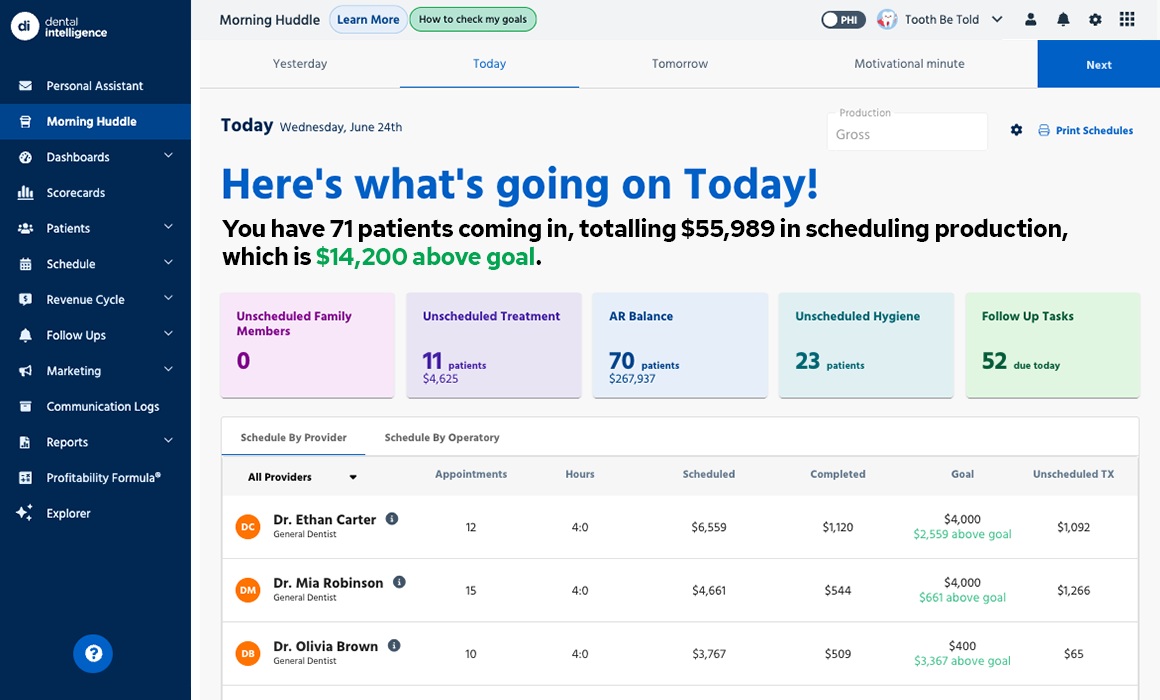
The practical machinery is less mysterious than the name. Morning Huddle provides a daily briefing. Scorecards organize performance measures. Patient Finder turns patient records into filtered lists. Follow-ups give a team a way to pursue unfinished business. An owner can look at the practice; an office manager can look at the day.
The distinction between production and collection matters here. Production describes work performed and its recorded value. Collections describe money received. A practice may improve the first while struggling with the second. Dental Intelligence’s reporting separates those conversations rather than letting one large number stand in for the health of the business.
Patient Finder illustrates both the power and the fussiness of the approach. The Analytics version filters a practice’s patient population using multiple criteria. Its documentation also explains why a search may disappoint: restrictive filters, narrow date ranges or differences in how the two modules define active patients. The list is only useful if someone understands what qualified a patient for it.
- 01ReadExisting practice records
- 02FindA gap worth addressing
- 03ActA message, booking or payment request
- 04CheckWhat actually changed
An editorial illustration of the workflow, not a measured performance funnel.
Buying the next step
In September 2019, Dental Intelligence announced a $34 million minority Series A investment from K1 Investment Management. Part of the funding supported the acquisition of LocalMed, which supplied real-time online appointment scheduling. The announcement also identified product development, hiring and enterprise partnerships as uses for the investment.
In March 2021, the company acquired Modento. Its capabilities included two-way communication, reminders, digital forms, virtual check-in and team chat. The strategic logic is easy to follow: a report can identify a patient who needs attention; scheduling and communication tools can help turn that discovery into an appointment.
Today, Engagement includes patient messaging and administrative workflows. Payments adds requests by text or email, payment plans and account visibility. DI Insurance is powered by Vyne. CareCredit integration brings financing applications and payments into the workflow. Each addresses another place where staff might otherwise stop, change tools and start again.
Sixteen offices were fifteen too many to start with
North Carolina Pediatric Dentistry’s company-published case study gives that strategy a useful test. Finance leader Kelly Thome faced 16 offices with inconsistent reporting and aging receivables. Staff had lost trust in a previous reporting system and returned to their own manual numbers. A colleague’s experience with Dental Intelligence, followed by a demo, persuaded her to change.
The initial all-office rollout stumbled. Thome asked the implementation team to slow down, get a few offices working properly and then expand. Training and billing-process changes accompanied the software. The story reports accounts-receivable days moving from more than 90 to about 18, but the lesson is in the sequence: establish a workable routine before multiplying it.
“Once a team stops trusting a system, they stop using it”
Kelly Thome, North Carolina Pediatric Dentistry, in Dental Intelligence’s customer case study
That is a vendor-published customer account, not a controlled comparison. Its result belongs to a particular organization and a set of operational changes. It is nevertheless unusually helpful because the software purchase did not produce instant cooperation. The implementation had to change.
The small print has a character limit
Dental Intelligence’s business model is subscription software sold to practices and groups. Analytics, Engagement and a bundle are available; selected capabilities require upgrades. Base subscription fees are specified in customer orders. For a buyer, the useful price is therefore the complete quote for the intended workflow.
SMS segments included monthly in Engagement and full-bundle subscriptions under the published policy.
The SMS policy makes one part of the bill concrete. Consider an additional 2,500 segments in a month: at the listed overage rate, they cost $100; a prepaid monthly block costs $50. That comparison assumes the published terms apply to the customer’s agreement. A segment is a billing unit, so a long message can use more than one. Brevity has acquired an accounting department.
A wider suite, with a few doors still open
The market offers alternatives with different emphases. Jarvis Analytics concentrates on dental business intelligence and multi-practice reporting. Weave overlaps in communication, payments and AI reception. Dental Intelligence’s proposition combines analytics and the patient-facing actions around it. Buyers should compare the jobs their staff need to complete, including the integrations each job requires.
Its expertise is deliberately dental. The company says one in six team members is a dental professional. Its published mission is to make the profession more fulfilling and the patient experience easier. Its careers material stresses ownership, outcomes and community. Those are declared values; the product’s more tangible evidence is its attention to dental-specific work such as hygiene reappointment and treatment follow-up.
Updated August 2026 documentation describes the Better Together workspace, consolidating Analytics and Engagement. The consolidation has limits worth understanding: enterprise DSO reports remain in the Analytics-only portal, as does the Analytics Patient Finder. A shared workspace can reduce switching while still leaving specialist tools elsewhere.
The newest employee answers questions
Explorer, documented in August 2026, adds conversational queries against a practice’s own data. An owner or manager can ask about production, collections or patient trends instead of assembling every report manually. AI Receptionist works on a different problem: calls that staff cannot answer, including after hours. The company describes patient recognition, appointment scheduling, payment links and call summaries.
The useful test for either feature is specific. Can a manager inspect the numbers behind an answer? Does a booked appointment follow the office’s rules? Does the team know which calls need personal attention? Practices evaluating the tools can use those questions to make a demo resemble their working day.
The broader lesson is available without buying anything. Pick one gap. Agree on its definition. Give someone responsibility for acting on it. Check whether the action changed the result. That routine needs dependable records, compatible systems and staff time; a dashboard will struggle where those conditions are absent. Dental Intelligence’s story is interesting because so much of its work lives in these ordinary details. A patient remembers a helpful message. A team remembers a shorter list. A practice notices when the money finally arrives.
Keep exploring
Follow the company, inspect the workflows or watch the product in action.