The modern law firm has a peculiar way of misplacing money. Nobody leaves a sack of cash in a taxi. The losses arrive in tenths of an hour: an email answered without a timer, a pre-bill waiting for a partner's pen, a payment recorded in one system but not another. Excellent legal work happens. The invoice, somehow, takes the scenic route.
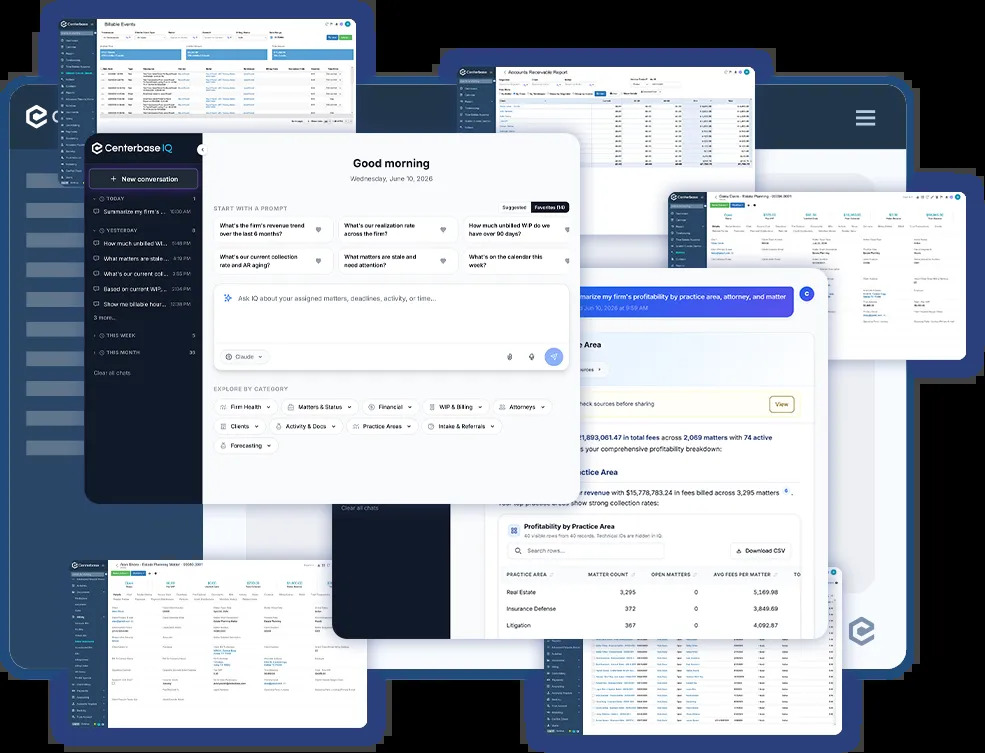
Centerbase makes software for that unglamorous distance between work performed and cash collected. Its cloud platform puts matters, documents, calendars, timekeeping, bills, payments, firm accounting and trust accounting in one record. More recently, Centerbase IQ lets a managing partner ask that record a plain-English question - which attorney was most profitable this quarter, say - and see the underlying entries behind the answer.
The company is aimed squarely at midsize firms, a market that has historically had two awkward choices. They can stretch a simple small-practice app until it wheezes, or keep a powerful server-era system that requires specialists and workarounds. Centerbase sells a third option: the depth of a serious back office, the accessibility of the cloud and enough configuration to preserve how a particular firm works.
A company born twice
Centerbase did not begin with a courtroom revelation. Founder John Forbes sketched the idea on an airplane napkin because he wanted one system to run his own midsize technology company: workflow, billing, accounting and customer relationships together. While the product took shape, Forbes's daughter was in law school. The overlap became difficult to miss. Law firms had matters instead of projects and trust ledgers instead of ordinary bank accounts, but the operating problem was familiar.
Development and customer feedback pulled the software toward legal. Centerbase made its industry debut at ABA TECHSHOW in 2017. This was the consequential change of mind: not a new feature, but a narrower customer. The product stopped trying to be a flexible system for any business and became opinionated about legal billing, conflicts, trust reconciliation, pre-bills and the strange choreography of a law firm month-end.
The ugly middle is the market
The cleanest way to understand Centerbase is to follow one hour of legal work. An attorney opens a document in Word, answers a client in Outlook, records time against the matter, pushes the entry through electronic pre-bill review, sends an invoice, accepts a card or ACH payment and reconciles the deposit. Each handoff is a chance for delay, re-entry or error. Centerbase's advantage is less about winning each feature in isolation than about keeping the chain inside one data model.
That explains the broad product list. Matter management stores people, deadlines, tasks and documents. Automated workflows can open records, populate templates, send notices or schedule activities when a status changes. Time capture works through mobile, Word and Outlook. Billing handles electronic pre-bills, split payors and legal invoice formats. Native general-ledger and trust accounting support three-way reconciliation. A client portal exposes selected bills, files and calendar items without exposing the rest of the firm.
The company also bought its way toward both ends of the lifecycle. Family Law Software, acquired in 2021, adds the specialized calculations and paperwork of divorce practice. Legalfit, acquired in 2022, adds law-firm websites, search marketing and intake. In 2025, Centerbase launched payments powered by Stripe. The intended loop now begins with a prospective client's web visit and ends with collected revenue and a profitability report.
A $35,000 argument, with fine print
Centerbase's most persuasive evidence comes from mundane before-and-after stories. At Griffith Davison, lawyers once made handwritten time notes because their decade-old system lacked convenient mobile entry. Billing meant printing, revising, reprinting and mailing. After moving timekeeping and billing into Centerbase, the firm reported capturing 10 additional billable hours per attorney each month and cutting a 25-day billing cycle to three days. Payments arriving within 30 days rose by 25 percent.
At Latham, Luna, Eden & Beaudine, attorneys emailed administrators for basic figures and sent time to paralegals for entry. Cutting a check took eight steps. The firm reported saving 75 hours a month and roughly $35,000 a year after centralizing the work. Billing went from about 10 days to three, and receipts arrived an estimated 20 percent faster.
These are company-published case studies, not controlled experiments. A buyer should not paste the numbers into a budget and call it diligence. The useful part is the mechanism. Contemporaneous time capture finds work that memory misses. Electronic review removes paper from the billing queue. Self-serve dashboards stop finance staff from becoming a human report API. Online payment shortens the distance between invoice and cash.
“It gets the bills out, so we get paid.”Hannah Eaves, managing partner, Elias Law Group
Elias Law Group supplies the most dramatic implementation test. In 2021, 74 lawyers and 25 staff left an Am Law 100 firm with 600 clients and more than 1,000 matters. Centerbase had six weeks to stand up billing and timekeeping with incomplete information constrained by confidentiality. The new firm reported that 99 percent of its first bills went out on time. Accounting manager Chanel Lawrence no longer had to email 600 to 800 invoices individually each month.
AI after the plumbing
Centerbase waited until 2026 to make AI the front of the story. That restraint matters. Centerbase IQ does not primarily draft briefs or summarize discovery. It answers questions about the business: work in progress older than 60 days, partner profitability, aging receivables, matter margins. Responses include charts and citations back to source records. The company says a firm can enable it in under five minutes because the data already lives in Centerbase.
This is a sober use of generative AI. The hard work happened earlier, when time entries, invoices, trust transactions and matters were made consistent enough to query. A chatbot on top of six disagreeing systems would only produce faster confusion. Centerbase's wager is that owning the operational record gives its intelligence layer a narrower, more auditable job.
The NetDocuments ndMAX integration announced in March 2026 extends that logic. NetDocuments handles the work product; Centerbase handles the matter and financial context around it. Microsoft 365, iManage, LawToolBox and Plaid fill other edges. The platform is broad, but it is not pretending a law firm will abandon every specialist tool.
The price is a project, not a button
Centerbase does not publish a standard subscription price. Quotes are scoped to firm size and requirements. The company includes onboarding and training, and describes a typical implementation as a 12-to-14-week journey through data cleanup, test migration, configuration, training and go-live. Professional services, advanced training and Legalfit marketing can cost extra. Centerbase Payments has no monthly platform fee, but each transaction carries a fee.
That is not the buying experience of a five-person team opening a credit card account on Friday. It is closer to replacing a firm's circulatory system. Configuration is the attraction and the tax. Reviewers often praise custom fields, reporting and support; some also describe a learning curve and an initially overwhelming feature set. A firm gets value only if attorneys enter time, partners approve bills and administrators agree on the new workflow.
The honest fit check
- A very small practice with basic matters may pay for depth it never uses.
- A firm unwilling to clean data or name process owners will carry old disorder into a new system.
- Teams committed to a separate accounting core should test the promised single source of truth carefully.
- The strongest returns depend on measurable leakage: missed time, slow billing, duplicate entry or weak reporting.
What another operator can copy
The Centerbase playbook is more portable than its feature list. First, look for a market stranded between a simple tool and an enterprise suite. Second, respect its complexity instead of sanding it away. Third, connect the steps closest to revenue. Fourth, migrate history, because a system without yesterday's matters cannot become tomorrow's source of truth. Finally, add AI only where the answer can point back to a record.
For a law-firm buyer, the copyable move is equally plain: baseline the current billing cycle, unrecorded time, report requests and reconciliation hours before watching a demo. Choose one ugly workflow and make every vendor run it end to end. Ask who owns data cleanup. Put adoption targets in the rollout. Measure the same four numbers 90 days after go-live. A giant feature checklist is less revealing than one invoice making the complete trip.
Centerbase now serves more than 500 midsize firms and is backed by growth investor Mainsail Partners. Michael Dunn, who became CEO in 2025, inherited a company that had more than doubled revenue under predecessor Paul Bridgewater. The opportunity is substantial, but its shape has not changed much since the napkin: make a complicated business legible to the people running it.
There will always be shinier corners of legal technology. Centerbase lives near the ledger, where a missing six-minute increment is small until it happens thousands of times. Its pitch lands because it respects a basic truth. Law firms sell judgment, advocacy and time. The software earns its keep when all three survive the journey to the bill.