ProfitSolv lives in the small, expensive gap between doing professional work and getting paid for it. A lawyer opens a matter, records six-minute increments, stores client files, moves money into the correct account and sends a bill. An accountant chases documents, assigns a tax-season workflow, tracks time, collects a signature and nudges an invoice. Every handoff is a place to lose an hour, a document or a client.
This is not the part of business that earns a keynote. It is the part that earns the money. ProfitSolv, formed in 2020 by private-equity firm Lightyear Capital, has spent its short life assembling software for those handoffs. Rocket Matter handles legal practice management. TimeSolv tracks time and billing. CosmoLex combines matters with firm and trust accounting. Tabs3 brings decades of legal billing history. Mango serves accounting practices. Law Ruler manages leads and intake. TitleTap builds the digital front door. LexShare and LexSign move files and signatures. Clearview Social helps professionals distribute content.
The result is less a single product than a well-stocked hardware store for firms. In June 2025, new investor FTV Capital said the portfolio served about 21,000 small and midsized businesses, from solos to firms with more than 150 practitioners. ProfitSolv's own site counts more than 100,000 professionals and more than 250,000 matters and projects. The company says the business scaled tenfold from launch through that 2025 investment.
The roll-up began with a broken handoff
ProfitSolv's first three building blocks were Rocket Matter, TimeSolv and ImagineTime, an accounting-practice platform now represented in the portfolio by Mango. The founding thesis was blunt: professional software and payments were fragmented, firms were still pushing work through paper and disconnected point products, and the market would reward integrated systems. In legal services alone, the opportunity was then estimated at $1.4 billion. By 2025, investors described the combined U.S. legal and accounting practice-management market as larger than $5 billion and growing at more than 10 percent a year.
What failed first in the old setup was rarely the lawyer's legal analysis or the accountant's tax judgment. It was the administrative relay race. A lead arrived but never became a clean client record. Time was captured late. An invoice had the wrong detail. A document waited in somebody's inbox. A client intended to pay, but the payment page lived somewhere else. ProfitSolv did not invent these failures. It bought products that had spent years learning their local dialects.
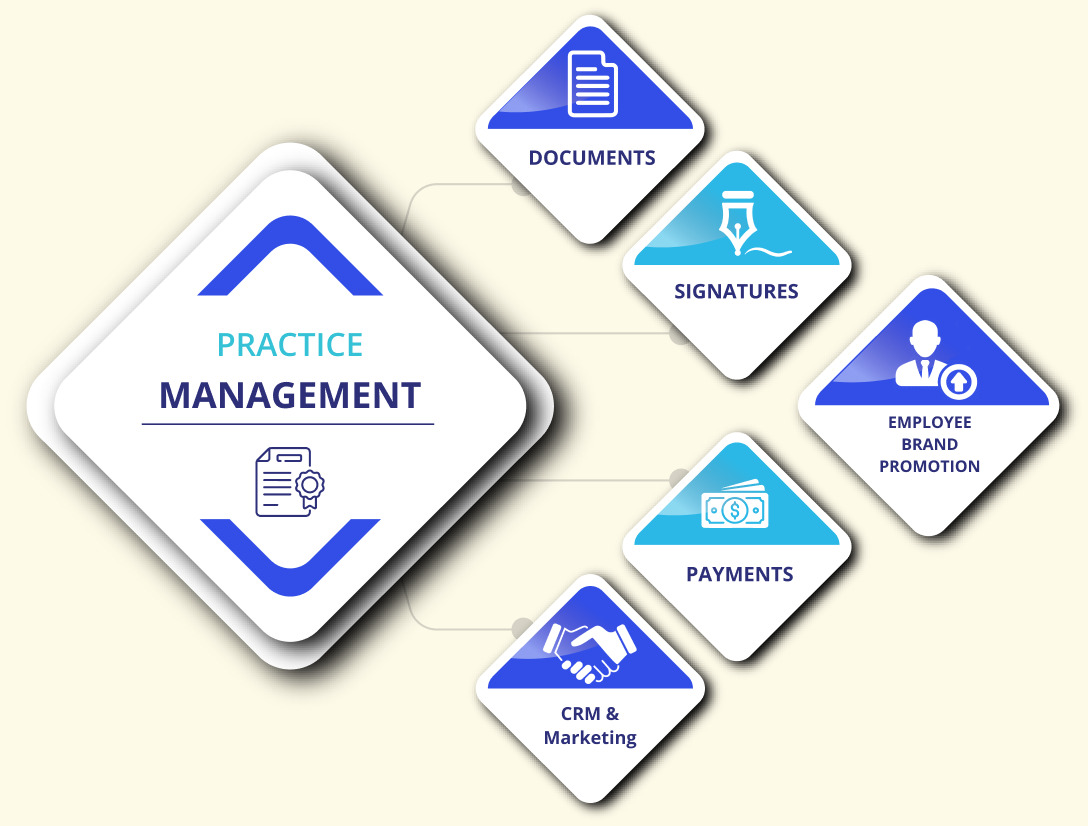
One owner, several front doors
A conventional SaaS pitch promises one clean replacement for everything. ProfitSolv's portfolio quietly admits that the world is messier. A solo attorney who wants a cloud service is not the same buyer as a 70-person law firm with years of Tabs3 workflows. A CPA practice cares about tax deadlines and document requests in a way an architecture firm does not. Some customers want an all-in-one system; others want a billing specialist that connects to tools they already trust.
That explains why ProfitSolv kept a shelf of recognizable brands instead of repainting every product the same color. Tabs3 traces its roots to 1979 and remains associated with deep billing, financial and trust-accounting functions. CosmoLex, developed in 2012 and launched as a company in 2013, offers a cloud system with accounting built in. Rocket Matter was an early cloud legal-practice product. TimeSolv focuses on time and billing across legal and other professions. Each is an answer to a slightly different version of the same anxious question: can I trust this system with the work that becomes revenue?
“Without ProfitSolv, professionals are left juggling multiple systems and manual workflows.”FTV Capital, explaining its 2025 investment
This variety is a competitive weapon against broad horizontal products and a practical response to specialist rivals. In law, ProfitSolv meets Clio, MyCase, PracticePanther, LEAP and CARET Legal. In accounting, Mango encounters Canopy, Karbon, TaxDome and the improvised QuickBooks-centered stack. For payments, portfolio products face LawPay and generic processors. ProfitSolv can sell industry-specific accounting and compliance, deployment choice and built-in payments. A generic project manager can imitate a task list. It has a harder time imitating trust-account rules, legal billing codes or decades of firm data.
Payments turn useful software into an economic engine
Subscription fees are only the first layer of the business model. The more interesting layer appears when the software creates the invoice and presents the payment option. ProfitSolv products support cards, ACH transfers, recurring billing, payment plans, retainers and, in TimeSolvPay, trust-compatible payments. A 2025 update advertised next-day funding and sign-up inside the TimeSolv application. PayPal was added as another portal option.
That placement matters. The payment is not a separate financial errand; it is the final step in a workflow the software already understands. A firm gets fewer systems to reconcile and a shorter path to cash. ProfitSolv gets transaction economics on top of recurring software revenue. FTV has used this embedded-finance playbook elsewhere and said it saw room to expand it here. The June 2025 strategic investment, co-led with Lightyear, was earmarked for product and AI development, payments, go-to-market work and more acquisitions. The amount and acquisition prices were not disclosed.
There was a moment of strategic suspense just before that investment. In March 2025, Fortune reported that ProfitSolv was seeking a buyer and could fetch around $1 billion. The market for mergers was sluggish. Three months later, the announced outcome was not a clean exit: FTV joined as an investor and Lightyear stayed. The public record does not reveal the boardroom debate, but the transaction itself shows what changed. The next chapter would be financed around continued product work, payment expansion and acquisitions, not handed wholesale to a new owner.
The useful lesson - and the trap
There is a playbook here that another vertical-software builder can copy. Start with a profession where mistakes are costly and workflows are full of rules. Buy or build products with genuine domain memory. Preserve the brand customers recognize. Add adjacent tools at the handoffs where data gets retyped. Put payments next to billing. Serve more than one company size instead of forcing every customer into the same interface.
The copyable version
Own a workflow close to revenue, keep the specialist credibility, and earn the right to add payments. The sequence matters. A payment button without trusted workflow is merely another payment button.
It does not work everywhere. A roll-up becomes a junk drawer if brands remain isolated, support worsens or prices rise without product improvement. Integration can also destroy the local knowledge that made an acquired tool valuable. Customers with simple needs may prefer one cheaper horizontal application. Large enterprises may demand a unified data model and global controls that a portfolio of midmarket products cannot deliver. Firms that are deeply attached to existing software face migration costs high enough to cancel the convenience of a new suite.
Private-equity ownership adds another test. Professional firms store sensitive client records and build years of operating habit into these systems. They notice when road maps stall, support queues lengthen or formerly separate competitors begin to look like one pricing umbrella. ProfitSolv's advantage is that its software is sticky. Its obligation is not to mistake stickiness for affection.
Where ProfitSolv fits now
ProfitSolv sits at the intersection of vertical SaaS, legal tech, accounting software and fintech. Its customers are not buying abstract digital transformation. They are buying fewer missed hours, cleaner trust accounting, faster document collection, a visible intake pipeline and invoices that turn into cash with less chasing. The software is operational plumbing, sold with the language and rules of the profession using it.
The company is now headquartered in West Palm Beach, Florida, where it publicly celebrated a new office ribbon cutting in 2026. CEO Kelley Castell has led ProfitSolv since its formation. His background spans payments and business services, including First Data and Bluefin Payment Systems, which is a tidy résumé for a company trying to fuse workflow with money movement. The leadership bench also leans heavily toward sponsor-backed SaaS, integration and operations.
The headline numbers are large enough to matter and small enough to leave room: about 21,000 firms in a market investors say exceeds $5 billion. The hard work is no longer spotting fragmentation. ProfitSolv has already bought a generous portion of the map. The hard work is making the map feel like a route - from the first prospective-client click to the final cleared payment - without flattening the useful differences between the products. If it can do that, boring software keeps being very good business.