law-firm-software
(16)
Paxton AI Puts a Junior Associate in the Browser
Paxton folds research, drafting and document review into one legal workspace. The pitch is fewer scavenger hunts through case files; the catch is that a licensed human still has to check the work.

Centerbase's Bet: The Messiest Part of a Law Firm Is Also Its Profit Engine
The Dallas software company built one system for the work lawyers do and the money their firms collect. Its best argument is not futuristic AI - it is getting an invoice out before everyone forgets where the time went.
Filevine Turned a Lawyer’s Software Headache Into a $400 Million Bet on Legal AI
The Utah company began as an escape from legal software that forced firms to work someone else’s way. A decade later, its configurable case system has become the foundation for a broader - and much more expensive - legal intelligence campaign.

WinIt Turned New York’s Orange Tickets Into a Legal-Tech Wedge
A photo of a parking ticket became the front door to a larger business: consumer disputes, attorney access and the software plumbing behind high-volume legal work. The clever part is not the app - it is how WinIt packaged delay, paperwork and uncertainty into a workflow people will pay to avoid.

Expert Institute Put a Price on the Hardest Part of Litigation: Knowing Which Expert to Trust
Lawyers can search a million profiles and still hire the wrong witness. Expert Institute built a managed platform around the mess - then made expert search, medical review, and opposition research purchasable as a case cost.
Clio Put the Law Firm in a Browser. Now It Wants the Lawyer’s Work, Too.
The Canadian software company won by making the unglamorous machinery of a law firm work online. Its US$1 billion vLex deal is a much riskier bet: that the same company can help run the office and reason over the law.

The Software That Weaponizes a HIPAA Loophole Against the Records Department
Every personal injury case stalls in the same place: waiting on a records clerk who has no reason to hurry. Arctrieval turned a line of HIPAA regulation into a stopwatch that providers can't ignore.

The Legal AI Race Is Flashy. Litera Is Betting on the Plumbing.
For three decades, Litera built tools for the unglamorous details of legal work - redlines, metadata, clauses, matters and client data. Now it is trying to turn that installed base into one connected AI platform without making lawyers abandon the software they already trust.

Legora
Legora is a Stockholm-founded collaborative AI platform built for legal work. It helps lawyers research, review, and draft across complex matters, running inside familiar tools like Microsoft Word and Outlook. Formerly known as Leya, the company (founded 2023) serves tens of thousands of legal professionals at 1,000+ law firms and in-house teams across more than 50 markets, and crossed $100M in annual recurring revenue before raising a $600M Series D at a $5.6B valuation in 2026.

Nexl
Nexl is an AI-powered growth platform built specifically for law firms. Founded in Sydney in 2018 by former Gilbert + Tobin innovation lead Philipp Thurner, it unites CRM, relationship intelligence, marketing, and collaborative workspaces into a single front-office system. Its core differentiator is a zero-entry approach that automatically captures emails, meetings, and relationships without lawyers having to log data, solving the low-adoption problem that plagues legacy legal CRMs. More than 150 firms worldwide, including AmLaw 100 leaders, use Nexl to turn business development strategy into daily action.

Tavrn
Tavrn is a San Francisco-based legal technology company that builds AI agents for personal injury law firms. Its platform automates the slow, manual back office of pre-litigation work - retrieving medical records from providers nationwide, turning dense records into structured medical chronologies, drafting demand letters, running client intake, and surfacing eDiscovery documents. Founded in 2022 by Pedro Paulino and Vitor Vavolizza, Tavrn targets high-volume, contingency-fee firms and pitches itself on measurable ROI: faster record retrieval, sharply reduced review time, and quicker time to settlement. The company raised a $15M Series A led by Left Lane Capital in July 2025.

Billables AI
Billables AI is a San Francisco startup that runs quietly in the background of a lawyer's workday, watching the email, documents, calls, and calendar entries flow past, and turning them into finished, billable time entries - descriptions and all. Founded in 2023 by a team from SambaNova, Pinterest, and Mya Systems, the company argues that law firms lose real money not because lawyers do not work, but because they forget to write down that they did. It has raised roughly $14 million across a 2024 seed and a 2026 Series A, and now sells its passive, API-based timekeeping to hundreds of midmarket law firms.
Caddi
Caddi is a Seattle-based AI company that turns screen recordings into working automations. Its 'record-to-code' platform watches a professional demonstrate a repetitive back-office task - client intake, document filing, billing, data entry - and generates deterministic, API-driven code that runs the workflow across 80+ tools. Aimed at law firms, financial advisors, accountants and consultants, Caddi pitches itself as a way to do more work at the same headcount without asking teams to learn yet another complicated tool.
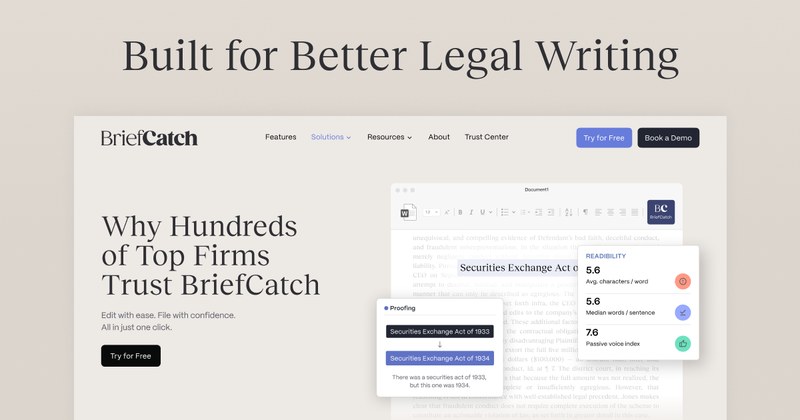
BriefCatch
BriefCatch is an AI-assisted legal writing and editing platform founded by bestselling author and legal-writing authority Ross Guberman. It plugs directly into Microsoft Word to give lawyers, judges, and courts real-time, expert-informed suggestions that sharpen clarity, precision, and persuasive impact, drawing on a library of thousands of edits and examples from top legal writers. Trusted by 45+ Am Law 200 firms, 80+ courts, and government agencies, BriefCatch raised a $6M Series A in December 2025 and acquired editing-software maker WordRake in February 2026.
PointOne
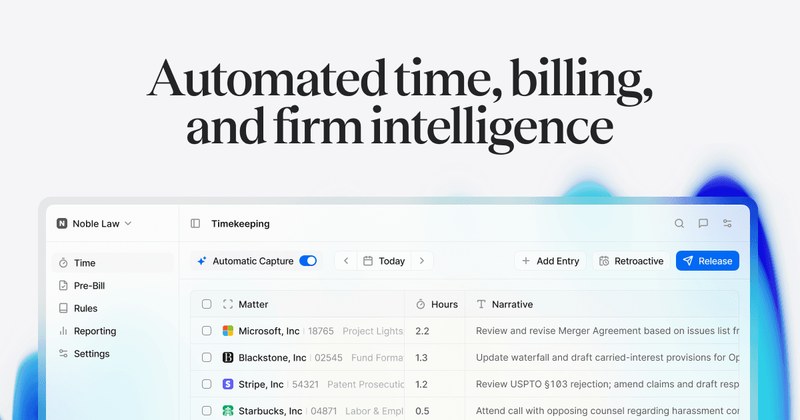
PointOne is a New York-based AI platform that automates timekeeping, billing compliance, and firm intelligence for law firms. Instead of forcing attorneys to reconstruct their day in six-minute increments, PointOne passively captures activity across documents, email, calendar, web, and calls, then uses AI to generate complete, compliant, narrative time entries. Founded in 2023 by former Google engineers Katon Luaces and Jeremy Ben-Meir, the company raised a $16M Series A in 2026 (total funding ~$20M) and reports customers capturing 6-11% more billable time per day.

Katon Luaces
Katon Luaces is the co-founder and CEO of PointOne, an AI time platform that passively captures, classifies, and validates billable hours for law firms. A former Google and Applied Intuition engineer and Columbia machine-learning teaching assistant, he started PointOne in 2023 with CTO Jeremy Ben-Meir to fix the most-hated chore in law: the six-minute billing increment. The Y Combinator Winter 2024 company raised a $16M Series A led by 8VC in March 2026, bringing total funding to roughly $20M, with firms reportedly capturing 6 to 11 percent more billable time per day.