The most expensive person in a lawsuit may be the one who has not been hired yet. An expert witness can clarify causation, explain a machine failure, price a lifetime of care, or turn a pile of medical notes into a coherent story. The wrong one can arrive with an old contradiction, a licensing problem, a weak fit, or a courtroom history opposing counsel understands better than the firm that retained them. Expert Institute exists in that anxious interval between “we need an expert” and “this is the person we are willing to put on the stand.”
The New York company is part recruiter, part research desk, part medical-review shop, and part SaaS platform. Through Expert iQ, law firms can request a custom expert search, investigate an opposing witness with Expert Radar, ask physicians to assess case merit, generate searchable medical chronologies, trade hard-to-find transcripts, and keep the work organized. It is not a self-serve directory wearing an AI badge. The company’s real product is an orchestrated decision.
A directory tells you who exists. A case needs more.
Founder and CEO Michael Talve spotted a familiar professional-services failure: litigators often reached for the colleague referral, the same known witness, or a static online list. Those shortcuts feel efficient until the specialty is narrow, the deadline is ugly, or the witness’s public record contains something inconvenient. Expert Institute’s answer was to aggregate expert information at scale, then keep human recruiters in the loop to test fit, availability, credentials, fees, and communication.
For a firm, the workflow is deliberately plain. Describe the case and specialty. Researchers recruit and vet candidates. The lawyer holds complimentary calls before choosing. Once retained, the expert and law firm work directly; Expert Institute says it does not mark up the expert’s professional fee. That last detail matters. The company charges for finding and preparing the connection, not for clipping a percentage from every hour of testimony.

“We believe the strongest legal advocacy starts with access to superior expert insights.”Expert Institute’s stated operating belief
What the $3,500 actually buys
Public pricing makes the offer easier to examine. Expert Search, Expert Radar, Medical Record Review, and physician-authored Research Guides each start at $3,500 per engagement. Medical chronologies are quoted by page count. Firms with recurring volume can buy a custom subscription with preferred pricing, expedited turnaround, firm-wide Expert iQ access, unlimited data retention, and a customer-success contact. The company supplies receipts so a firm can attribute work to a case instead of swallowing it as office overhead.
That framing is as important as the number. Legal-tech sellers often ask a managing partner to approve another software bill. Expert Institute asks a litigation team to compare a known case cost with hours of lawyer and paralegal time, the price of a missed filing, or the damage from retaining an expert who does not survive scrutiny. Predictability is part of the product.
The product that looks under the CV
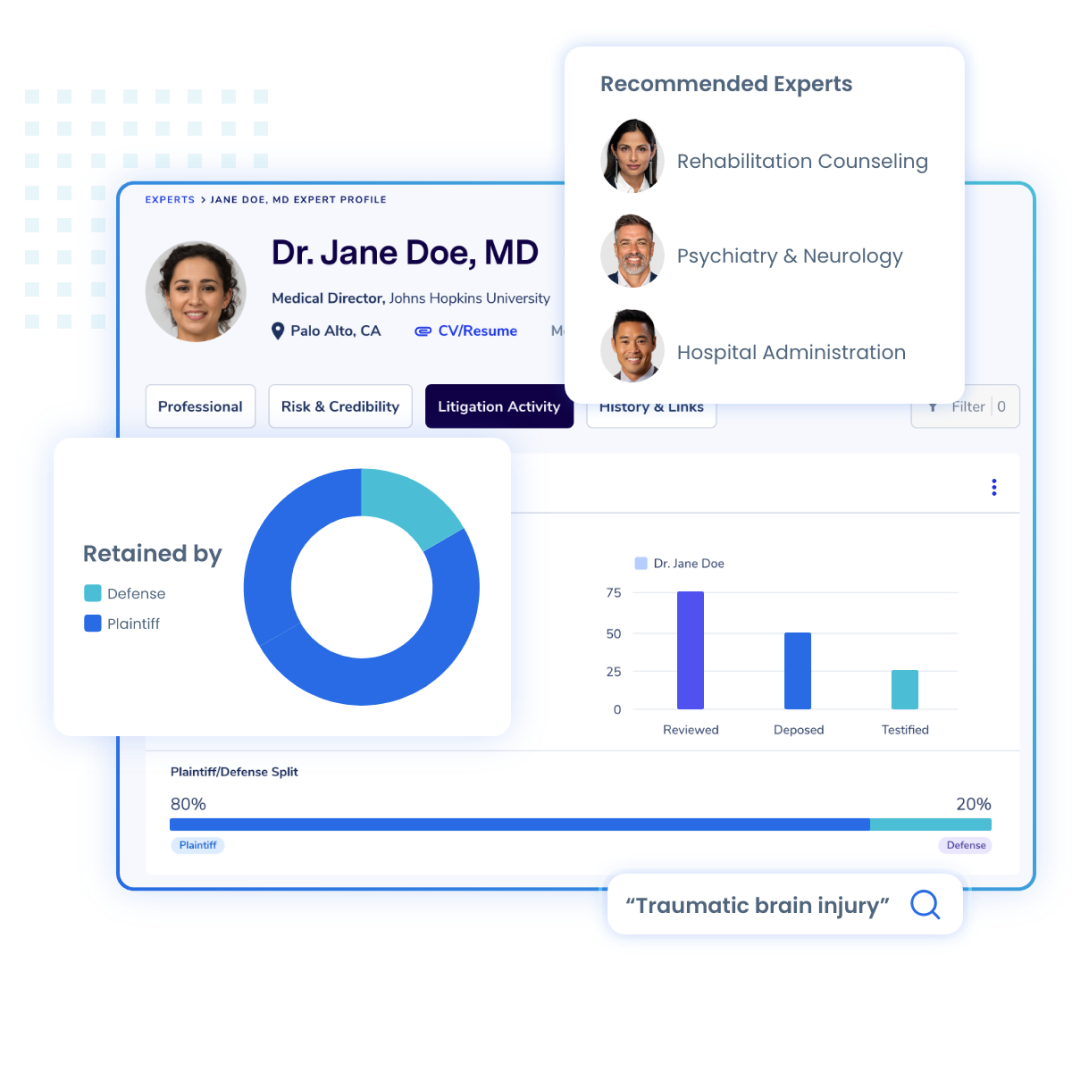
Expert Radar is the clearest expression of the company’s evolution from matching service to litigation-intelligence platform. A Radar profile pulls together prior cases, Daubert and Frye challenges, deposition and trial transcripts, court filings, disciplinary actions, board sanctions, professional history, publications, lectures, media, and social activity. Machine learning and large language models help process case-law documents and surface credibility issues. Researchers still matter because common names, missing records, and ambiguous context are not edge cases in this work. They are the work.
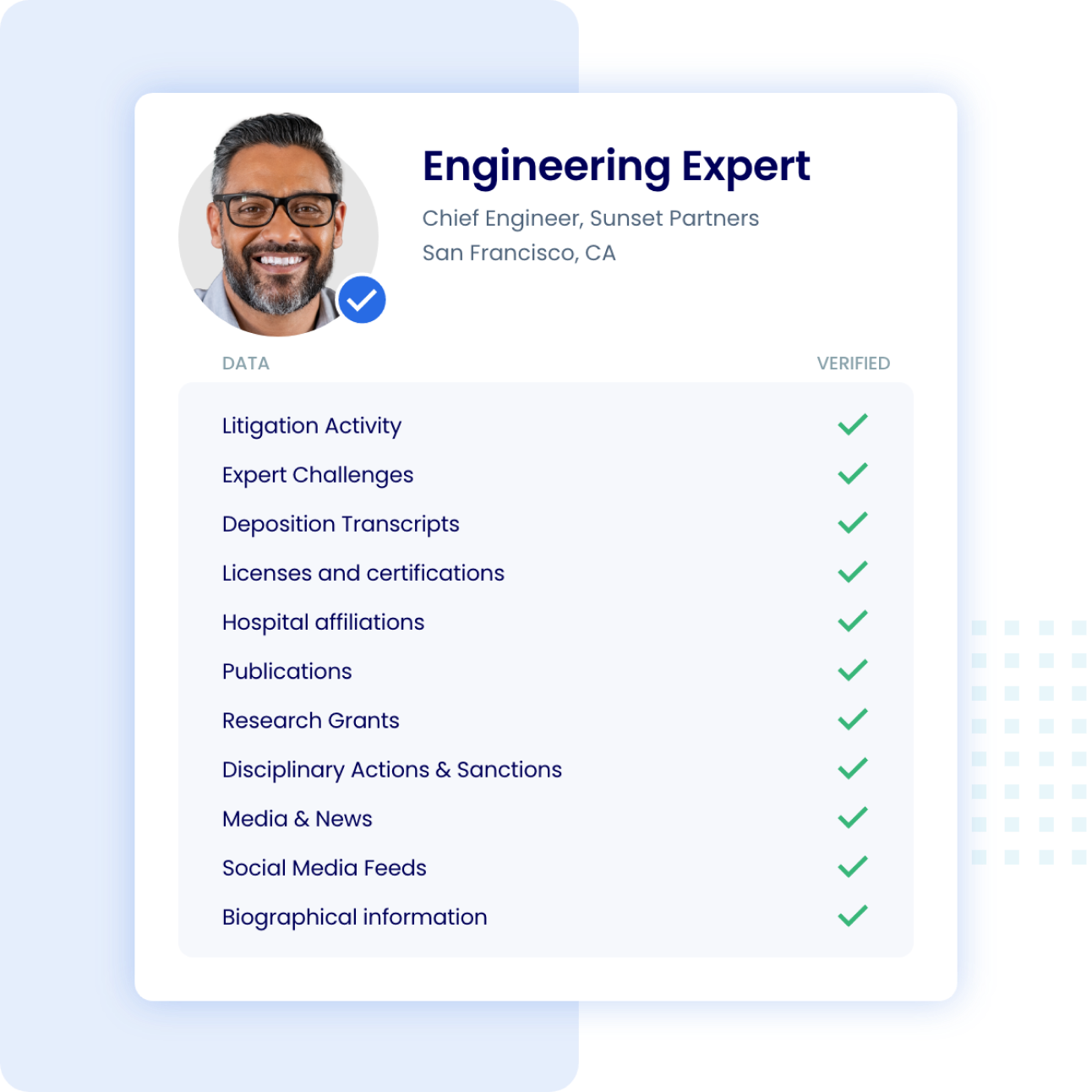
The result is not only opposition research. Firms can investigate their own retained witness before the other side does. A finished report is monitored for 12 months, with alerts for new litigation, discipline, or publications. In one public client account, attorney Eric Weitz said Radar surfaced social-media timestamps that his team compared with a medical record in a wrongful-death case. The value was not a magical answer. It was narrowing where counsel should look and giving the team material to investigate.
Medical records are where the hybrid model earns its keep
Personal-injury and medical-malpractice teams have a second problem: a record can be hundreds or thousands of pages long, repetitive, badly scanned, and clinically ambiguous. Expert Institute offers two related answers. Medical Chronologies uses AI to turn files into digitized, hyperlinked, searchable timelines. Medical Record Review puts the matter before physicians who can assess merit, standard of care, causation, and the questions a lawyer should ask next.
The distinction is worth preserving. Automation is useful at extraction, organization, and retrieval. Clinical judgment is useful when the same note could mean a diagnosis was considered, confirmed, or merely copied forward. A chronology that makes uncertainty look settled can send a case in the wrong direction. Expert Institute’s 75-plus physician group and its software sit side by side because neither solves the whole problem alone.
A marketplace hidden inside the filing cabinet
The Transcript Network may be the most copyable piece of product design. Plaintiff firms upload unique deposition or trial transcripts and receive credits after the documents are vetted. Those credits unlock other transcripts in the network; extra credits can be purchased. The platform also stores reports, affidavits, exhibits, and CVs, with annotation and collaboration tools. Scarce documents attract contributors, contributions improve the library, and the library attracts the next firm.
This is where Expert Institute fits in the broader market. It is not quite a general expert network such as GLG, whose center of gravity is paid consultation. It is not merely legal research such as Westlaw or LexisNexis. It is not only a referral shop. Its advantage is the bundle: recruiting, proprietary and third-party data, medical expertise, workflow software, and a service team arranged around litigation.
What changed their mind - and what broke first
The first thing that broke was the shortcut. Static directories became stale. Referrals recycled familiar names. A CV described credentials but not necessarily contradictions. As the service accumulated data and repeated workflows, a software layer became more valuable. By 2020, even the company’s visual identity felt behind what the business had become. It dropped “The” from its public name and reintroduced itself as the intersection of technology, consulting, data, and human insight.
Capital followed that arc. Spectrum Equity made the company’s first institutional growth investment in 2017. Levine Leichtman Capital Partners acquired it from Spectrum in September 2024 on undisclosed terms, with Talve continuing as CEO and retaining equity alongside management. In June 2025, Expert Institute acquired ExpertConnect Litigation Support, adding strength in regulatory, commercial, intellectual-property, and other complex disputes. No public price was disclosed for either acquisition.
The part founders can steal
Use a managed service to learn the strange exceptions before declaring the workflow ready for self-service automation.
Every search, transcript, profile, and review can improve the next job when permissions, provenance, and data quality are handled carefully.
Sell a predictable outcome against expensive internal time and risk. The budget category can be as decisive as the feature list.
When customers own scarce inputs, reward contribution. The give-to-get transcript model creates supply without pretending documents appear by magic.
The playbook is service first, workflow second, data third, and software throughout. It works best when the task is frequent, expensive, and consequential enough to support human review. It also benefits from a customer base that produces reusable knowledge without turning confidential work into a free-for-all.
When the model does not earn its fee
A small, low-stakes matter may not justify a $3,500 starting engagement. A firm that already has the right specialist, knows the witness’s history, and rarely litigates may be better served by its own process.
The model also weakens when records are unavailable, the issue is too novel for meaningful comparisons, deadlines prevent proper vetting, or users treat AI output as a conclusion rather than a research aid. A unified dashboard cannot make incomplete evidence complete.
Expert Institute’s sober promise is not that software wins cases. Lawyers, facts, experts, judges, and juries remain stubbornly involved. The company sells a better prepared decision: more candidates, a deeper record, a cleaner medical file, a transcript found before cross-examination, and fewer reasons to be surprised. In litigation, surprise is exciting mostly to the side that planned it.