Ask any personal injury lawyer where their cases go to die and they will not say the courtroom. They will say the medical records department. A settlement can hinge on a single stack of billing statements, and that stack often sits in a queue behind a clerk who has no professional reason to move quickly. Weeks pass. Follow-up calls loop through phone trees. Requests get bounced over a misspelled name. Meanwhile the client waits, the case ages, and the firm eats the cost.
Arctrieval, a six-person company headquartered in Scottsdale, Arizona, built its entire business on that specific frustration. Its founder and CEO, Jared Vishney, started the company in 2009 not with a new algorithm but with a close reading of federal regulation. Buried in HIPAA is a provision most firms had been quietly stepping over for years - and it turned out to be the whole ballgame.
The mechanismTwo ways to ask for the same file
Most firms request records with a third-party HIPAA authorization: the client signs a form, the firm sends it to the provider, and the provider processes it on whatever timeline it prefers. There is no hard clock. Arctrieval routes requests through a different door - the patient's Individual Right of Access under 45 CFR 164.524. Under that rule, a provider must respond to a person asking for their own records within 30 days. It is not a favor. It is an obligation, backed by potential enforcement.
HIPAA Authorization
- Third party asks on the client's behalf
- Provider sets the pace
- No firm deadline
- Easy to reject on technicalities
Individual Right of Access
- The patient asks for their own records
- Statutory 30-day response window
- Enforcement teeth behind it
- Provider holds far less leverage
Same records, same providers, a different distribution of power. That single swap is the product's spine. Everything else - the dashboard, the integrations, the automated follow-ups - is scaffolding built around it.
The productA dashboard, not a phone tree
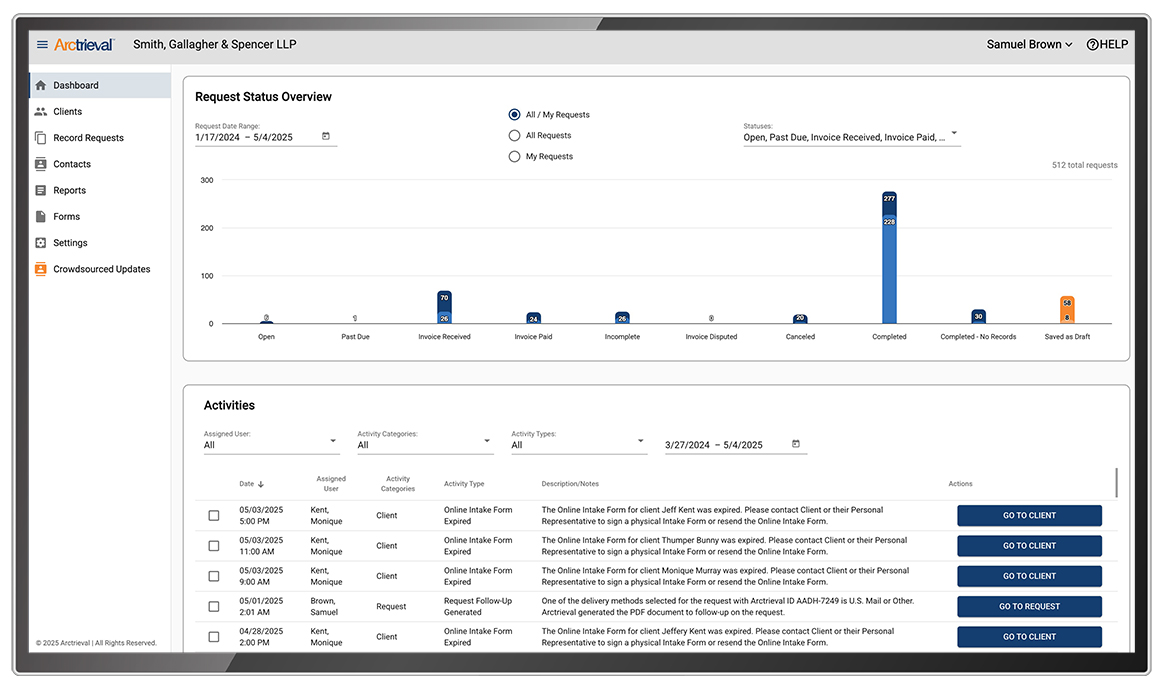
Arctrieval is software a firm's own staff runs in-house. It drafts compliant requests, submits them, and then handles the part everyone hates: persistent follow-up. Instead of a paralegal redialing a hospital, the platform tracks every open and closed request by provider on a single dashboard, attaches supporting documents, and logs the communication trail. The company reports firms get 90% of their records within 30 days, with even complex requests typically resolved inside 45 to 60 days.
in 30 days
missing records
platform
The onboarding is quick - the company says initial setup runs 30 to 45 minutes, with most firms fully operational inside a week. Notably, there is no free trial. Arctrieval argues a trial can't show value in the time allotted, and points prospects to a live, tailored demo instead. It is a small detail, but a telling one: this is a company confident enough in its narrow use case to make you commit before you touch it.
Where it plugs inLiving inside the case file
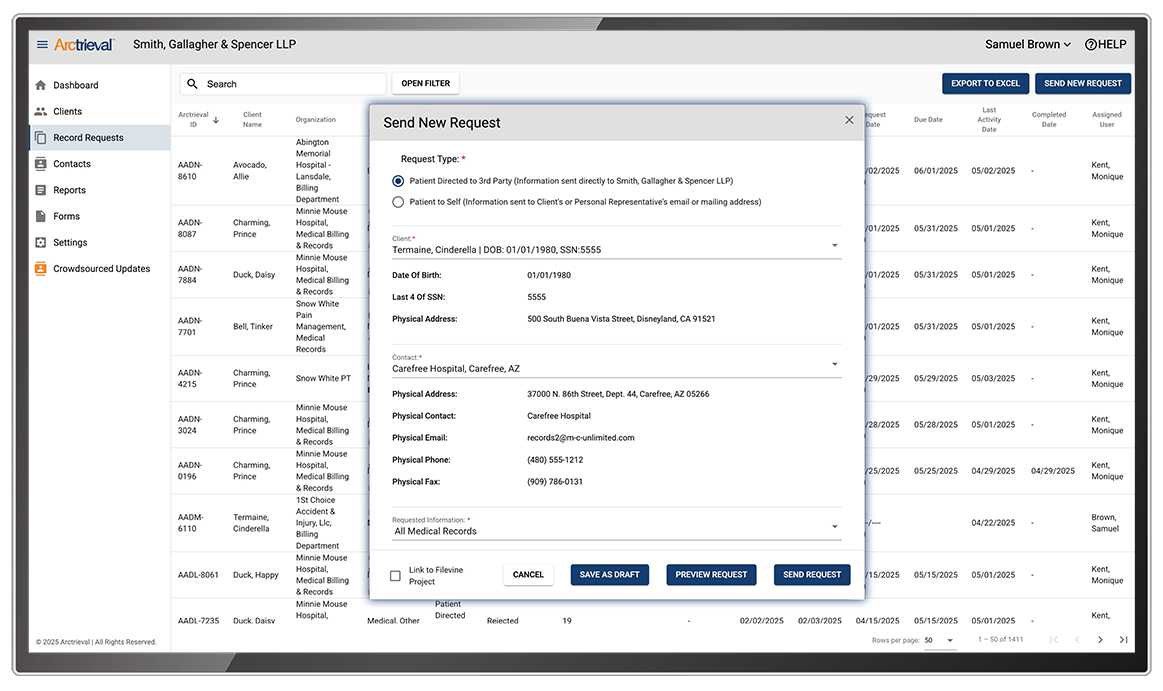
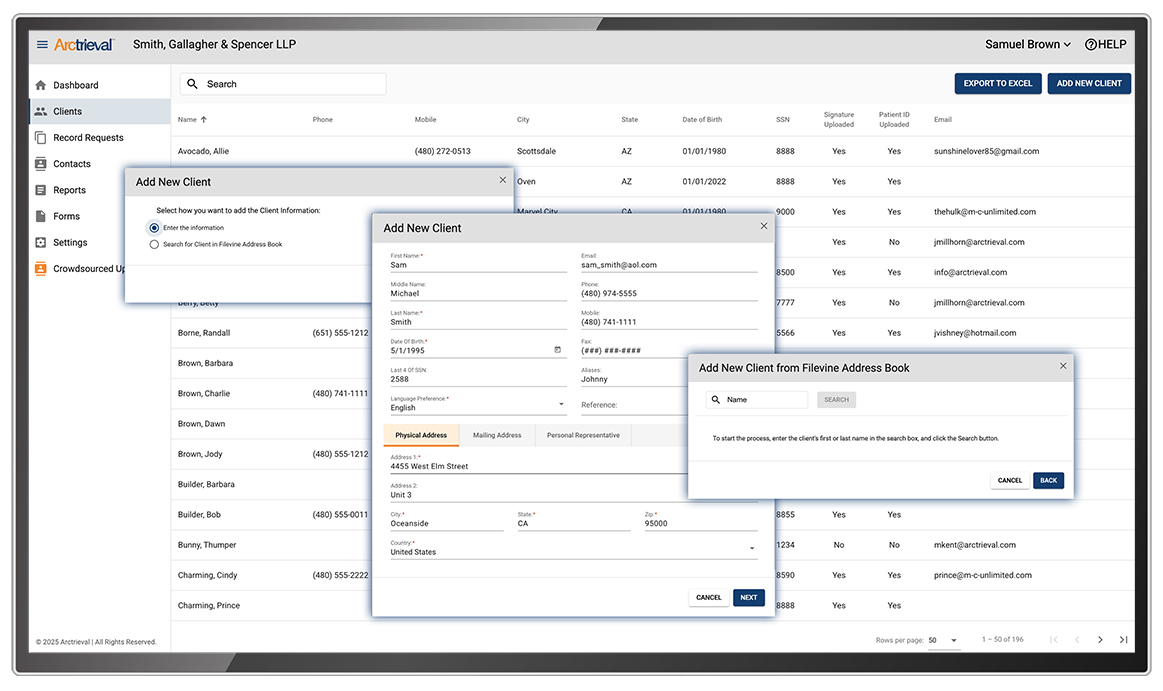
A tool that makes lawyers switch tabs loses. So Arctrieval syncs into the case management systems firms already live in - it pulls client and provider details in, and pushes PDFs, provider information, and request history back out to the matter. Its certified MyCase integration keeps records "organized, audit-ready, and free from manual uploads or duplicate entry," and it lists support across the tools plaintiff firms favor.
The receiptsWhat it looks like at one firm
KRA Legal, a California firm with three attorneys and 16 staff, ran roughly 400 active cases on a paper-based process - drafting, printing, assembling, and mailing every request, then calling providers to chase them. Initial requests alone ate about 20 hours a month. After switching, the firm cut request prep from roughly 30 minutes to 10 minutes per client, and Kaiser Permanente retrieval that had dragged on for months came back in about one.
The firm estimates roughly 50 hours of administrative work eliminated each month - time redirected to sending demand letters faster and taking on more cases with the same staff. As one team member put it: "The records retrieval process is much less stressful. I can get other tasks done."
The problem, up closeWhy records outlast the lawsuit
To understand why a tool this narrow can support a company, it helps to sit with the problem. A personal injury claim is, in large part, a documentation exercise. The severity of an injury, the reasonableness of treatment, the size of the bills - all of it lives in files held by hospitals, imaging centers, physical therapists, and billing companies, each with its own intake process, its own release-of-information vendor, and its own tolerance for delay. A single client can generate a dozen separate requests to a dozen separate custodians. Multiply that by a caseload of hundreds and the arithmetic gets ugly fast.
The traditional fixes each have a tax. Outsourcing to a copy service moves the labor off the firm's desk but hands over the timeline and adds per-page fees that clients ultimately absorb. Doing it by hand keeps control but consumes paralegal hours that scale linearly with the caseload - exactly the hours KRA Legal was spending before it switched. Arctrieval's argument is that the bottleneck was never the labor itself. It was the legal posture of the request. Change the posture, and the labor shrinks with it.
The founderMarketing eyes on a legal problem
It matters that Vishney came out of product marketing and business development rather than a law practice. His background shows in how the company frames itself: not as a compliance product or a document vault, but as a productivity tool aimed squarely at the people doing the chasing. Arctrieval sells to firms, but it is built for the paralegal - the person who actually navigates the phone tree and eats the rejection over a misspelled name. That is a marketer's instinct, to design for the user's daily friction rather than the buyer's org chart.
He has also spent time educating the market directly, appearing on legal podcasts to explain the Individual Right of Access to attorneys who had never thought to use it. When a company's edge is a piece of regulation, teaching the audience the regulation is a form of distribution - every lawyer who understands 45 CFR 164.524 is a lawyer who now has a reason to buy the software that operationalizes it.
The businessFlat fee versus the per-page racket
The pricing is a direct shot at the traditional record-retrieval industry, where outside vendors mark up copies by the page and hold the timeline. Arctrieval charges a flat monthly subscription - advertised from $155 a month, priced by number of users - with unlimited requests and no per-request or per-page markups. Costs that do pass through, like fax overages at six cents a page, are exactly that: pass-through. Clients receive and pay provider invoices directly.
That model reframes the competition. Arctrieval is not really up against another piece of software so much as against a habit - the reflex to outsource record retrieval to a copy service, or to keep grinding through it by hand. Its answer is neither: keep the work in-house, but make your own team about 80% faster at it.
The betThe boring-problem advantage
Vishney, a UCLA graduate who speaks fluent German, spent years in product marketing and business development before starting Arctrieval. The company took on only about $40,000 in debt financing back in 2010 and stayed small - six people serving more than 450 firms. In a legal-tech market sprinting toward flashy AI, Arctrieval's edge is almost aggressively unglamorous: it read the statute, found a faster legal pathway, and built the push-button version of it.
There are limits. The Individual Right of Access covers a person's own records, so the approach fits plaintiff-side and personal injury work far better than, say, third-party discovery. And a legal advantage that rests on regulation is only as durable as the regulation. But for the specific, painful, universal problem of prying medical records loose, Arctrieval's wager - that leverage beats effort - has found 450 firms who agree.