A contract is an odd place to look for the future of enterprise software. It is where a company writes down what it intends to do, then often leaves the document behind while everyone gets on with doing it. Procurement negotiates. Legal checks. Finance pays. Somewhere between those desks, an obligation can become nobody’s immediate problem.
Leah is building its business around that gap. Formerly ContractPodAi, the company wants the agreement to remain connected to the work it governs: supplier checks, approvals, renewals, payments, and the exceptions that send people hunting through email. Its proposition has grown from managing contracts to coordinating the business processes attached to them.
That ambition explains the shorter name. On January 5, 2026, ContractPodAi became Leah, adopting the identity of its own AI product. Existing customers kept their accounts and workflows. The message to prospective buyers changed more dramatically: a vendor associated with the legal department wanted a conversation with the rest of the enterprise.
The handoff became the target
The company traces its origins to 2012. Sarvarth Misra and Robert Glennie brought corporate-law backgrounds to a market in which legal work was still slow to digitize. Its current leadership page also identifies chief operating officer Viraj Chaudhary as a co-founder. Misra remains chief executive; Glennie is executive director.
Early ContractPodAi software addressed recognizable legal chores: producing agreements, keeping them in a repository, and reviewing documents received from another party. Its contract analyst, branded E:V, used IBM Watson. The expertise came from a specific professional problem, rather than a general invitation to ask a machine anything.

Leah’s present-day account of its evolution identifies the human handoff as the ceiling it encountered. Making one task faster still left somebody responsible for moving the result into the next system. The company says that observation prompted a rebuild around coordinated AI agents during 2022 and 2023.
That is the company’s retrospective explanation, not evidence that its earlier product collapsed. The distinction matters. This was a funded software business expanding its thesis. By October 2025, it had announced Leah Agentic OS, explicitly extending its reach across corporate functions. The January rebrand put the company name in line with that larger product brief.
What happens after “approved”?
Leah Agentic CLM still provides the familiar contract lifecycle: intake, drafting, review, negotiation, signature, storage, and tracking obligations. A business user can seek an answer about an agreement; a legal reviewer can apply an approved playbook; a team can follow the document through approval rather than asking who has the latest copy.
Agentic OS supplies a broader construction kit. It combines specialized agents, a visual workflow builder, an application builder, and orchestration that coordinates work across functions. Leah Legal applies that machinery to legal operations. Procurement and finance offerings extend the scope to supplier assessment, purchasing processes, invoice management, and related commercial work.
Consider a supplier-onboarding workflow, an example the company uses to demonstrate its platform. An intake request starts compliance checks and risk scoring. A contract can be generated from an approved template. A higher-risk case goes to a designated reviewer. Signature and downstream notifications follow. The value depends on those steps sharing the same context.
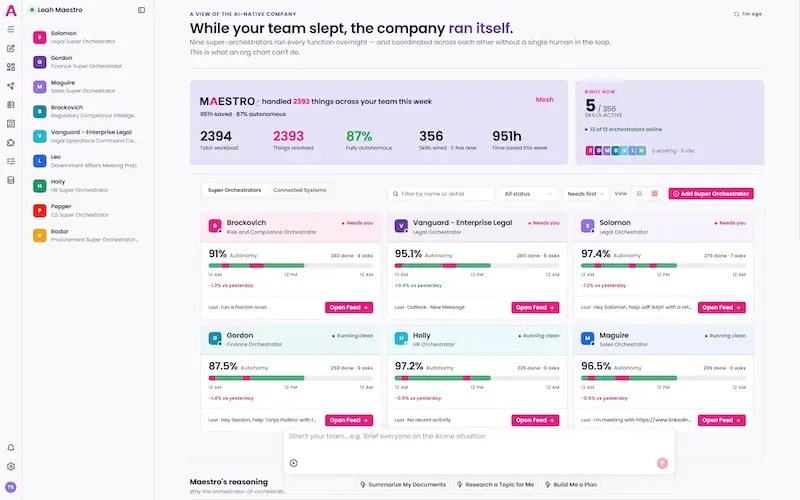
In May 2026, Leah added Maestro, a layer above the function-level orchestrators. It is designed to give executives a view of AI workloads, their status, and their connections across departments. That makes the product story unusually managerial: once software agents do more work, somebody still needs to see what the agents are doing.
The certificate that slipped past
A published NopalCyber customer story supplies a more concrete reason to care. Its advisory team was helping clients assess a growing population of vendors through questionnaires, spreadsheets, and reviews conducted at onboarding. According to Leah’s account, one legal client discovered during an audit that a vendor’s SOC 2 certification had been expired for six weeks.
The first thing that failed was continuing visibility. An assessment could describe a supplier at one moment without catching a later change. The case describes due diligence taking two to three weeks per vendor, with consultants also spending more than 40 hours a month manually rechecking certifications and scores.
NopalCyber adopted Leah Procurement’s supplier-risk and due-diligence agent, beginning with two clients before expanding. It configured assessments for different industries and connected risk scores to supporting evidence. Certificate expirations and other changes could trigger alerts and rescoring. The work shifted from repeatedly gathering information toward examining the cases that deserved attention.
Faster vendor onboarding
Less conventional scoring effort
Those percentages are useful as a case, not a universal forecast. The practical lesson is the operating design: start with a limited rollout, make scoring configurable, and preserve the evidence behind the recommendation. A risk score has a much better chance of being useful when the person receiving it can inspect how it was reached.
$170 million bought room to expand
The capital behind this expansion arrived before the latest agentic-AI vocabulary. In July 2019, ContractPodAi announced a $55 million Series B led by Insight Partners, with Eagle Proprietary Investments participating. A September 2021 Series C brought another $115 million, led by SoftBank Vision Fund 2, again with Eagle involved.
The two rounds total $170 million. The 2021 announcement earmarked proceeds for platform development and international expansion, including opportunities in Asia-Pacific through SoftBank’s network. It also described a broader legal platform, with configurable applications for work such as claims, proposal reviews, and intellectual-property management. Expansion beyond a contract repository was already underway.
“We are just scratching the surface of what we can do.”Sarvarth Misra · September 2021
For a buyer, the relevant cost is different: an enterprise software agreement and the effort required to put it into operation. Leah’s sales process begins with a demonstration and an assessment of workflows. Its rollout approach includes connecting systems, configuring policies, and introducing capabilities in phases. Evaluation should therefore account for staff time, integration work, and adoption alongside the commercial quote.
The advisers are part of the distribution
Leah targets enterprise legal, contracting, procurement, and finance teams. Its customer material includes Cushman & Wakefield, ANSA McAL, Terumo Europe, and PwC, as well as NopalCyber. Its customer page reports more than 500 enterprise customers. That is a company-reported scale figure; individual deployments can cover very different portions of an organization.
Professional-services relationships help explain how it reaches those buyers. The company announced a Morae partnership in 2024. In February 2026, it expanded its relationship with PwC UK around agentic operating models for Global Business Services. That brings the software into conversations about how shared services should be organized, rather than leaving it solely in a legal-technology procurement exercise.
The distinction has commercial consequences. A platform reaching across departments needs people who understand those departments and can change their processes. Advisers can help with that work. They also create another route to customers for a vendor whose ambition now involves more stakeholders than a single legal team.
Inside Leah, the public hiring pitch combines technical ambition with familiar workplace promises: flexible vacation, wellness days, offsites, and meditation meet-ups. These are employer-stated policies. The more revealing organizational detail is the combination of legal specialists, AI leadership, and customer-facing roles needed to sell and implement a product that crosses professional boundaries.
The test is a complete piece of work
Leah is not alone in pursuing intelligent contracts. Ironclad markets AI agents and playbooks across the contract lifecycle. Icertis connects contract intelligence to enterprise systems, including procurement through SAP Ariba. Leah’s argument is that its legal and commercial expertise, joined to cross-function orchestration, makes those connections a central part of the product. Buyers should test that argument against their own processes.
A sensible evaluation starts with one recurring job: onboarding a supplier, reviewing a standard agreement, or tracking a defined obligation. Specify the acceptable outcome, the authoritative information, the person who owns exceptions, and the actions the software may take. Then measure the whole process, including correction and review time. Faster drafting alone does not establish that the business completed the work faster.
Leah’s legal product describes different levels of autonomy, from advisory assistance to execution with approvals or within rules for lower-risk work. That flexibility matters when the input is incomplete, a policy is ambiguous, or a decision needs negotiation. An agent cannot settle an organization’s disagreement about who has authority simply by moving the task along.
The fit is strongest where work repeats, records can be connected, and decisions can be expressed clearly enough to govern. A small team handling a few unusual agreements may gain less from a platform spanning several departments. An enterprise with inaccessible records or unsettled approval rules has preparation to do before the promised coordination becomes practical.
Leah’s opportunity is easy to recognize: companies already put many of their operating instructions into contracts. Its challenge is to keep those instructions attached to daily work without making oversight harder. The revealing moment comes after the signature, when somebody has to make sure the promise becomes an action.