A contract is an odd kind of memory. It records what two companies agreed, often in exhausting detail, while concealing the conversation that made agreement possible. Why was that liability clause acceptable? Was the concession routine, or a favour granted to get one troublesome deal over the line? The document survives. The explanation can be harder to locate.
Chamelio has built its business around that gap. Its software is intended for in-house legal departments, where the next question often resembles the last one, but arrives through another channel, attached to another document, with another deadline. The proposition is appealingly practical: let the accumulated work of a legal team help with the work arriving today.
- The job: connect contracts, negotiations, intake and approvals in one legal platform.
- The distinction: use the company’s own precedents and playbooks to inform new work.
- The stakes: $36 million raised, with a $26 million Series A announced in September 2026.
The filing cabinet forgot the conversation
The founding team came at the problem from complementary directions. Alex Zilberman and Gal Lellouche had built businesses; Gil Banyas had been a general counsel. Zilberman’s previous experience included Pagaya and AnyVision. Lellouche had founded an AI company acquired by Sage. Banyas knew the legal department’s predicament from the inside.
In Zilberman’s account, the frustration came from manual work and disconnected software encountered while scaling earlier companies. Chamelio was founded in 2024. The observation behind it was less exotic than its AI vocabulary: useful knowledge was spread across tools that made a lawyer responsible for reconnecting it.

Work-Bench, an early investor, describes the market as two imperfect halves: contract systems that hold company data, and generic AI tools disconnected from company history. That is an investor’s argument, rather than a neutral verdict on every competitor. It nevertheless identifies Chamelio’s chosen territory: the space between keeping a record and knowing how to use it.
A precedent walks into Microsoft Word
Start with Chamelio Negotiate, a sidebar inside Microsoft Word. The company describes AI-assisted review and redlining informed by earlier negotiations and the team’s playbook. A lawyer can see deal context while editing, rather than interrupting the job to hunt through a separate repository.
The companion Smart Repository extracts contract information and connects related documents, including amendments, order forms and parent agreements. That last feature is quietly consequential. A contract rarely lives alone; its meaning may depend on another piece of paper. Finding the main agreement without its amendment can leave a beautifully organized but incomplete answer.
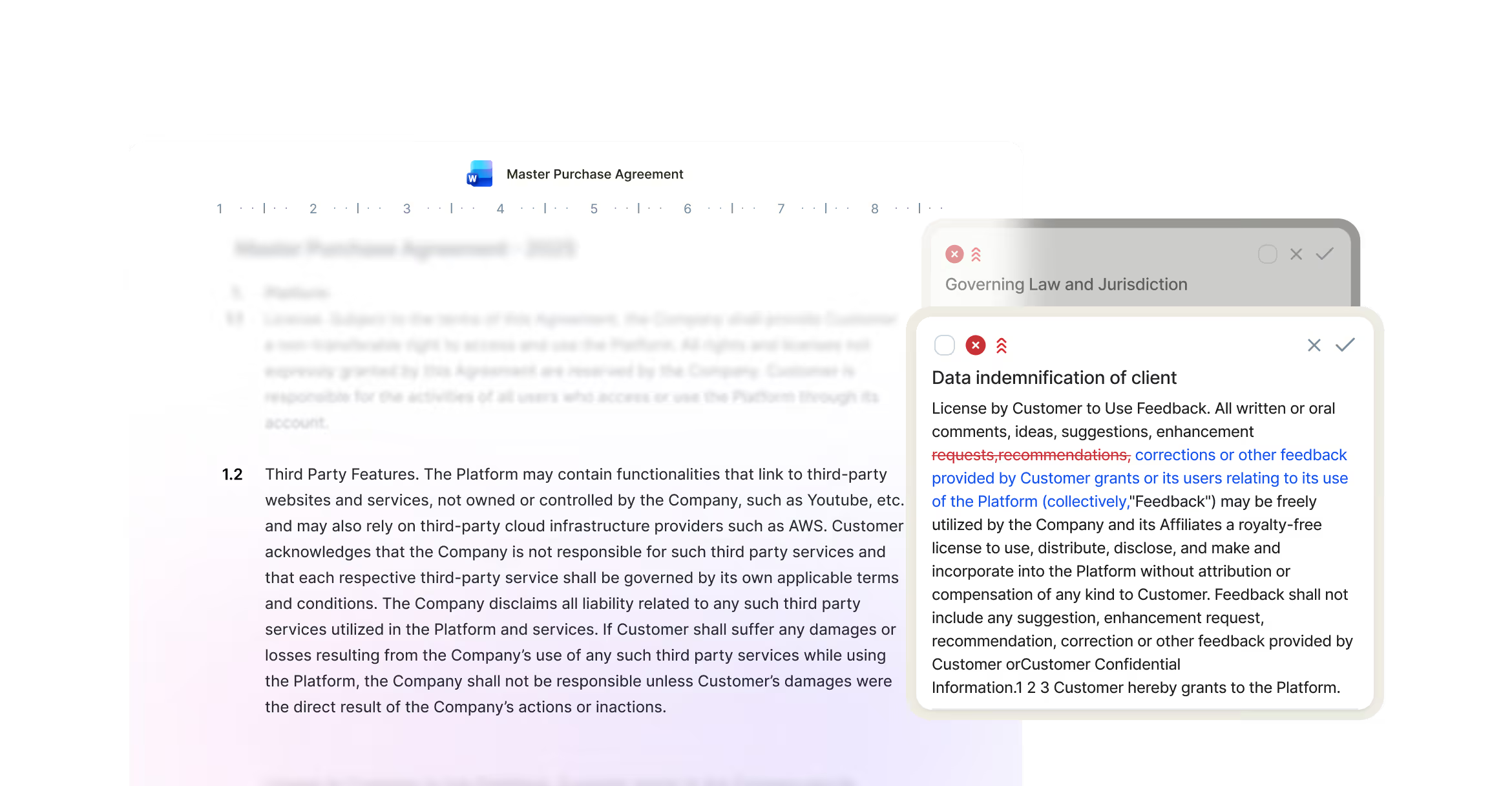
Its broader product set includes intake, tasks, workflows, an AI agent and workload insights. The connective idea matters more than the menu: an incoming request, the document under negotiation and the eventual signed agreement should contribute to the same working knowledge.
and decisions
and playbooks
and escalate
The first pass is where the minutes go
The customers are corporate legal teams, from growth companies to larger enterprises. Publicly named users include Wiz, Socure, monday.com, AppsFlyer, Fiverr and Lightricks. These are businesses with agreements to process and colleagues waiting for answers, rather than consumers seeking a one-off legal opinion.
A company-published Lightricks testimonial gives the proposition a tangible shape. General counsel Noa Rosenberg Segalovitz reports that NDA turnaround fell from 24 hours to under an hour, with Chamelio handling the first pass and escalating the matters needing legal attention. That is one customer’s reported experience, not a forecast for every buyer.
“only escalates what needs legal review”Noa Rosenberg Segalovitz, general counsel at Lightricks, in a Chamelio testimonial
For a prospective user, the useful question is which repeated task has a sufficiently clear rule. A routine NDA may be a sensible starting point. A novel agreement with unusual commercial consequences requires a different approval boundary. Chamelio describes both autonomous low-risk work and workflows with lawyers retained in the loop.
The bill includes more than a seat
Zilberman describes an annual SaaS subscription charged per seat, with a usage component covering documents, workflows and advanced capabilities or integrations. The buying exercise therefore includes estimating how much work will pass through the platform. A small team processing many agreements can have a different usage profile from a larger team processing fewer.
Deployment also includes dedicated legal engineering expertise, according to the September announcement. These specialists help migrate repositories and translate existing processes into workflows. That detail deserves attention: rules remembered by a person must become rules a system can follow. Software procurement, in this case, includes the business of making tacit knowledge explicit.
Security belongs in that same purchasing conversation. Chamelio’s security page lists encryption in transit and at rest, least-privilege access controls, third-party penetration testing and SOC 2 Type II. Those measures concern handling sensitive material; they do not decide whether an old concession is a wise precedent.
$36 million says the archive has a future
Work-Bench’s January 2026 announcement specified a $5.7 million seed round following an Emerge-led pre-seed, bringing total funding to $10 million. The September Series A added $26 million, led by Entrée Capital with Work-Bench, Emerge and Bright Pixel participating.
Capital raised, not revenue. January includes the earlier pre-seed.
The company reports fourfold ARR growth between its seed and Series A, without publishing an absolute revenue figure. Public accounts disagree about the elapsed months. The clearer development is the spending plan: more product work, legal engineering and onboarding technology, alongside US expansion.
There is a useful practice here even for a reader who never buys Chamelio. Preserve the reason for a legal decision alongside the decision itself. Mark exceptions as exceptions. Identify who may approve the next departure. A memory system fed indiscriminately with past deals risks confusing what happened with what ought to happen again.
Chamelio’s promise depends on that distinction. Its ambition is to make legal history operational. The human contribution is deciding which parts of that history deserve another outing.