Luminance is for the legal team whose contracts have become a second, badly indexed company. The sales department remembers one concession, procurement remembers another, and the lawyer who negotiated the language has since moved to Lisbon. When renewal day arrives, everyone can find the PDF. Nobody can find the reason.
That is the interesting problem Luminance now wants to solve. The Cambridge company began with machine-assisted document review and due diligence, then expanded across the contract lifecycle. Its current platform covers six verbs: Draft, Negotiate, Analyze, Comply, Investigate and Collaborate. In January 2026 it added what it calls institutional memory, connecting accepted positions and negotiation history across a contract portfolio. In June, it introduced Luna Crescent, the first member of a model family trained specifically for contract work.
So the elevator pitch has changed. This is no longer merely a clause highlighter for a deal room. Luminance wants to be the place where a company remembers how it contracts. That ambition makes sense for a multinational with thousands of agreements, regional playbooks and approval bottlenecks. It is much harder to justify for a four-lawyer shop that mainly wants faster NDA redlines.
First, decide whether your mess is big enough
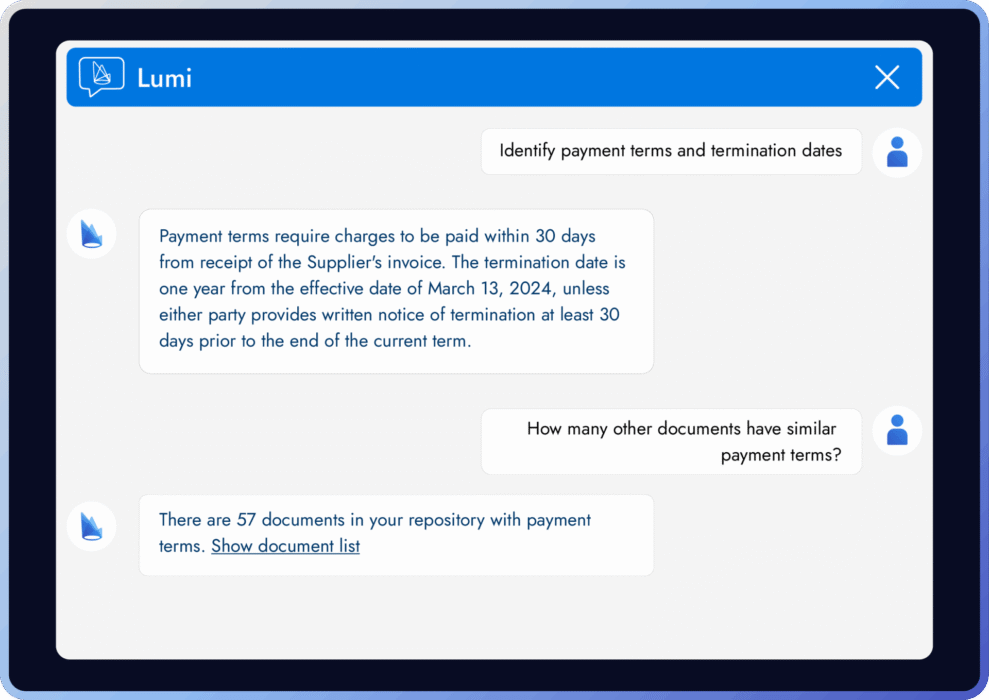
A useful buyer starts with volume, repetition and risk. If lawyers repeatedly compare supplier paper with the same playbook, answer the same renewal questions or search a repository for variations of one liability clause, Luminance has a clear job. It flags non-standard language, explains why it differs, proposes a markup and lets the reviewer keep working in Microsoft Word. Ask Lumi can summarize an agreement, find payment terms or draft middle-ground language.
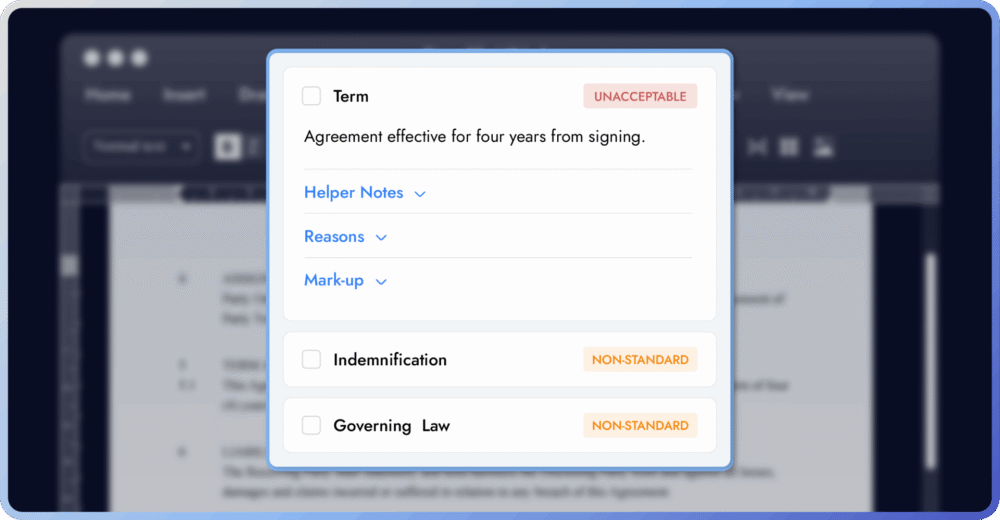
The repository side matters just as much. Natural-language questions can reach across stored documents, while the Analyze and Comply workflows surface dates, duties, unusual positions and approaching milestones. Investigate extends the same document intelligence into due diligence and eDiscovery. Collaborate handles intake and approvals so business users do not have to begin every request with an email titled “quick one.”
The fit gets weaker when contract volume is low, standards live comfortably in a short playbook, or the team cannot assign an owner to implementation. Enterprise software does not organize a legal function by osmosis. Templates need owners. Fallback positions need approval. Repositories need sensible access rules. Luminance can reduce repetitive reading, but it cannot settle an internal argument over who is allowed to accept a cap on liability.
What the machine sees in the margins
Luminance describes its architecture as a “Panel of Judges,” a mixture-of-experts approach that reaches answers through probabilistic consensus. Luna Crescent adds a vertical model trained for the structure and commercial language of contracts. The company says the training data came from a high-quality subset of more than 220 million verified legal documents. Its in-house ContractIQ Bench contains more than 180,000 manually annotated and reviewed data points covering provisions such as termination rights, confidentiality duties and liability caps.
Those are company-built benchmarks, not a public independent league table, so procurement teams should treat the figures as an invitation to test rather than a verdict. Bring unseen contracts from several jurisdictions. Include ugly scans, amendments, schedules and deliberately awkward drafting. Agree the correct answers before the pilot. Measure false reassurance as carefully as missed clauses.
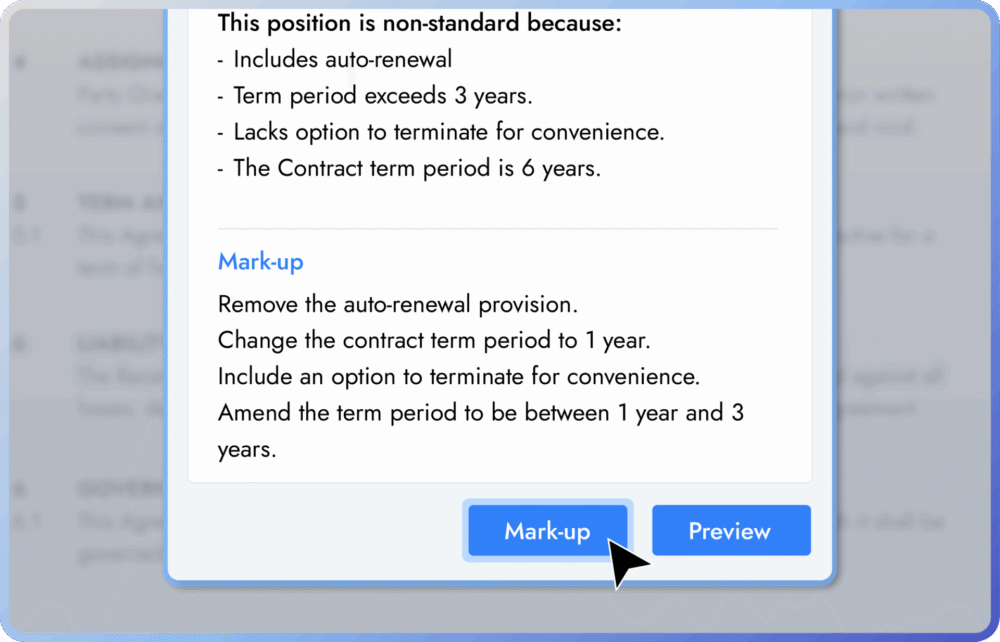
The clever bit is not producing another redline. It is keeping the reasoning that made the redline acceptable.YesPress assessment
Lumi Go pushes automation further. A Luminance customer can send a draft to a counterparty and let the AI negotiate routine points through a browser-based exchange. The 2026 update adds explanations for its decisions. This is useful territory for standardized, high-volume agreements. It is also where guardrails matter. Buyers should ask who sets the acceptable range, when a person is pulled in, how every move is logged and what happens when the counterparty supplies hostile or contradictory instructions.
Scale figures are company-reported. They describe adoption and training context, not the accuracy of a particular answer on your paper.
The proof, the applause and the quiet bits
Luminance says more than 1,000 organizations in 70 countries use the platform, including all Big Four consulting firms and over a quarter of the Global Top 100 law firms. Named corporate customers include AMD, BBC Studios, Hitachi, Liberty Mutual, Koch Industries, DHL and NTT DATA. The company raised $75 million in a February 2025 Series C led by Point72 Private Investments, after a $40 million round in 2024.
Customer stories give the time-saving pitch some shape. In one case study, Troutman Pepper estimated that a review of 12,000 documents fell from more than 400 hours to 135, allowing work to finish in two weeks instead of two months. Shahin, an Australian property group, said almost every contract in its business went through Luminance and reported a sharp reduction in external legal costs. These are selected vendor case studies, so they are useful examples rather than neutral averages.
Public product reviews are surprisingly scarce beside the customer count. Recent G2 feedback praises anomaly detection, non-standard clause flags and a clean interface, while also mentioning an initial learning curve and unclear pricing. Several recent reviews were incentivized, another reason not to mistake the star score for a controlled study. Reddit discussion is thinner still. Legal-tech commenters repeatedly make the broader point that substantive output needs human review and that integration with Word and document systems determines whether a tool becomes daily equipment or an expensive extra tab.
Pricing remains behind a demo request. Luminance has previously said that database size affects cost and that onboarding, training and uploading are included in the upfront price. There is no current public rate card to compare with a self-serve product. A serious evaluation should therefore price the full first year: license, internal project time, data cleanup, integrations, security review, template maintenance and the people required to make adoption stick.
Implementation also changes the economics of accuracy. A system that saves ten minutes on a review but sends every exception to the same overworked lawyer has moved the queue, not removed it. During a pilot, separate work into routine, judgment-heavy and genuinely novel contracts. Record where the AI proposes useful language, where it merely identifies an issue and where a human starts over. Then follow one agreement from intake to signature and another through renewal. The second journey tests the institutional-memory claim: can a new reviewer recover the business reason, approved fallback and prior exception without opening six email chains? That is a harder test than a polished clause demo, and far closer to the reason a company would buy the platform.
A buyer’s five-question cross-examination
Make the salesperson work on your facts.
- Which answers show a citation to the exact source language?
- What data is retained, where is it hosted and who can access it?
- How does the system handle amendments, scans and conflicting playbooks?
- Which integrations are included in the quote, and which require services?
- What is the escalation rule when automated negotiation reaches a boundary?
- Can we export documents, metadata, audit trails and learned positions?
Security and governance deserve their own session. Ask for current certifications, subprocessors, retention rules, incident procedures and model-training commitments in writing. Map permissions to the actual organization, not a tidy demo tenant. A regional sales lead should not casually search an acquisition folder because both sit under “commercial.” Source citations help reviewers verify an answer, but access control decides whether the answer should have been available at all.
| If your priority is... | Put on the shortlist | Why compare |
|---|---|---|
| End-to-end CLM | Ironclad, Icertis, Evisort | Compare workflow design, repository governance and implementation burden. |
| Law-firm AI workspace | Harvey, Legora, CoCounsel | Compare research, drafting breadth and connections to firm knowledge. |
| Word-first contract review | Spellbook, Robin AI | Compare speed to first value, playbook control and fit for smaller teams. |
| Diligence extraction | Kira Systems, Evisort | Compare clause models, bulk review workflow, reporting and precision on your documents. |
The verdict: buy the memory, not the magic
Luminance belongs on the shortlist for enterprises and law firms that need contract review, repository intelligence and workflow automation to share context. Its specific appeal is continuity: the negotiated decision can inform the next review instead of disappearing into somebody’s inbox. Teams with modest volume, weak internal standards or no implementation owner should start smaller.
The product’s breadth is real, and so is the homework. A controlled pilot should compare Luminance with the current manual process and at least one narrower alternative. Track review time, corrections, escalations and adoption, not merely clauses found. If institutional memory means cleaner decisions six months later, the platform has done something valuable. If it only produces faster drafts that senior lawyers must rebuild, you have purchased velocity without relief.
The final question is pleasantly old-fashioned: will people trust it enough to use it, and distrust it enough to check? Legal AI works in that narrow corridor. Luminance has built a substantial machine for the trip.