The dangerous thing about a contract is rarely the sentence everyone remembers. It is the renewal window on page 47, the indemnity that changed during round three, or the side letter sitting in somebody else’s folder. Robin AI is built for this unglamorous reality. It gives legal and business teams a secure place to search agreements, ask questions in ordinary language, compare clauses at scale, track obligations, and work on redlines in Microsoft Word. The compelling part is not that an AI can talk about a contract. Plenty can. Robin makes a serious effort to point each answer back to the underlying words.
That makes Robin most relevant to in-house legal departments, private-markets firms, compliance teams, and procurement groups with more documents than spare afternoons. A solo founder reviewing one NDA a month will find the sales process and enterprise machinery excessive. A general counsel facing 4,000 vendor agreements, a data-breach response, or a due-diligence room has a different problem. Here, minutes compound.
Why the contract pile needs a memory
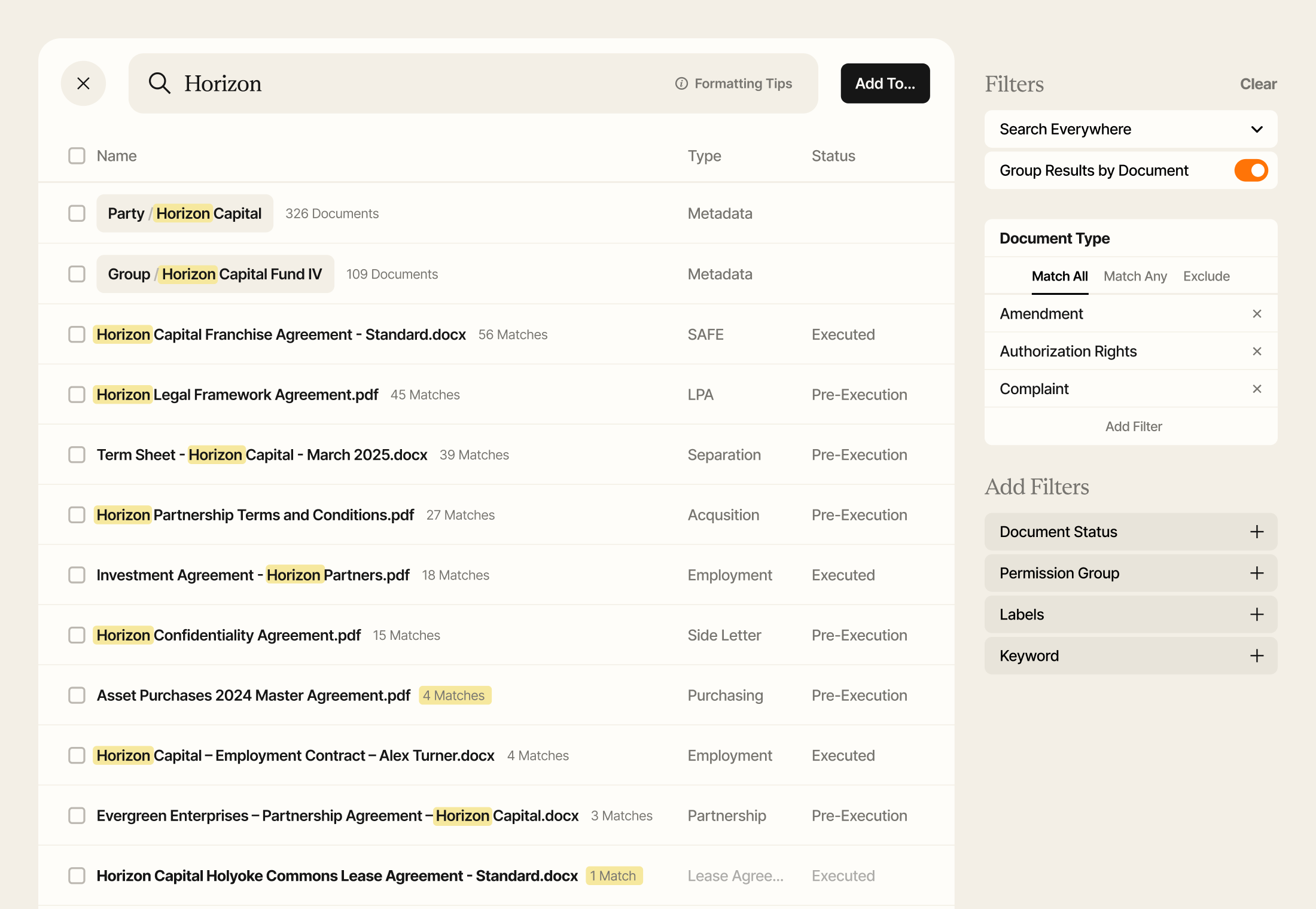
Contract lifecycle systems are good at recording where a document lives and which approval comes next. The content often remains inert. Someone still has to open the file, interpret the clause, and stitch together amendments. Robin’s 2025 Legal Intelligence Platform tries to make that archive usable as evidence. Its Legal Library enriches documents with metadata and permissions. Workspaces hold conversations and table-based analyses. Search goes beyond a title or keyword, with filters for document type, status, properties, and conditional rules.
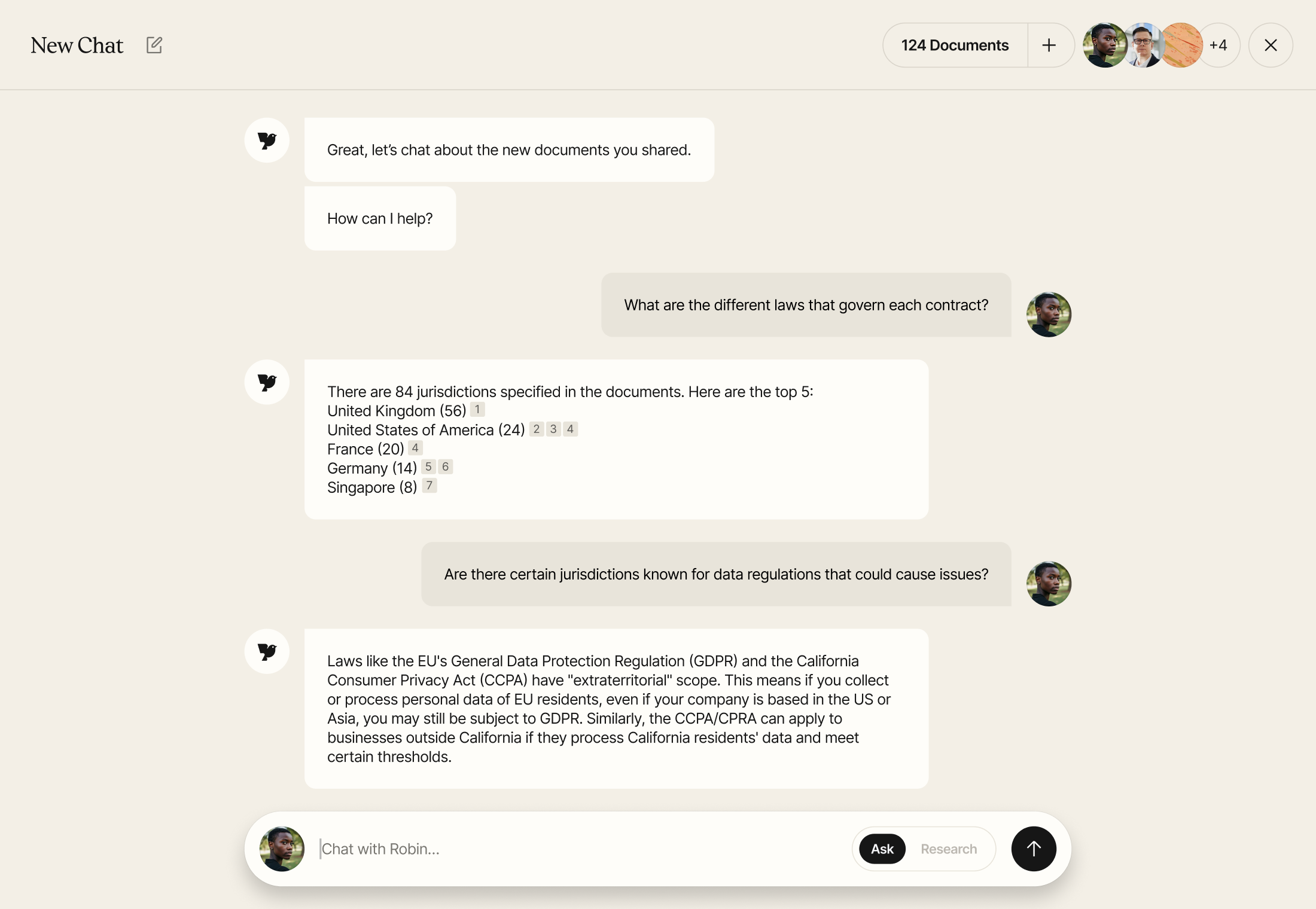
The practical promise is institutional memory. Ask which customer agreements contain a 24-hour breach-notification requirement, compare caps on liability, or find the fallback language the company accepted last quarter. Robin returns an answer and links to the source passage. That citation is not a decorative footnote. It is the handrail that lets a lawyer check whether the machine understood the clause, confused an amendment, or supplied a confident half-truth.
What it actually does all day
Chat is the front door. Users can ask a general legal question, attach documents from a computer or the Legal Library, and continue with follow-ups in a saved thread. A research mode draws on public legal authorities. A playbook-review tool generates a marked-up document against the organization’s preferred positions. The Word add-in brings the same library, precedents, and redlining suggestions into the place lawyers already draft.
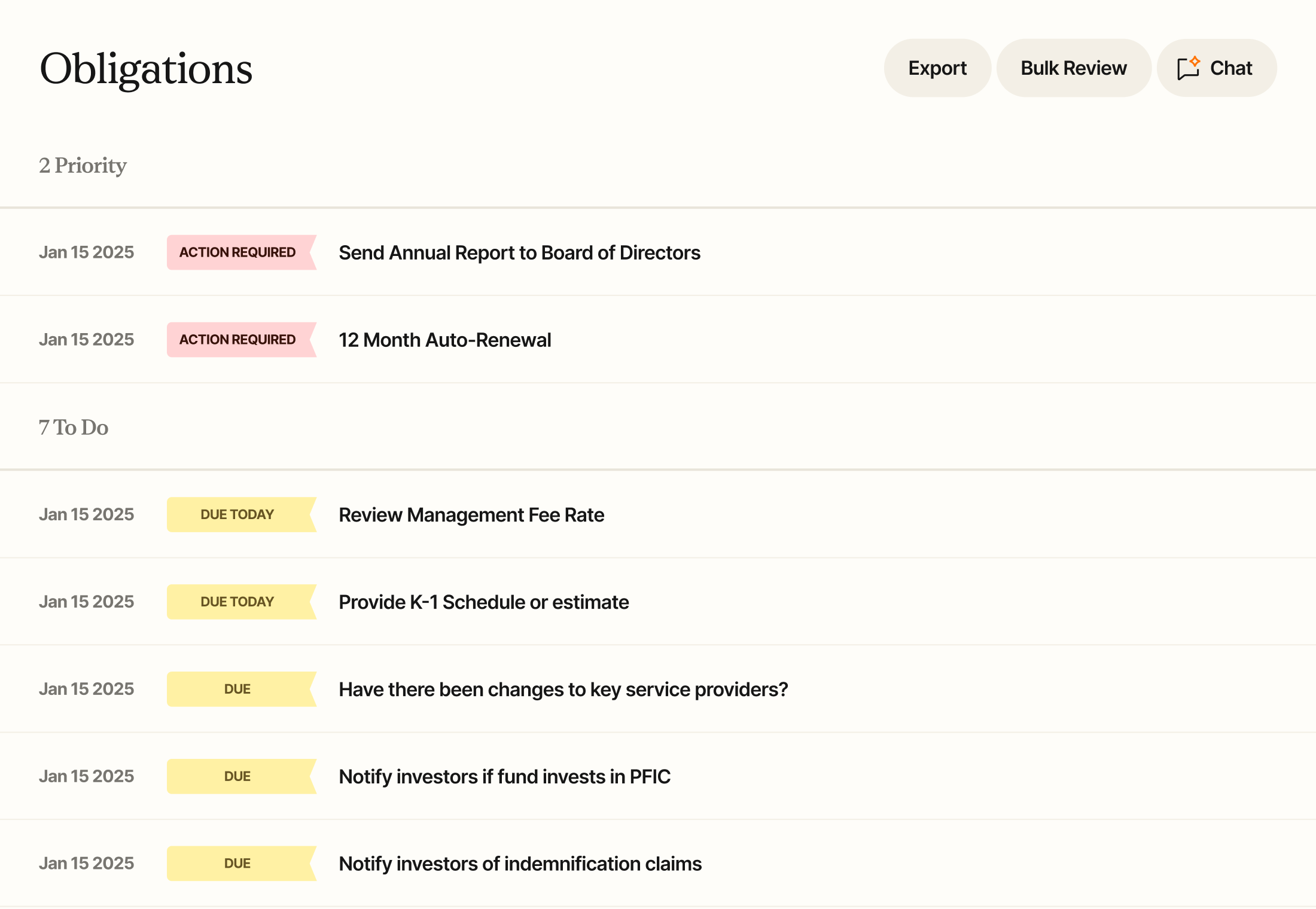
Tables is the power tool. It extracts dates, values, terms, criteria, and summaries from large sets of documents into a structured view, with citations and export options. That suits diligence, regulatory reviews, and portfolio questions where the answer is a pattern rather than one clause. Obligations turns commitments into assigned tasks, reminders, status dashboards, escalation flows, and audit trails. Search finds the documents. Chat explains them. Tables makes them comparable. Obligations gives somebody a job to do.
A sensible Robin workflow
The good bits, with receipts
Robin’s strongest idea is validation by design. In February 2025, the company said Claude 3.7 Sonnet led its vendor-agreement clause-identification tests and was live in the assistant. By November it was publishing evaluations involving Sonnet 4.5 and describing its own Robin Evaluation Framework. Its internal LeMAJ system breaks answers into legal data points and grades them against lawyer-informed criteria. These are company-run evaluations, so buyers should ask to see results on their own clauses and failure cases. Still, workflow-specific testing is more useful than waving around a general reasoning score.
The customer evidence is vivid. The University of Cambridge says one limited-partnership-agreement review dropped from about ten hours to five minutes. Convex Insurance says an NDA can be turned around with ten minutes of its team’s time. On G2, one reviewer described using Robin several times a week for amendments, summaries, and risk identification. These are testimonials, not controlled trials. They do show where users feel the benefit: repetitive first passes, consistent positions, and fast explanations for internal stakeholders.
“It’s like having an excellent paralegal or lawyer on hand to assist.”Verified-user review syndicated from G2, January 2025
The interface matters, too. A legal tool can be accurate and still fail because nobody wants to leave Word or learn a parallel ritual. Robin’s add-in respects the habitat. The web workspace handles document-scale analysis; Word handles the live negotiation. The system can use precedent language, templates, and playbooks, which makes an enterprise’s own positions part of the workflow rather than an attachment someone forgot to open.
Where the human earns the chair
Legal language is not merely information retrieval. Meaning can turn on jurisdiction, document hierarchy, commercial context, or a definition three exhibits away. Robin itself recommends a human in the loop. The software should compress the hunt and prepare a first pass. Counsel still decides whether an answer is complete, whether a proposed fallback is commercially acceptable, and whether an authority remains good law.
Independent review summaries echo the point. G2’s 2026 page says users praise ease and speed while some report missed details, weak search behavior, or features that need improvement. A small review count also calls for restraint. Run your own test set with amendments, scans, tables, unusual drafting, and deliberately tricky clauses. Measure false positives and omissions, not just impressive demos.
The continuity question
In October 2025, City AM and Sifted reported that Robin cut staff after a proposed $50 million financing did not close. City AM said the company was seeking a rescue buyer and that Robin declined to comment. We did not find a later public announcement resolving that process. A buyer should ask directly about ownership, runway, staffing, support, data portability, escrow, and the exit plan before putting a critical legal archive on the platform.
Security: serious claims, proper questions
Robin says customer data stays in its AWS cloud environment, is encrypted with AES-256 at rest and TLS in transit, and is not used for training or fine-tuning without express consent. Its data-processing materials name Anthropic Claude through Amazon Bedrock, SageMaker, Snowflake, Sentry, Mixpanel, and monitoring through CloudWatch, CloudTrail, and Datadog. The company reports SOC 2 Type II, ISO 27001:2022, Cyber Essentials, and GDPR-aligned controls.
Those are useful foundations, not a substitute for diligence. Ask which regions hold primary data and backups, how tenant isolation is tested, whether support staff can access documents, how model providers retain prompts, and how deletion is proven. The current terms say trial data may be deleted after a 30-day retention period if the account does not convert, so trial teams should export anything they need before access ends.
Price, procurement, and the alternatives
Robin does not publish a conventional price card on its site. The route is a demo and enterprise quote. Its terms allow a discretionary limited free trial; G2 lists a free one-user option and a contact-sales Pro plan, but that third-party listing should be confirmed before budgeting. Ask for the complete number: licenses, document or usage limits, migration, integrations, playbook setup, training, support, and any managed legal service.
| Option | Natural fit | Question to ask |
|---|---|---|
| Robin AI | Enterprise contract intelligence, cited analysis, obligations, and Word workflows | Can it prove accuracy on our agreements, and what continuity protections are available? |
| Harvey / Legora | Broader legal research, drafting, and firm-wide assistant work | How deep are repository, obligation, and playbook features? |
| Luminance | Contract review, negotiation, and diligence across large sets | Which platform performs better on our document types and languages? |
| Ironclad / Juro | End-to-end contracting workflow and lifecycle management | Do we need process orchestration, content intelligence, or both? |
| Spellbook | Word-centered drafting and review for smaller legal teams | Will a lighter add-in cover the use case without a repository project? |
The comparison should start with the job, not the logo. If the pain is intake and approvals, a mature CLM may matter more. If it is drafting inside Word, a focused add-in may be enough. If the team needs to interrogate thousands of executed agreements and turn the results into tables and obligations, Robin’s shape makes sense. For broad case-law research and litigation workflows, test the general legal assistants as well.
A buyer’s five-question cross-examination
- Can we test against our gold-standard contracts and see precision, recall, and citation accuracy?
- How does Robin resolve amendments, side letters, duplicates, scans, and conflicting definitions?
- What is the full annual cost after migration, configuration, integrations, and support?
- How do we export documents, metadata, conversations, tables, and obligations in usable formats?
- What has changed since the reported 2025 rescue-sale process, and who supports the product now?
Run a pilot around one measurable headache. Choose 100 representative agreements. Have experienced reviewers create the expected answers. Compare Robin’s results, correction time, and total turnaround against the current workflow. Include ugly documents. Record every unsupported answer. Interview the people who will use the tool after week three, when the demo glow has worn off. A useful system should reduce the number of places they hunt, the clauses they reread, and the deadlines they miss.
The verdict
Robin AI has a coherent view of legal work: the contract archive should become searchable memory, AI output should cite its source, and lawyers should spend less time locating language they still need to judge. Chat, Tables, obligations, advanced search, and Word redlining fit together around that view. The result is especially interesting for enterprise teams whose cost is hidden in repeated reading.
Buyers should bring healthy suspicion to both halves of the deal. Test the model on local reality, keep humans accountable, and investigate the vendor’s current corporate footing. If Robin can answer those questions with the same clarity it promises inside a contract, it deserves a serious pilot. The pile will still exist. At least it may finally remember what is in it.