The most expensive document in a company is often managed by the cheapest possible database: somebody’s memory. A customer agreement sits in an inbox. A supplier renewal hides in a spreadsheet. Legal has the redline, Sales has the deadline, Finance has the number and nobody has the whole story. Malbek exists to make that comedy less expensive.
Founded in 2017 by enterprise-software veterans Hemanth Puttaswamy, Matt Patel and Madhu Poolu, the Princeton company sells contract lifecycle management software to Legal, Sales, Procurement and Finance teams. Its platform handles the long middle of a business agreement: request, draft, negotiate, approve, sign, store, search, renew and report. The buyer is not shopping for a prettier PDF viewer. The buyer is trying to turn an unruly sequence of handoffs into a repeatable operating system.

That distinction matters because CLM has a deservedly awkward reputation. Older systems grew rigid, expensive and dependent on custom work. Adoption failed first. When the official tool became slower than email, people escaped to email. Malbek’s founders made the opposite architectural bet: one codebase, fluid configuration, visual workflows and connectors a business administrator can change without opening a developer ticket.
The product is the handoff
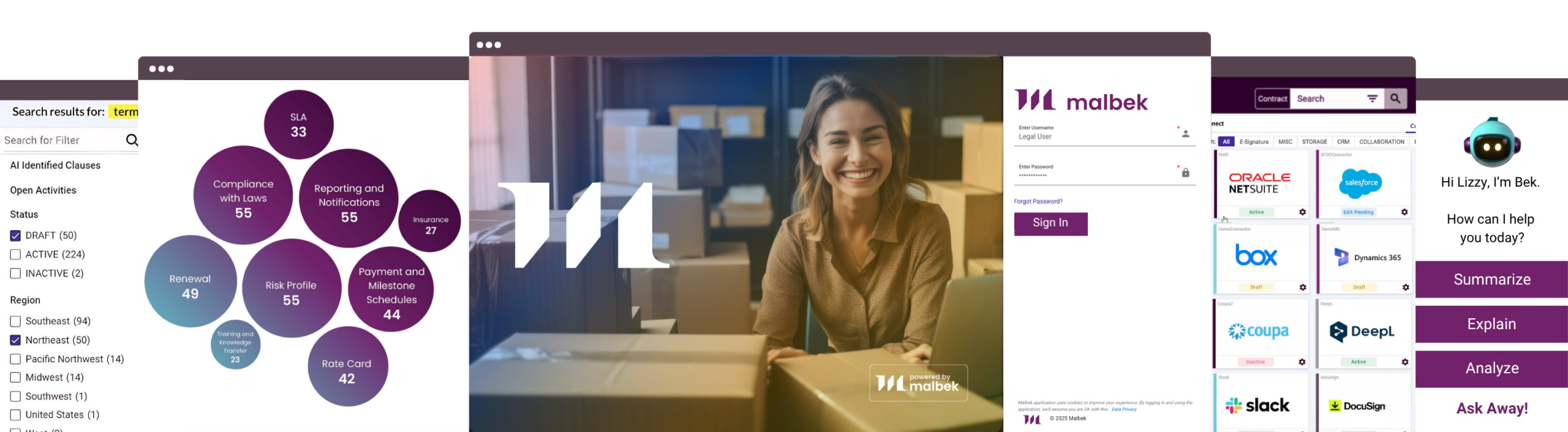
Malbek CLM is the core. Teams create templates and clause libraries, route approvals according to value or risk, compare redlines, collect signatures, store executed agreements and track the obligations that survive after the celebratory “signed” message. Malbek AI adds extraction, clause analysis, drafting guidance and conversational search through an assistant called Bek. Klix handles clickwrap agreements. Marketplace supplies more than 50 integrations. BusinessIQ, made generally available in April 2026, tries to read across a portfolio and surface pricing leakage, renewal exposure and related commercial signals.
The connective tissue may be more important than the AI. Salesforce can initiate a sell-side contract from an opportunity. Coupa can feed supplier and requisition data into buy-side work. DocuSign and Adobe can execute. ERP systems can receive the result. That keeps people inside the tools they already use and reduces rekeying - the small, repetitive failure that corrupts data and quietly kills enthusiasm.
What customers actually changed
The useful evidence is in the before pictures. Cloud Software Group, formerly TIBCO, had a slow, heavily customized legacy system with low adoption, expensive upgrades and no clean way to support multiple Salesforce instances. It selected Malbek for a global deployment serving thousands of users. According to the company’s case study, the migration took four months, required no code customization, moved tens of thousands of legacy contracts and reduced contract cycle time by 70 percent.
SurveyMonkey’s Procurement team had a different failure: visibility. Too many agreement types, too many sources, not enough certainty about status. The team began with three busy purchase categories - software, professional services and marketing - then built templates, a pre-approved clause library and a Coupa integration. Where it could use a template, SurveyMonkey reported cutting time to close by half.
“Where we are able to use a template, we are reducing the time to close by 50%.”Jeanette Milano · Head of Procurement, SurveyMonkey
Lighthouse offers the clearest answer to “what changed their mind?” Its internally built system required manual uploading, manual data entry and Legal’s attention on every client contract, even when the paper used approved language and carried no redlines. With Malbek linked to Salesforce, DealHub and DocuSign, Sales could move standard agreements from start to signature in minutes or hours. Lighthouse says approximately 80 percent of its templates no longer require legal review. Legal did not disappear; it stopped serving as a tollbooth for work it had already approved.
Pantheon, meanwhile, had outgrown shared folders and email during hypergrowth. Its case study reports a 36 percent efficiency improvement in the first quarter. Recruitics needed consistent templates, searchable contract data and a warning before renewals. It says Malbek began alerting the team 90 days before expiration and that the investment returned tenfold. These are vendor-published stories, so treat them as directional proof rather than universal guarantees. Still, they describe concrete behavior that changed, not merely feelings about a dashboard.
What it costs - and what buyers forget
Malbek is sold by custom quote. The company calculates price from user types, user count, chosen modules and integration connectors; some connectors cost extra. That makes it an enterprise purchase, not a self-serve experiment. The invoice also is not the entire cost. A buyer must clean old contracts, decide which metadata matters, standardize templates, settle approval authority and give someone ownership after launch.
The first implementation failure is rarely a missing AI feature. It is asking software to reconcile a process the company itself has never agreed upon. If Sales, Legal and Procurement cannot decide what counts as low risk, the workflow cannot make that decision for them. If executed contracts arrive with inconsistent names, missing amendments and dubious dates, commercial intelligence will summarize the mess with greater speed.
Where Malbek fits on the shelf
The CLM shelf has three broad zones. Lightweight tools make signatures and simple repositories easier. Specialist systems automate a department or agreement type. Enterprise platforms coordinate complex workflows across regions, business units and source systems. Malbek sits in the third zone, but it pitches the temperament of the first: less custom code, more control in the hands of an administrator. That combination is its position in a crowded market.
Its expertise is deepest where contracts cross departmental borders. Legal defines the policy. Sales supplies customer and opportunity data. Procurement brings vendors and purchase requests. Finance cares about payment schedules, caps, renewals and revenue recognition. Malbek gives each group a view of the same agreement without pretending they all do the same job. Industry packages for life sciences, manufacturing, consumer goods and retail add language and workflows for more regulated or high-volume environments. The 2024 partnership with consulting firm ZS, for example, pairs the platform with life-sciences implementation knowledge.
The competitive trade is straightforward. A larger incumbent may offer a broader corporate platform, a deeper services bench or a familiar brand already approved by Procurement. A younger point solution may deploy more cheaply for one small team. Malbek is most credible between those poles: an organization complicated enough to need enterprise controls, but tired of paying consultants whenever a field, routing rule or integration changes. Its public case studies repeatedly return to the same theme - business admins owning more of the machinery.
That does not make configuration free. Someone still has to understand contracts, translate policy into rules, test exceptions and watch adoption. Malbek’s services wrapper, called Malbek 360, covers roadmapping, implementation, training, support and value realization. Partners such as Epiq handle migrations and implementation work. The software may reduce dependence on custom developers, but a serious global rollout remains an operating change with software attached.
The AI chapter gets larger
Malbek began talking about proprietary AI long before every enterprise landing page acquired a sparkling copilot. The current system combines its own legal-language models with foundation models delivered through enterprise cloud services. Bek answers natural-language questions; BusinessIQ uses what Malbek calls LiveGraph and Context Threading to connect master agreements, statements of work, amendments and renewals. Answers are designed to point back to contract evidence.
This is a logical market move. CLM vendors including Icertis, Ironclad, DocuSign, Sirion, Conga, Agiloft and ContractPodAi all want to own more of the agreement economy. Authoring and storage are established categories. The newer prize is the CFO question: Which customers have unused price escalators? Which suppliers share a risky term? What revenue is exposed this quarter?
The company’s 2025 placement as a Leader in Gartner’s Magic Quadrant for Contract Life Cycle Management gives that ambition outside validation. The Series A came earlier: $15.3 million in September 2021, led by Noro-Moseley Partners with TDF Ventures and existing investor Osage Venture Partners. Alongside earlier seed rounds, reported total funding is about $20.6 million. The company remains private, and no public valuation has been disclosed.
The playbook worth copying
You do not need to buy Malbek to steal the operating logic. Choose one high-volume, low-risk agreement. Write the approved template and fallback clauses. Map who can approve what. Connect the CRM or procurement record to the contract. Automate signature and storage. Measure cycle time, legal touches and missed milestones before and after. Only then expand to trickier paper or portfolio-wide AI.
Use it when the process is ready to become a system.
- Good conditions: recurring agreement types, expensive handoffs, multiple departments, a process owner and systems worth connecting.
- Bad conditions: a tiny contract volume, no standard language, chaotic source data or a team hoping software will make governance decisions for it.
- The metric to steal: routine agreements completed without Legal touching them - while exceptions still reach the right lawyer.
Malbek’s mission is to help enterprises thrive at every step of the contract lifecycle. Its culture story uses three words - empathy, transparency and innovation - and its official mark turns those pillars into an ambigram inspired by files viewed in perspective. The brand play is polished. The more persuasive idea is plain: a contract department should remember less because its system remembers more.

Keep exploring
See the platform, customer stories and product demonstrations directly from Malbek, or follow the company’s operating updates.