Eight days is a peculiar amount of time. Long enough for a supplier to send another email. Long enough for a purchase to become urgent. At Flex, the global manufacturer, it was the average turnaround for redlining a complex supply-chain agreement. The document was moving through a legal process. Everyone around it was waiting.
- DocJuris turns contracts into screening reports, redlines and negotiation tasks.
- Flex used customized playbooks to give business teams earlier answers.
- Workforce now carries the approach into broader legal work, with human review deciding what ships.
DocJuris’s most interesting proposition begins in that waiting room. Software can route a document elegantly and still leave someone to read every clause. A dashboard may tell you where the delay lives without shortening it. The company’s wager is that a usable first response changes what happens next.
The first answer changed the queue
Flex initially worked with DocJuris on nondisclosure agreements. That pilot encouraged lead attorney Iringo Csifo-Nagy to tackle more complicated supplier contracts. The team examined volumes and turnaround times, then developed customized playbooks to identify contractual gaps. Preparation took effort: early glitches needed fixing, and the first test required weeks of work.
The resulting tool screened incoming agreements and supplied a summary of issues. Business stakeholders could begin discussions before receiving a lawyer’s elaborate redlined draft. ACC’s 2023 account reports screening results in less than five minutes, against the previous eight-day review turnaround. The distinction matters: this measured earlier access to useful analysis, rather than a signed agreement in five minutes.
“We knew exactly what the most time-consuming steps in our process were.”Iringo Csifo-Nagy · Flex
The business conversation could begin sooner. Signing still required negotiation.
There is a lesson here for anyone managing a queue. Ask what the next person needs to act. A procurement colleague may need three exceptions explained clearly, while counsel needs the full document. Giving both people the same lengthy response, on the same schedule, can manufacture delay.
The machinery behind a redline
DocJuris is built for legal, procurement and sales teams that repeatedly handle agreements. Its negotiation tools produce tracked changes, issue lists, exception tables and amendments. Those outputs sound prosaic because they are. Contracts travel between organizations; the format has to survive the trip. A persuasive answer trapped in a chat window creates another copying job.
Playbook OS supplies more than 50 curated templates, guided clause suggestions and plain-language editing. Teams can adapt preferred terms and fallbacks. DocJuris also advertises legal engineers who help build playbooks and workflows. That combination makes the product partly a document tool and partly an exercise in getting an organization to state its rules.
The expertise has practical consequences. “Improve this agreement” is an invitation to ambiguity. A defined liability position gives a reviewer something to check. Speed becomes useful when the proposed edit reflects the company’s actual appetite for risk, and someone has authority to approve an exception.

The expensive system that stayed unbought
Purolator supplies a second, less theatrical example. Earlier attempts at full contract lifecycle management systems had fallen short. Complexity, cost and integration with existing quote technology were obstacles. An ERP transition then exposed weaknesses in contract generation. The legal team needed a working solution before a critical launch.
DocJuris built an intake tool within the existing environment to generate standardized contracts. ACC’s 2025 case reports more than $300,000 in avoided purchase and implementation expenses for a new CLM, with no additional staff required. These are savings against the replacement approach, rather than a published DocJuris purchase price.
The copyable move is wonderfully unfashionable: inventory the tools already paid for, identify the broken handoff, and fix it. A company embarking on a technology overhaul might find this more useful than another promise to transform everything. The ambition is smaller; the consequence can be substantial.
An inbox is a perfectly good front door
In 2025, DocJuris introduced free email agents. Users attach a contract and receive screening analysis or a marked-up Word document. The support documentation describes roughly five-minute responses for markups and exception tables. Plain-language instructions can request a particular change; a new application need not become the first hurdle.
The free agent has an important boundary. Its generic report does not incorporate an organization’s past agreements or established playbook. Custom agents can be configured for those needs. This makes the free tool a useful way to inspect an output, while enterprise review requires a more deliberate discussion about whose standards govern it.
The Word offering follows the same instinct. A connected pane lets reviewers ask about the open document and preview proposed edits as native tracked changes. Legal engineers can build Custom Actions around specific tasks. The browser remains available for the wider workload. Familiarity, here, is a product feature.
A bigger assignment, with the same test
Henal Patel and Brian Ng are the founders, respectively CEO and CTO. A $3.2 million seed round preceded the $8 million Series A announced in October 2024, led by Silverton Partners. The company named Siemens, Dell and FedEx among users. Its Ntracts partnership brings review into healthcare contracting workflows.
In July 2026, Workforce widened the brief to legal research, regulatory risk, IP work and legal operations. Purpose-built apps return work for human review. The repository offering adds semantic search, cited answers and obligation alerts. DocJuris is moving into territory where contract intelligence and wider legal workflow software overlap.
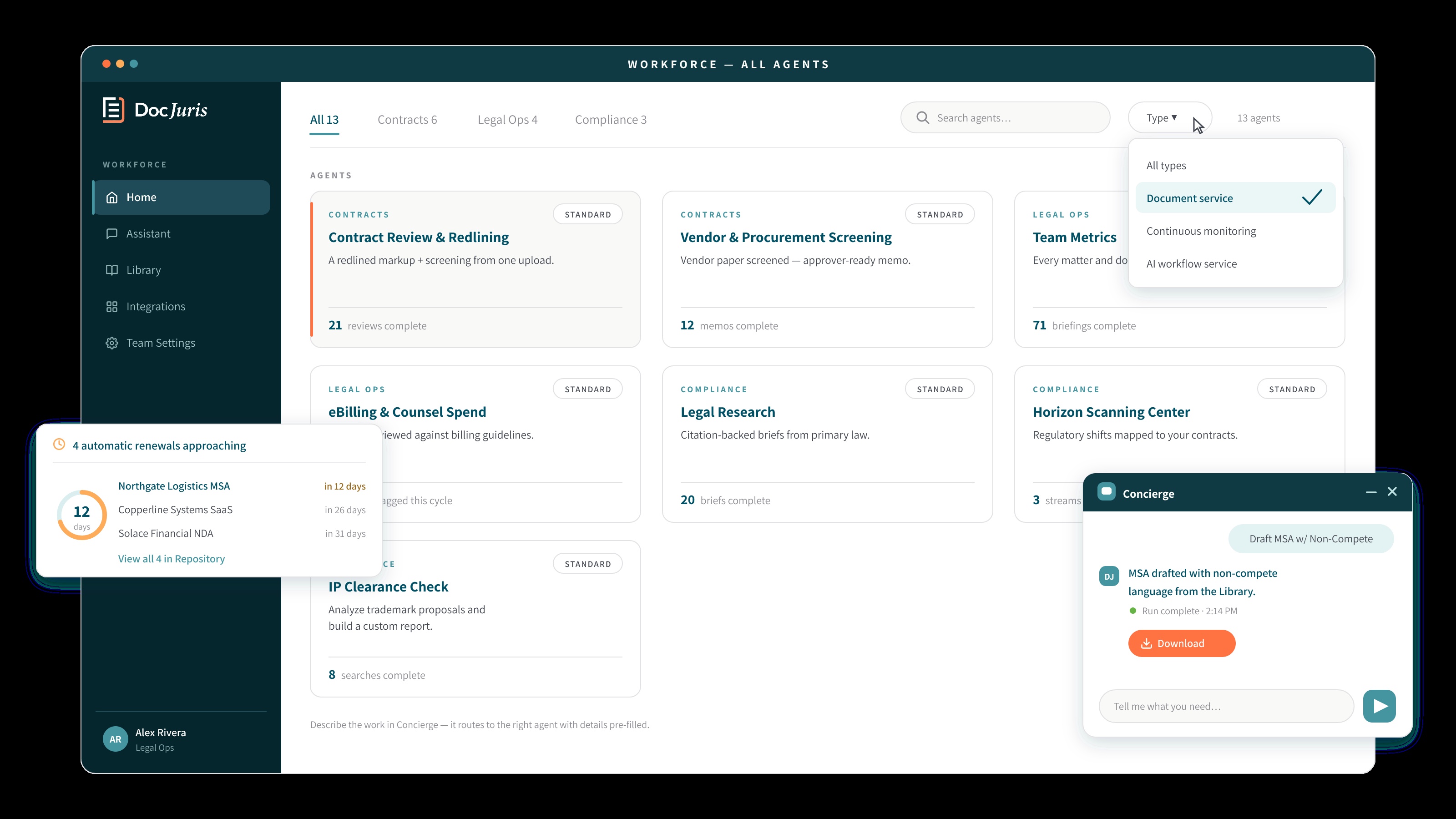
The alternatives span different jobs. Spellbook offers contract drafting and review in Word; Icertis covers the broader contract lifecycle. DocJuris competes across parts of that territory, emphasizing custom deliverables, legal-engineer support and connections to existing systems. A buyer should compare a complete handoff, including the corrections and exports, rather than judge the tools by a single generated clause.
The commercial model offers an annual platform fee sized to work and enabled apps, with unlimited users, or a one-time custom build followed by hosting and AI usage credits. Buyers request a scoped quote. That approach encourages inviting the colleagues who actually move an agreement, rather than counting them as additional seats.
For a buyer, the comparison should begin with a real task: a supplier draft, a recurring memo, an overlooked notice deadline. Test the output against approved rules and measure the human corrections. Without clear standards or a responsible reviewer, a fast first pass can simply accelerate confusion. The valuable five minutes are the ones that let somebody make a better next move.